


Sena hits out at BJP for 'free publicity' to Kanhaiya

March 7, 2016

Mumbai, Mar 7: In a veiled attack on the BJP for letting JNUSU President Kanhaiya Kumar get "free publicity", ally Shiv Sena today sought to know how he got bail in such a short span of time when others charged with 'sedition' are still languishing in jails.
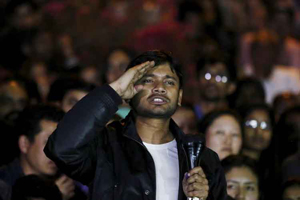
kanhaiyyaaa"(Union Minister) Venkaiah Naidu said Kanhaiya Kumar is getting free publicity. If that is so, who is responsible for letting him get free publicity? Today, nothing comes for free," the Sena said in an edit in its mouthpiece 'Saamana'.

"A price has to be paid for even the smallest of things. Working class people, labourers who used to save money in PF, will now be taxed on their earnings. In short, the government has only shown people nothing will be given for free," it said.

It said that Hardik Patel, who led the Patel agitation demanding reservation for his community in Gujarat is still behind bars after being charged with 'sedition' and so are people like Colonel Purohit and Sadhvi Pragya.

"Then how did Kanhaiya get bail so easily? Was it that keeping him behind bars was becoming a problem for the government and that it had to answer too many questions?" the Sena asked.

"If Naidu says Kanhaiya is getting free publicity, then our system and administration is responsible for it. He has become a hero because people are announcing reward for attack on Kanhaiya," it said, referring to BJP leader Kuldeep Varshnay announcing Rs 5 lakh prize money for cutting off the tongue of Kanhaiya, who he had alleged, was speaking against BJP and PM Narendra Modi after being released on bail.

A poster announcing Rs 11 lakh prize money to anyone "shooting down" Kumar was also spotted in Delhi.

The Sena further said that the sole aim (of politicians) is to win elections and form a government.

"Promises made before elections vanish into the air and farmers, labourers, working class and students are made victims. If this continues, there would be human bombs made within the country. These youngsters will be exploited for political games," the Sena warned.

Kumar, who was arrested on February 12 on sedition charges, was released from Tihar jail on March 3 after the Delhi High Court granted him interim bail for six months.

Comments

Rikaz
 - 
Monday, 7 Mar 2016

Of course he has become a household name around the world....he simply raised his voice against PEKU....great job....

Add new comment

  • Coastaldigest.com reserves the right to delete or block any comments.
  • Coastaldigset.com is not responsible for its readers’ comments.
  • Comments that are abusive, incendiary or irrelevant are strictly prohibited.
  • Please use a genuine email ID and provide your name to avoid reject.
News Network
April 3,2020

New Delhi, April 3: The Government on Thursday launched a mobile app developed in public-private partnership as part of efforts to contain the spread of coronavirus.

"The app, called 'AarogyaSetu' will enable people to assess themselves the risk for their catching the coronavirus infection," an official release said.

It said that the app will calculate this based on their interaction with others, using cutting edge Bluetooth technology, algorithms and artificial intelligence.

"Once installed in a smartphone through an easy and user-friendly process, the app detects other devices with AarogyaSetu installed that come in the proximity of that phone. The app can then calculate the risk of infection based on sophisticated parameters," the release said.

It said that the app will help the government take necessary timely steps for assessing risk of spread of COVID-19 infection and ensuring isolation where required.

"The app's design ensures privacy. The personal data collected by the app is encrypted using state-of-the-art technology and stays secure on the phone till it is needed for facilitating medical intervention," the release said.

It said the app is available in 11 languages and has highly scalable architecture.

"This app is a unique example of the nation's young talent coming together and pooling resources and efforts to respond to a global crisis. It is at once a bridge between public and private sectors, digital technology and health services delivery," the release said.

Comments

Add new comment

  • Coastaldigest.com reserves the right to delete or block any comments.
  • Coastaldigset.com is not responsible for its readers’ comments.
  • Comments that are abusive, incendiary or irrelevant are strictly prohibited.
  • Please use a genuine email ID and provide your name to avoid reject.
News Network
May 12,2020

Srinagar, May 12: Two paramilitary Central Reserve Police Force (CRPF) officers committed suicide after shooting themselves with their service rifles in Kashmir on Tuesday.

In the first incident, a CRPF sub-inspector on Tuesday committed suicide after shooting himself with his service rifle at Mattan area of south Kashmir’s Anantnag district. The deceased, identified as Fatah Singh of Jaisalmer in Rajasthan, had reportedly left behind a suicide note that read: “I am afraid, I may have Corona.”

Station House Officer (SHO) Akura, Mattan police station Jazib Ahmed said that they have followed the COVID-19 protocol while dealing with the body of the CRPF sub-inspector. “His samples have been taken and post-mortem conducted. Only results would confirm whether he was a COVID-19 positive,” he said.

CRPF spokesman in Srinagar Pankaj Singh said the officer had returned to his unit after performing a day-long duty. “As such, there is no evidence that he had caught COVID-19. Let’s wait for the final report. Details will be shared with the media,” Singh said.

Hours after the first incident, an assistant-sub-inspector of the CRPF posted in Srinagar also committed suicide by shooting himself dead with his service rifle.

Special Director General of CRPF, Zulfikar Hassan said they were trying to find out the reason for the two boys taking this extreme step.

Suicides and fratricide incidents are not uncommon among the CRPF and the Army personnel deployed in Kashmir. In 2006, recognising the rising fratricide and suicide cases among the armed forces, the then Defence Minister had constituted an expert group of psychiatrists under the Defence Institute of Psychological Research in order to suggest remedial measures to prevent suicide and fratricide incidents.

Over the last decade, incidents of fratricide have reportedly reduced in the Army as the force has taken measures to address the issue.

Comments

Add new comment

  • Coastaldigest.com reserves the right to delete or block any comments.
  • Coastaldigset.com is not responsible for its readers’ comments.
  • Comments that are abusive, incendiary or irrelevant are strictly prohibited.
  • Please use a genuine email ID and provide your name to avoid reject.
Agencies
June 6,2020

United Nations, Jun 6: The coronavirus disease has not "exploded" in India, but the risk of that happening remains as the country moves towards unlocking its nationwide lockdown that was imposed in March to contain the Covid-19, according to a top WHO expert.

WHO Health Emergencies Programme Executive Director Michael Ryan on Friday said the doubling time of the coronavirus cases in India is about three weeks at this stage.

“So the direction of travel of the epidemic is not exponential but it is still growing,” he said, adding that the impact of the pandemic is different in different parts of India and varies between urban and rural settings.

“In South Asia, not just in India but in Bangladesh and...in Pakistan, other countries in South Asia, with large dense populations, the disease has not exploded. But there is always the risk of that happening,” Ryan said in Geneva.

He stressed that as the disease generates and creates a foothold in communities, it can accelerate at any time as has been seen in a number of settings.

Ryan noted that measures taken in India such as the nationwide lockdown have had an impact in slowing transmission but the risk of an increase in cases looms as the country opens up.

“The measures taken in India certainly had an impact in dampening transmission and as India, as in other large countries, open up and as people begin to move again, there's always a risk of the disease bouncing back up,” he said.

He added that there are specific issues in India regarding the large amount of migration, the dense populations in the urban environment and the fact that many workers have no choice but to go to work every day.

India went past Italy to become the sixth worst-hit nation by the COVID-19 pandemic.

India saw a record single-day jump of 9,887 coronavirus cases and 294 deaths on Saturday, pushing the nationwide infection tally to 2,36,657 and the death toll to 6,642, according to the health ministry.

The lockdown in India, was first clamped on March 25 and spanned for 21 days, while the second phase of the curbs began on April 15 and stretched for 19 days till May 3. The third phase of the lockdown was in effect for 14 days and ended on May 17. The fourth phase ended on May 31.

The country had registered 512 coronavirus infection cases till March 24.

The nation-wide lockdown in containment zones will continue till June 30 in India but extensive relaxations in a phased manner from June 8 are listed in the Union home ministry's fresh guidelines on tackling the Covid-19 pandemic issued last week.

WHO Chief Scientist Soumya Swaminathan said the over 200,000 current coronavirus cases in India, a country of over 1.3 billion people, "look big but for a country of this size, it's still modest.”

She stressed that it is important for India to keep track of the growth rate, the doubling time of the virus and to make sure that that number doesn't get worse.

She said that India is a “heterogeneous and huge country” with very densely populated cities and much lower density in some rural areas and varying health systems in different states and these offer challenges to the control of Covid-19.

Swaminathan added that as the lockdown and restrictions are lifted, it must be ensured that all precautions are taken by people.

“We've been making this point repeatedly that really if you want behaviour change at a large level, people need to understand the rationale for asking them to do certain things (such as) wearing masks,” she said.

In many urban areas in India, it's impossible to maintain physical distancing, she said adding that it then becomes very important for people to wear appropriate face coverings when they are out, in office settings, in public transport and educational institutions.

“As some states are thinking about opening, every institution, organisation, industry and sector needs to think about what are the measures that need to be put in place before you can allow a functioning and it may never be back to normal.”

She said that in many professions working from home can be encouraged but in several jobs, people have to go to work and in such cases measures must be put in place that allow people to protect themselves and others.

“I think communication and behaviour change is a very large part of this whole exercise,” she added.

Comments

Add new comment

  • Coastaldigest.com reserves the right to delete or block any comments.
  • Coastaldigset.com is not responsible for its readers’ comments.
  • Comments that are abusive, incendiary or irrelevant are strictly prohibited.
  • Please use a genuine email ID and provide your name to avoid reject.