



Senior Congress leader Murli Deora dies of cancer

November 24, 2014

Mumbai, Nov 24: Senior Congress leader and former Union minister Murli Deora passed away in Mumbai on Monday morning due to cancer. He was 77 and is survived by his wife and two sons, including former MP Milind Deora.

Murli bhai as he was known as died at around 3.25 am. He had been unwell and admitted to a hospital. He had come home two days ago, family sources said.
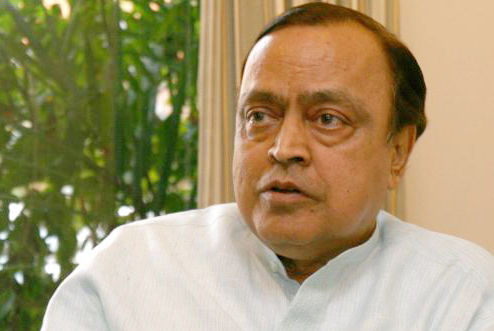
Murli Deora

Deora's mortal remains would be kept at the Mumbai Congress office, where party workers would pay their last respects from 12 noon to 2pm. His last rites would be performed at Chandanwadi Crematorium later in the day, the family sources said.

Deora, who held several important portfolios during his decades-long career, first contested the civic elections in Mumbai in 1975.

An economics graduate, Deora was Mayor of Mumbai from 1977 to 1978 and was later elected to the Lok Sabha four times from Mumbai South, a seat later held by his son, Milind, who is also a former MP and ex Union minister. Currently, he was serving his third term as a Rajya Sabha MP.

He held the portfolio of Petroleum and Natural Gas during the UPA–1 regime. The Congress veteran had also served as the Mumbai Congress President for 22 years.

He joined the Union Cabinet in 2006, shortly before he turned 70 and led oil diplomacy in Myanmar, Algeria and Egypt, and held talks with ministers from Sudan, Chad, Ethiopia and Comoros.

Deora also hosted the first India-Africa Hydrocarbon Conference and Exhibition in November 2007. In July 2011, Deora became Minister of State for Communications and Information Technology.

Comments

Add new comment

  • Coastaldigest.com reserves the right to delete or block any comments.
  • Coastaldigset.com is not responsible for its readers’ comments.
  • Comments that are abusive, incendiary or irrelevant are strictly prohibited.
  • Please use a genuine email ID and provide your name to avoid reject.
Agencies
June 10,2020

New Delhi, Jun 10: The Enforcement Directorate (ED) on Wednesday brought back over 2,300 kg of polished diamonds and pearls worth Rs 1,350 crore of firms belonging to Nirav Modi and Mehul Choksi from Hong Kong, officials said.

Out of the 108 consignments that landed at Mumbai, 32 belong to overseas entities "controlled" by Modi while the rest are of Mehul Choksi firms.

Both the businessmen are being probed by the ED under the Prevention of Money Laundering Act (PMLA) in connection with an over USD 2 billion alleged bank fraud at a PNB branch in Mumbai.

The valuables include polished diamonds, pearls and silver jewellery, and is worth Rs 1,350 crore. 

The ED completed "all legal formalities" with authorities in Hong Kong to bring back these valuables, the agency said.

These will formally seized under the PMLA now, it said.

Comments

Add new comment

  • Coastaldigest.com reserves the right to delete or block any comments.
  • Coastaldigset.com is not responsible for its readers’ comments.
  • Comments that are abusive, incendiary or irrelevant are strictly prohibited.
  • Please use a genuine email ID and provide your name to avoid reject.
Agencies
July 21,2020

New Delhi, Jul 21: Air India trade unions have complained to Civil Aviation Minister Hardeep Puri that the government has now turned a blind eye to the management's ethnic cleansing at lower levels through compulsory leave without pay (LWP), redundancies and wage cuts.

In a letter to Puri, the Joint Action Forum of Air India unions said, "We are deeply ashamed to say that it seems that after praising our Air Indian Corona Warriors at grand functions, respectfully, the government has now turned a blind eye to this management's ethnic cleansing of Air Indians at the lower levels, through compulsory LWP, redundancies and wage cuts."

The Joint Action Forum of Air India unions strongly opposes this Compulsory Leave without pay scheme as it is an illegal practice and is not a voluntary scheme.

"In fact the Board resolution itself empowers the Chairman and Managing Director with extraordinary powers, which seem akin to a High Court, to pack off employees on 2 years leave (extended to 5 years) at CMD's discretion or at the arbitrary whim of the Regional heads," the trade unions said.

"This said Compulsory LWP scheme violates every labour law put in place by Parliament and orders of the Supreme Court and various other courts and seeks to dispossess the lower categories workers of their legally guaranteed rights," it added.

The trade unions have pointed out that the redundancies are at the elite management cadre level and not the workers.

"We are indeed shocked that the management of Air India could prepare and formulate a scheme for compulsorily sending workers on leave without pay, which is akin to an illegal lay-off, under the garb of a Leave Without Pay, when ironically the redundancy actually lies in the upper echelons of management and not with the humble workers of Air India, who have slogged to make our Airline the treasure it is," they complained to Puri.

"It must be noted that out of 11,000 permanent employees, our management occupies almost 25% as Executive Cadre, with little or no accountability. Solely amongst the Elite Management Cadre, we have 121 top officers ranking from DGMS, GMs, EDs to Functional Directors, most of whom are either performing duplicate job functions or are indeed redundant and not to mention the retired relics serving as consultants and also the CEOs of various subsidiary companies," they added.

Trade unions said the redundancy or compulsory leave without pay scheme if any at all, has to apply only to these Executives, more so, when they do not even have protection of labour laws or Supreme Court orders.

Strangely, the topmost corporate executive cadre and the backroom Generals, have saved themselves from the axe of wage cuts, by sacrificing a piffling of a few grand, whilst the frontline warriors of flying cabin crew, engineers, ground staff have borne the biggest brunt head on, the unions said.

Comments

Add new comment

  • Coastaldigest.com reserves the right to delete or block any comments.
  • Coastaldigset.com is not responsible for its readers’ comments.
  • Comments that are abusive, incendiary or irrelevant are strictly prohibited.
  • Please use a genuine email ID and provide your name to avoid reject.
News Network
June 18,2020

New Delhi, Jun 18: The border clash between Indian and Chinese soldiers in Ladakh broke the brittle quiet – and also the sense of security for anxious Chinese nationals in India who fear a backlash with anti-Chinese sentiment spiralling in the country.

With the high altitude violent face-off in eastern Ladakh’s Galwan Valley spurring hashtags such as “Boycott China” and “Teach Lesson to China” and leading to street protests, the undercurrents of tension were evident.

Wary of being identified, some said they had been reassured by their friends but were still apprehensive for themselves and their families.

"They (Chinese families) don''t want to speak to the media. They are not going out and are worried about their security and well being. Their families are also worried back home," Mohammed Saqib, secretary general of the India China Economic & Cultural Council, told PTI.

He added that his Chinese friends in India been calling him since they heard news about Monday night’s clashes in which 20 Indian soldiers were killed -- the worst military confrontation in five decades -- and expressed concern over growing anti-China sentiments.

A Chinese national from Beijing working in Gurgaon for a Chinese mobile firm initially refused to talk, saying he did not want to speak to the media and later shared his thoughts only on condition of anonymity.

"There is talk of border standoff and tensions, but we know Indians are very warm people and that is why I have told my family that all is fine here and they should not worry," he said.

Another Chinese national working in Gurgaon said he and his family are feeling the stress amid the spiralling conflict between India and China, but many friends have been reassuring him.

"They (Chinese in India) are under a lot of stress naturally. Such a conflict puts a lot of stress as they could bear the brunt and the same applies to Indians in China," B R Deepak, professor at the Centre for Chinese and South East Asian Studies of the Jawaharlal Nehru University said.

He said it was unfortunate that the border standoff derailed the commemorative programmes aimed at strengthening ties at a time the two countries were gearing to celebrate 70 years of establishment of diplomatic ties.

Experts also feel the border clash is likely to have a significant negative impact on the economic and people to people ties.

There are scores of Chinese in India working in various Chinese firms and also those who are studying in universities like JNU.

About 3,000 Chinese people, doing business or studying in big cities in India, were stranded in India at the start of the COVID-19 crisis, and about half of them returned to China before the lockdown began on March 25.

The Chinese Embassy in New Delhi announced on May 25 that they will arrange for flights to take back students, tourists and businesspersons to five Chinese cities, including Shanghai and Guangzhou.

"It will impact the psychology of the Chinese here. There are 2,000 Chinese firms in various sectors in India which are going to be impacted," Deepak said.

Future investments from the Chinese side could also be impacted, he said.

Moreover, as far as people-to-people contacts are concerned, the number of Chinese students choosing India as a preferred destination is likely to go down, Deepak said.

Alka Acharya, another China expert, said there are two kinds of impacts of such an incident -- short term and medium term.

Usually after the initial nationalistic reaction in the short term things tend to normalise in the medium term, but with such a border clash happening for the first time in decades clearly the resonance would be much more in both India and China, said Acharya, professor at the Centre for East Asian Studies, School of International Studies, in JNU.

“Due to the impact of the COVID-19 crisis on the economy, whether India can take a hardline in terms of economics towards China, is a tricky question,” she said.

In the immediate context, there may be a dip in economic ties with calls for boycott of Chinese goods and services, Acharya said.

The manner in which this crisis is resolved will affect how ties will be affected in the medium term, she said.

The headlines have added to the anxiety.

A group of ex-armymen gathered near the Chinese embassy to protest the killing of 20 Indian Army personnel in Ladakh’s Galwan Valley. And another group of around 10 protesters belonging to the Swadeshi Jagaran Manch protested near the Teen Murti roundabout in Central Delhi.

The anti-China sentiment prevalent among the common public is also finding a reflection in government policy with sources saying the Department of Telecom (DoT) is set to ask state-owned Bharat Sanchar Nigam Ltd (BSNL) not to use Chinese telecom gear in its 4G upgradation.

Trade bodies like CAIT are also calling for a boycott of Chinese products.

And Chinese handset maker Oppo cancelled the livestream launch of its flagship 5G smartphone in the country amid protests.

Monday night’s clashes between the Chinese and Indian troops in Galwan Valley significantly escalated the already volatile border standoff between the two countries.

The casualties on the Chinese side are not yet known. However, government sources, citing an American intelligence report, claimed the total number of soldiers killed and seriously wounded could be 35.

Comments

Add new comment

  • Coastaldigest.com reserves the right to delete or block any comments.
  • Coastaldigset.com is not responsible for its readers’ comments.
  • Comments that are abusive, incendiary or irrelevant are strictly prohibited.
  • Please use a genuine email ID and provide your name to avoid reject.