



Sex abuse scandal haunts Pope Francis' aide and Australia's top Catholic cleric George Pell

Agencies
June 29, 2017

Sydney, Jun 29: From country priest to trusted top Vatican aide, the rise of Australia's most senior Catholic cleric George Pell has been plagued in its twilight by sordid controversies from the past.pope
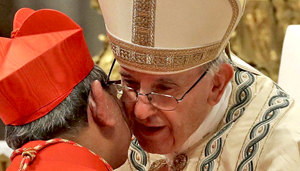
To his admirers, the 76-year-old cardinal embodies the orthodox traditions of Australian Catholicism, but to his critics, he represents an institution that has failed to properly deal with child sex abuse allegations.

Pell, who was charged on Thursday with historical child sex abuse, strongly denies the allegations and says he had no knowledge of widespread paedophilia in the church in Australia, even suggesting a conspiracy to bring him down.

Born in 1941, he grew up in the rural Australian town of Ballarat where he was a keen member of his college debating team, a lead actor in school productions and a champion Australian Rules footballer.

His devout Catholic mother was reportedly pleased that her son decided to pursue a career in the Church, whereas his father, an Anglican, was bewildered that he turned down a contract from one of the country's top football teams.

Having chosen a religious path, he completed part of his studies in Rome before being ordained as a priest for the Ballarat diocese in 1966.

As his star rose, he went on to become Archbishop of Melbourne and then Sydney at the behest of Pope John Paul II and in 2003 was named to the Vatican's powerful College of Cardinals, a position that allowed him to vote for the next Pope of the day.

Then in 2014, he was handpicked by Pope Francis to make the church's finances more transparent.

"Cardinal Pell is one of the greatest churchmen that Australia has seen," former conservative Australian Prime Minister Tony Abott has said.

From the pulpit, and publicly, Pell has espoused traditional Catholic values, from a tough stance on euthanasia and gay marriage to his rejection of climate science and criticism of the harsh treatment of asylum-seekers.

But his reputation has been tarnished in recent years not just by claims that he covered up abuse by priests in Victoria state where he worked, but by allegations that he himself abused boys.

Australian police did not provide further details of the charges on Thursday, citing the need to preserve the integrity of the judicial process.

A national inquiry into the institutional responses to child sex abuse in Australia between 1950 and 2010 found that seven percent of Catholic priests were accused but that the allegations were never investigated.

The inquiry, ordered in 2012, found that 4,444 alleged incidents of paedophilia were reported to church authorities and that in some dioceses, more than 15 percent of priests were perpetrators.

Repeatedly questioned during the inquiry about paedophile priests in the Ballarat diocese in the 1970s and 80s, Pell apologised on behalf of the church but insisted he had no memory of claims of sustained mistreatment.

He did, however, admit he "mucked up" in dealing with paedophile priests in the 1970s, but said he was deceived by senior clergy about what was happening during a time of "crimes and cover-ups".

Australia's most powerful Catholic was cleared of any wrongdoing when historical accusations were levelled at him while he was Archbishop of Sydney in 2002.

But victims insist he must have been aware of the rampant abuse.

"I believe (Pell) did his job well," child abuse survivor Julie Stewart said after Pell gave evidence to the commission last year.

"He did his job by protecting the church's assets and protecting the church`s name, but I don't believe he protected the children."

Comments

Add new comment

  • Coastaldigest.com reserves the right to delete or block any comments.
  • Coastaldigset.com is not responsible for its readers’ comments.
  • Comments that are abusive, incendiary or irrelevant are strictly prohibited.
  • Please use a genuine email ID and provide your name to avoid reject.
News Network
May 30,2020

Washington, May 30: President Donald Trump said Friday he would strip several of Hong Kong's special privileges with the United States and bar some Chinese students from US universities in anger over Beijing's bid to exert control in the financial hub.

In a day of concerted action, the United States and Britain also raised alarm at the UN Security Council over a controversial new security law for Hong Kong, angering Beijing which said the issue had no place at the world body.

In a White House appearance that Trump had teased for a day, the US president attacked China over its treatment of the former British colony, saying it was "diminishing the city's longstanding and proud status."

"This is a tragedy for the people of Hong Kong, the people of China and indeed the people of the world," Trump said.

Trump also said he was terminating the US relationship with the World Health Organization, which he has accused of pro-China bias in its management of the coronavirus crisis.

But Trump was light on specifics and notably avoided personal criticism of President Xi Jinping, with whom he has boasted of having a friendship even as the two powers feud over a rising range of issues.

"I am directing my administration to begin the process of eliminating policy that gives Hong Kong different and special treatment," Trump said.

"This will affect the full range of agreements, from our extradition treaty to our export controls on dual-use technologies and more, with few exceptions," he said.

Secretary of State Mike Pompeo on Wednesday informed Congress that the Trump administration would no longer consider Hong Kong to be separate under US law, but it was up to Trump to spell out the consequences.

China this week pressed ahead on a law that would ban subversion and other perceived offenses against its rule in Hong Kong, which was rocked by months of massive pro-democracy protests last year.

US restricts students

In one move that could have long-reaching consequences, Trump issued an order to ban graduate students from US universities who are connected to China's military.

"For years, the government of China has conducted elicit espionage to steal our industrial secrets, of which there are many," Trump said.

Hawkish Republicans have been clamoring to kick out Chinese students enrolled in sensitive fields. The FBI in February said it was investigating 1,000 cases of Chinese economic espionage and technological theft.

But any move to deter students is unwelcome for US universities, which rely increasingly on tuition from foreigners and have already been hit hard by the COVID-19 shutdown.

China has been the top source of foreign students to the United States for the past decade with nearly 370,000 Chinese at US universities, although Trump's order will not directly affect undergraduates.

Critics say Trump has been eager to fan outrage about China to deflect attention from his own handling of the coronavirus pandemic that has killed more than 100,000 people in the United States, the highest number of deaths of any country.

Chuck Schumer, the top Democrat in the Senate, called Trump's announcement "just pathetic."

Eliot Engel, a Democrat who heads the House Foreign Affairs Committee, noted that Trump treaded lightly on Hong Kong during last year's protests as he sought a trade deal with Xi.

"Now, the president wants to shift the blame for his failures onto China, so he's doing the right thing for the wrong reason," Engel said.

Trump's order could also trigger retaliation. China in March expelled US journalists after the Trump administration tightened visa rules for staff at Chinese state media.

Clash at UN

The United States and Britain earlier in the day urged China to reconsider the Hong Kong law during talks at the UN Security Council, where China wields a veto -- making any formal session, let alone action against Beijing, impossible.

The Western allies raised Hong Kong in an informal, closed-door videoconference where China cannot block the agenda.

They said China was violating an international commitment as the 1984 handover agreement with Britain, in which Beijing promised to maintain the financial hub's separate system until at least 2047, was registered with the United Nations.

"The United States is resolute, and calls upon all UN members states to join us in demanding that the PRC immediately reverse course and honor its international legal commitments to this institution and to the Hong Kong people," said US Ambassador Kelly Craft, referring to the People's Republic of China.  

China demanded that the United States and Britain "immediately stop interfering in Hong Kong affairs," saying the law did not fall under the Security Council's mandate.

"Any attempt to use Hong Kong to interfere in China's internal matters is doomed to fail," warned a statement from China's UN mission.

"There was no consensus, no formal discussion in the Security Council, and the US and the UK's move came to nothing," it said.

Comments

Add new comment

  • Coastaldigest.com reserves the right to delete or block any comments.
  • Coastaldigset.com is not responsible for its readers’ comments.
  • Comments that are abusive, incendiary or irrelevant are strictly prohibited.
  • Please use a genuine email ID and provide your name to avoid reject.
News Network
March 5,2020

Washington, Feb 5: Experts warned a US government panel last night that India's Muslims face risks of expulsion and persecution under the country’s new Citizenship Amendment Act (CAA) which has triggered major protests.

The hearing held inside Congress was called by the US Commission on International Freedom, which has been denounced by the Indian government as biased.

Ashutosh Varshney, a prominent scholar of sectarian violence in India, told the panel that the law championed by prime minister Narendra Modi's government amounted to a move to narrow the democracy's historically inclusive and secular definition of citizenship.

"The threat is serious, and the implications quite horrendous," said Varshney, a professor at Brown University.

"Something deeply injurious to the Muslim minority can happen once their citizenship rights are taken away," he said.

Varshney warned that the law could ultimately lead to expulsion or detention -- but, even if not, contributes to marginalization.

"It creates an enabling atmosphere for violence once you say that a particular community is not fully Indian or its Indianness in grave doubt," he said.

India's parliament in December passed a law that fast-tracks citizenship for persecuted non-Muslim minorities from neighboring countries.

Responding to criticism at the time from the US commission, which advises but does not set policy, India's External Affairs Ministry said the law does not strip anyone's citizenship and "should be welcomed, not criticized, by those who are genuinely committed to religious freedom."

Fears are particularly acute in Assam, where a citizens' register finalized last year left 1.9 million people, many of them Muslims, facing possible statelessness.

Aman Wadud, a human rights lawyer from Assam who traveled to Washington for the hearing, said that many Indians lacked birth certificates or other documentation to prove citizenship and were only seeking "a dignified life."

The hearing did not exclusively focus on India, with commissioners and witnesses voicing grave concern over Myanmar's refusal to grant citizenship to the Rohingya, the mostly Muslim minority that has faced widespread violence.

Gayle Manchin, the vice chair of the commission, also voiced concern over Bahrain's stripping of citizenship from activists of the Shiite majority as well as a new digital ID system in Kenya that she said risks excluding minorities.

More than 40 people were killed last week in New Delhi in sectarian violence sparked by the citizenship law.

India on Tuesday lodged another protest after the UN human rights chief, Michele Bachelet, sought to join a lawsuit in India that challenges the citizenship law's constitutionality.

Comments

Add new comment

  • Coastaldigest.com reserves the right to delete or block any comments.
  • Coastaldigset.com is not responsible for its readers’ comments.
  • Comments that are abusive, incendiary or irrelevant are strictly prohibited.
  • Please use a genuine email ID and provide your name to avoid reject.
Agencies
July 24,2020

Chengdu, Jul 24: China on Friday asked the US to close down its Consulate in Chengdu in retaliation to Washington's decision to shut the Chinese Consulate in Houston.

A statement by the Chinese Foreign Ministry said China has informed the US Embassy of its decision to withdraw its consent for the establishment and operation of the US Consulate General in Chengdu.

This was in response to "unilateral" decision by the US to shut the Houston Consulate. China's decision is legitimate and necessary response to the unreasonable actions of the US, it said.

The US on Wednesday ordered the closure of the Chinese consulate in Houston, a move it said was aimed "to protect American intellectual property and private information."

Reacting strongly to the US move, Chinese Foreign Ministry spokesman Wang Wenbin termed it as an "unprecedented escalation and warned retaliatory measures.

China on Thursday said that "malicious slander" is behind an order by the US government to close its consulate in Houston, Texas, and maintained that its officials have never operated outside ordinary diplomatic norms.

Wang said the order to close the consulate violates international law and basic norms governing international relations, and seriously undermines China-US relations.

This is breaking down the bridge of friendship between the Chinese and American people, Wang said.

Comments

Add new comment

  • Coastaldigest.com reserves the right to delete or block any comments.
  • Coastaldigset.com is not responsible for its readers’ comments.
  • Comments that are abusive, incendiary or irrelevant are strictly prohibited.
  • Please use a genuine email ID and provide your name to avoid reject.