



Sex ratio among youth could drop below 900 in India

News Network
June 20, 2017

New Delhi, Jun 20: The consistently falling male-female ratio among India’s youth, which remains hopelessly skewed as a result of preference for a male child in previous decades, could fall below 900 in the next 15 years.Sexratio
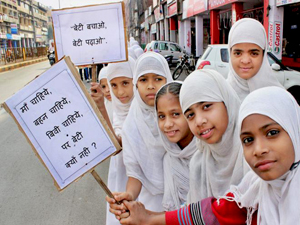
The recently published ‘Youth in India 2017’ report has found that the drop in sex ratio is more rapid among the youngsters than what is observed in the overall population.

“A negative aspect of youth in India is that the sex ratio in youth population is consistently decreasing from 1991 onwards. It has come down to 939 in 2011 as compared to 961 in 1971, and is projected to decline further to 904 (World Bank projection) in 2021,” the report, released by the Central Statistics Office, said.

Quoting the World Bank projection, it said the sex ratio among the youth could further decline to 898 by 2031. Having dropped to 945 in 1981, this ratio rose marginally to 250 in 1991. It was 940 in 2001 and 939 at the beginning of the following decade. However, youth population has been showing a consistent growth from 30% in 1971 to 34% in 2011. The report stated that it would drop to 31.8% in 2031.

“The percentage of male youth population to the total male population follows the pattern of overall youth and was also on a steady rise till 2011. But the share of female youths to total females showed a slight decrease in 2001, which might have resulted due to a declining sex ratio during this period,” it noted.A welcome change is in the number of married women in younger age groups. The percentage of currently married women in the age group of 15 to 19 has dropped from 69.57 in 1961 to 19.47 in 2011.

“The mean age for effective marriage for women in India has come up to 22.3 in 2014 as compared to 19.4 in 1995,” the report said. It also said India has the “relative advantage at present” over other countries in terms of distribution of youth population.

According to census, the total youth population increased from 168 million in 1971 to 422 million in 2011. “India is seen to remain younger longer than China and Indonesia, the two major countries other than India that determine the demographic features of Asia,” it added.

Comments

Add new comment

  • Coastaldigest.com reserves the right to delete or block any comments.
  • Coastaldigset.com is not responsible for its readers’ comments.
  • Comments that are abusive, incendiary or irrelevant are strictly prohibited.
  • Please use a genuine email ID and provide your name to avoid reject.
News Network
March 6,2020

New Delhi, Mar 6: Union Finance Minister Nirmala Sitharaman on Friday will move the Insolvency and Bankruptcy Code (Second Amendment) Bill, 2019 for consideration and passing in Lok Sabha.

In December last year, the Union Cabinet had approved a proposal to promulgate an ordinance to amend the Insolvency and Bankruptcy Code (IBC) 2016.

The amendments will remove certain ambiguities in the IBC 2016 and ensure smooth implementation of the code, an official statement said.

The move is aimed at easing the insolvency resolution process and promoting the ease of doing business. Aimed at streamlining of the insolvency resolution process, the amendments seek to protect last-mile funding and boost investment in financially-distressed sectors.

Under the amendments, the liability of a corporate debtor for an offence committed before the corporate insolvency resolution process will cease.

The debtor will not be prosecuted for an offence from the date the resolution plan has been approved by the adjudicating authority if a resolution plan results in change in the management or control of the corporate debtor to a person who was not a promoter or in the management or control of the corporate debtor or a related party of such a person.

The amendments are aimed at providing more protection to bidders participating in the recovery proceedings and in turn boosting investor confidence in the country's financial system.

Comments

Add new comment

  • Coastaldigest.com reserves the right to delete or block any comments.
  • Coastaldigset.com is not responsible for its readers’ comments.
  • Comments that are abusive, incendiary or irrelevant are strictly prohibited.
  • Please use a genuine email ID and provide your name to avoid reject.
News Network
May 27,2020

New Delhi, May 27: Professor Johan Giesecke of the Karolinska Institute, Sweden, on Wednesday claimed that India will ruin its economy very quickly if it had a severe lockdown.

Claiming that a strict lockdown may disrupt India's economic growth, Giesecke during an interaction with Congress leader Rahul Gandhi said: "In India, you will do more harm than good with strict lockdown measures. India will ruin its economy very quickly if it had a severe lockdown."

While calling for a soft lockdown approach in India, he suggested that India has to ease restrictions one by one. It may, however, take months to completely come out of lockdown, he said.

He further criticised countries across the globe for having no post-lockdown strategy.

Emphasising on the disease, the Swedish health expert said that coronavirus is spreading like a wildfire across the world. "It is a very mild disease. Ninety-nine per cent infected people will have very less or no symptoms," he added.

Meanwhile, Ashish Jha, Director Harvard Global Health Institute and a recognised public health official, in interaction with Gandhi, called for a need to go in for an 'aggressive' COVID-19 testing to create confidence among people.

"When the economy is opened post-lockdown, you have to create confidence. There is a need for aggressive testing strategy in high-risk areas," he said.

He asserted that COVID-19 is not the last pandemic in the world, adding that "We are entering the age of large pandemics".

Jha further said that countries like South Korea, Taiwan and Hong Kong have responded the best to COVID-19 pandemic, while Italy, Spain, the US and the UK have responded the worst.

A few days ago, the Gandhi scion had interacted with former Reserve Bank of India Governor Raghuram Rajan and Nobel Prize Winner Abhijit Banerjee to discuss various issues related to the COVID-19 crisis.

Comments

Add new comment

  • Coastaldigest.com reserves the right to delete or block any comments.
  • Coastaldigset.com is not responsible for its readers’ comments.
  • Comments that are abusive, incendiary or irrelevant are strictly prohibited.
  • Please use a genuine email ID and provide your name to avoid reject.
News Network
May 21,2020

Kolkata, May 21: Around 300 nurses have left Kolkata for Manipur after resigning from their jobs, said JS Joyrita, Deputy Residence Commissioner, Manipur Bhavan, Kolkata on Wednesday.

"Around 60 more nurses will be leaving tomorrow. We are getting many calls from people who want to go back to Manipur," she said.

Earlier, it was reported that 185 nurses have quit their job from hospitals in Kolkata and returned to Imphal. Cristella, a nurse said: "We are not happy that we left our duties. But we faced discrimination, racism and people sometimes spit on us. Lack of PPE kits, and people used to question us everywhere we went."

According to the latest information available on the website of the Ministry of Health and Family Welfare, 2961 cases of the virus have been reported from West Bengal 1074 cured/migrated/discharged and 250 deaths.

India's COVID-19 tally reached 1,06,750 on Wednesday, according to the Union Ministry of Health and Family Welfare. As many as 140 deaths have been reported in the last 24 hours, taking the total number of deaths to 3,303. Out of the total cases, 61,149 are actives cases and 42,298 patients have been cured/discharged/migrated.

Comments

Add new comment

  • Coastaldigest.com reserves the right to delete or block any comments.
  • Coastaldigset.com is not responsible for its readers’ comments.
  • Comments that are abusive, incendiary or irrelevant are strictly prohibited.
  • Please use a genuine email ID and provide your name to avoid reject.