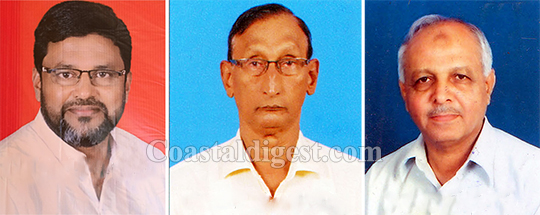
Shahul Hameed elected president of Jamiyyatul Falah DK-Udupi

[email protected] (CD Network)
July 31, 2016

Mangaluru, Jul 31: Social worker K K Shahul Hameed has been unanimously elected President of Jamiyyatul Falah (JF) Dakshina Kannada and Udupi Central Council.

3pic

K K Shahul Hameed, Syed Zubair Shah, Zameer Ambar 

Mr Hameed, who is also the chairman of Education and Health Standing Committee in Dakshina Kannada Zilla Panchayat, has been serving in the Bantwal unit of the JF.

The election of new office bearers was held during the annual general body meeting of the JF central council held on Saturday at its community hall in Mangaluru.

The following office bearers have been unanimously elected for the year 2016-17:

The vice Presidents: Shabih Ahmed Khazi (Udupi unit) and Abdul Shukoor (Puttur unit); General Secretary: Syed Zubair Shah (Mangaluru city unit); Treasurer: Zameer Ambar (Mangaluru city unit); Joint Secretary: Saleem Handel (Moodbidri unit); Organizing Secretary: MH Iqbal (Bantwal unit); Press Secretary: Sheikh Zainuddin (Puttur unit).

Mohammed Iqbal Yusuf, Mohammed Mansoor Ahmed, Ibrahim Saheb Kota were present.

On the same occasion Rs 2, 32,000 educational aid was handed over to two medical students on behalf of JF Dammam unit.

Out-going president Abdul Latheef delivered welcome address. Mohammed Shareef presented annual report. Zubair Shah proposed vote of thanks. Mohammed Haneef compered the programme.

Comments

True commentator
 - 
Monday, 1 Aug 2016

Congratulations for the new team.

May Allah help them to achieve the best performance fulfilling the needs of needy.

Asif Ibrahim
 - 
Sunday, 31 Jul 2016

All the best new office bearers .

Add new comment

  • Coastaldigest.com reserves the right to delete or block any comments.
  • Coastaldigset.com is not responsible for its readers’ comments.
  • Comments that are abusive, incendiary or irrelevant are strictly prohibited.
  • Please use a genuine email ID and provide your name to avoid reject.
News Network
April 11,2020

Bengaluru, Apr 11: Former prime minister H D Deve Gowda claimed the lockdown decision was taken in 'haste' without forethought because of which farmers and the working class were 'suffering' and suggested measures to mitigate the impact. The state government should have consulted experienced citizens, officials, progressive farmers, farmer organisations and wholesale traders about the pros and cons before lockdown, he said in a letter to Chief Minister B S Yediyurappa, while highlighting that 61 per cent of the state's population depended on agriculture.

Because of the "hasty decision taken without any preparations", farmers of the country and the state are facing financial distress," he said in the April 9 letter, a copy of which was released to media here on Friday. The JD(S) patriarch suggested taking up some measures, including ensuring no restrictions on agriculture activities, procurement of horticulture produce at a fair price, relaxing export curbs on it, to provide relief to farmers, agriculture labourers, and daily wage workers.

On Sunday, Gowda had said he has assured Prime Minister Narendra Modi of his support in the nation's battle against COVID-19 pandemic when the latter called him to discuss the situation. In his letter to the chief minister, Gowda said: "...the lockdown implemented to control the spread of coronavirus has led our farmers into despair and put their lives into a burning fire.

This lockdown looks like a decision taken at haste without proper thinking and forethought for our farmers, agriculture labourers, and daily wage workers." He said the lockdown decision was taken after remaining 'quite' for about two months since the first corona infection was reported in the country on January 30. Among the suggestions made by the former prime minister include, procurement of horticulture produce at a fair price like in the case of milk from villages by the government through related organisations like Karnataka Horticulture Federation, HOPCOMS among others.

As horticulture produce was perishable, there should be no restriction on its procurement, transportation and marketing; all processing related activities of horticulture produce should be given relaxation from the lockdown, he said. Gowda also called for relaxation on exports for horticulture produce and its processed items. There should be no restriction on agriculture activities; a national grid has to be set up for marketing of horticulture produce, he said.

If such measures were not taken up immediately, the government will have to pay compensation to farmers for losses. Lack of remedial measures would lead to a shortage of supply, leading to rebellion from the people and may result in farmers' suicides and bringing about a situation that might be more grave than coroanvirus, he said.

Comments

Add new comment

  • Coastaldigest.com reserves the right to delete or block any comments.
  • Coastaldigset.com is not responsible for its readers’ comments.
  • Comments that are abusive, incendiary or irrelevant are strictly prohibited.
  • Please use a genuine email ID and provide your name to avoid reject.
News Network
August 7,2020

Bengaluru, Aug 7: Amid the rising number of COVID-19 cases in Karnataka, the state's health department issued fresh guidelines for the disposal of bodies of COVID patients.

"Although an increased risk of COVID infection from a dead body to health workers or family members who follow standard precautions while handling the body is unlikely, the lack of scientific data requires the utmost care to avoid the inadvertent spread of COVID-19 during these times," the statement from the health department's press release read, emphasising on the dignity of the dead and the religious and cultural tradition.

The 23-page press release elaborated on guidelines regarding testing, handling of dead bodies and other specificities in relation to the management of COVID-19 bodies.

"Testing should not be insisted in every case of death, but only when they have a recorded history of influenza-like symptoms. The body should be handed over to the family members/ relatives in a dignified manner immediately after swab collection and hospitals should provide handouts with a list of dos and don'ts in English and Kannada laying down relevant information," the statement said.

It added, "At the mortuary, health care workers, mortuary staff and the family of the deceased body shall not come in direct contact with the dead body and must wear full personal protective equipment (PPE). If the family or relative are for any reason unable to cremate or bury the body, the local health authority shall arrange for the dignified last rites as per the religious traditions of the family."

Regarding autopsies (post mortem) on COVID-19 bodies, the state department said that they should be avoided, except in necessary circumstances.

The statement also gave detailed guidelines regarding the appropriate recording of COVID-19 deaths in line with the Indian Council of Medical Research (ICMR) guidelines.

Additionally, the health department made a statement about the admission procedure for COVID positive patients referred by other district administrations saying, "It is now mandatory for all the referrals from the BBMP admission and discharge of COVID positive patients to be done through the online COVID Hospital Bed Management System (CHBMS)."

The state's count of coronavirus cases was 1,51,449 in the past 24 hours.

So far, a total of 2,804 people have died due to COVID-19 in the state, while the average recovery rate in Karnataka is 49.3 per cent.

Comments

Add new comment

  • Coastaldigest.com reserves the right to delete or block any comments.
  • Coastaldigset.com is not responsible for its readers’ comments.
  • Comments that are abusive, incendiary or irrelevant are strictly prohibited.
  • Please use a genuine email ID and provide your name to avoid reject.
News Network
April 29,2020

Washington, Apr 29: A US government panel on Tuesday called for India to be put on a religious freedom blacklist over a "drastic" downturn under Prime Minister Narendra Modi, triggering a sharp rebuttal from New Delhi.

The US Commission on International Religious Freedom recommends but does not set policy, and there is virtually no chance the State Department will follow its lead on India, an increasingly close US ally.

In an annual report, the bipartisan panel narrowly agreed that India should join the ranks of "countries of particular concern" that would be subject to sanctions if they do not improve their records.

"In 2019, religious freedom conditions in India experienced a drastic turn downward, with religious minorities under increasing assault," the report said.

It called on the United States to impose punitive measures, including visa bans, on Indian officials believed responsible and grant funding to civil society groups that monitor hate speech.

The commission said that Modi's Hindu nationalist government, which won a convincing election victory last year, "allowed violence against minorities and their houses of worship to continue with impunity, and also engaged in and tolerated hate speech and incitement to violence."

It pointed to comments by Home Minister Amit Shah, who notoriously referred to mostly Muslim migrants as "termites," and to a citizenship law that has triggered nationwide protests.

It also highlighted the revocation of the autonomy of Kashmir, which was India's only Muslim-majority state, and allegations that Delhi police turned a blind eye to mobs who attacked Muslim neighborhoods in February this year.

Coronavirus state-wise India update: Total number of confirmed cases, deaths on April 29

The Indian government, long irritated by the commission's comments, quickly rejected the report.

"Its biased and tendentious comments against India are not new. But on this occasion, its misrepresentation has reached new levels," foreign ministry spokesman Anurag Srivastava said.

"We regard it as an organization of particular concern and will treat it accordingly," he said in a statement.

The State Department designates nine "countries of particular concern" on religious freedom -- China, Eritrea, Iran, Myanmar, North Korea, Pakistan, Saudi Arabia, Tajikistan and Turkmenistan.

The commission asked that all nine countries remain on the list. In addition to India, it sought the inclusion of four more -- Nigeria, Russia, Syria and Vietnam.

Pakistan, India's historic rival, was added by the State Department in 2018 after years of appeals by the commission.

In its latest report, the commission said that Pakistan "continued to trend negatively," voicing alarm at forced conversions of Hindus and other minorities, abuse of blasphemy prosecutions and a ban on the Ahmadi sect calling itself Muslim.

India's citizenship law fast-tracks naturalization for minorities from neighbouring countries -- but not if they are Muslim.

Modi's government says it is not targeting Muslims but rather providing refuge to persecuted people and should be commended.

But critics consider it a watershed move by Modi to define the world's largest democracy as a Hindu nation and chip away at independent India's founding principle of secularism.

Tony Perkins, the commission's chair, called the law a "tipping point" and voiced concern about a registry in the northeastern state of Assam, under which 1.9 million people failed to produce documentation to prove that they were Indian citizens before 1971 when mostly Muslim migrants flowed in during Bangladesh's bloody war of independence.

"The intentions of the national leaders are to bring this about throughout the entire country," Perkins told an online news conference.

"You could potentially have 100 million people, mostly Muslims, left stateless because of their religion. That would be, obviously, an international issue," said Perkins, a Christian activist known for his opposition to gay rights who is close to President Donald Trump's administration.

Three of the nine commissioners dissented -- including another prominent Christian conservative, Gary Bauer, who voiced alarm about India's direction but said the ally could not be likened to non-democracies such as China.

"I am deeply concerned that this public denunciation risks exactly the opposite outcome than the one we all desire," Bauer said.

Trump, who called for a ban on Muslim immigration to the US when he ran for president, hailed Modi on a February visit to New Delhi.


Comments

Add new comment

  • Coastaldigest.com reserves the right to delete or block any comments.
  • Coastaldigset.com is not responsible for its readers’ comments.
  • Comments that are abusive, incendiary or irrelevant are strictly prohibited.
  • Please use a genuine email ID and provide your name to avoid reject.