Sharjah ruler promises to release 149 Indian prisoners

Agencies
September 27, 2017

Thiruvananthapuram, Sept 27: A total of 149 Indians serving prison terms for minor and financial offences in Sharjah will be released following the amnesty declared here by the Emirate's visiting ruler Sultan Bin Mohammed Al- Quasimi.

The announcement came in response to a request by Kerala Chief Minister Pinarayi Vijayan seeking the release of Keralites who had completed three years of their jail term in Sharjah.

According to a joint communique issued by the Sharjah and Kerala governments, those facing punishment for minor offences and financial misappropriation would be given pardon as per the general amnesty.

Al-Quasimi was honoured with an honorary D.lit Degree from Calicut University at a function held at Raj Bhavan here. Governor Justice (retd) P Sathasivam conferred the degree.

Sharjah also agreed to open an institution of higher learning for Arabic studies and research and set up a chain of skill development centres for imparting training to those seeking jobs in the Gulf region.

"This was announced by Al-Quasimi during his one-to-one meeting with Vijayan", the communique said.

Sharjah has also accepted in-principle the state's proposal for giving international driving licence to those who seeking jobs in the Emirate, the release said.

A joint committee consisting top officials of Sharjah and Kerala would be set up to work out an action plan to implement projects agreed to by both sides.

The Kerala government also offered land for construction of a permanent building for the UAE consulate in the state capital.

The Sharjah Family City project, cultural centre and International Education Complex to be set up by Kerala in Sharjah were some of the other projects under the active consideration of the Sharjah government, the release said.

Later, giving a lecture, Al-Quasimi hailed the harmony among the people of Kerala and wanted them to preserve it.

"I saw a dance yesterday. I was very happy to see three sects of people dancing together with love. I hope that will remain always," he said.

Al-Quasimi, who reached here on September 24 on a five- day visit to the state, promised he would be back within a year to celebrate the fulfilling of promises he had made.

The ruler met the chief minister at his official residence in the morning. He also met the council of ministers yesterday and discussed various issues pertaining to Kerala and Sharjah.

Comments

Syed
 - 
Wednesday, 27 Sep 2017

Appreciated....And Ache Din for Indian Prisoners.....Thanks to PV and Sultan of Sharjah.

Danish
 - 
Wednesday, 27 Sep 2017

Both are good rulers

Ganesh
 - 
Wednesday, 27 Sep 2017

Great sultan... Real humanitarian 

Kumar
 - 
Wednesday, 27 Sep 2017

Great news... when centre failed and state won to save many lives...

Add new comment

  • Coastaldigest.com reserves the right to delete or block any comments.
  • Coastaldigset.com is not responsible for its readers’ comments.
  • Comments that are abusive, incendiary or irrelevant are strictly prohibited.
  • Please use a genuine email ID and provide your name to avoid reject.
News Network
February 5,2020

Mumbai, Feb 5: Maharashtra Chief Minister Uddhav Thackeray on Wednesday said there was no need to fear the Citizenship Amendment Act, but asserted his government will not allow the proposed National Register of Citizens to be implemented as it would "impact people of all religions".

Throwing out Bangladeshi and Pakistani migrants out of the country was an old demand of the Shiv Sena, the chief minister said in the third and concluding part of his interview to party mouthpiece 'Saamana'.

"I can confidentally say the Citizenship (Amendment) Act (CAA) is not meant to throw Indian citizens out of the country. But, the National Register of Citizens (NRC) is going to impact Hindus as well," the Sena president said.

India has the right to know the number of minorities from neighbouring nations who applied for Indian citizenship after being persecuted in their home countries, he said.

"When they come here, will they get homes under the 'Pradhan Mantri Awas Yojana'? What about employment and education of their children? All these issues are important and we have the right to know," hesaid in the interview to Saamana's executive editor and Sena MP Sanjay Raut.

"As chief minister, I should know where will these people be relocated in my state. Our own people don't have adequate housing. Will these people go to Delhi, Bengaluru or Kashmir, since Article 370 is now scrapped?" he wondered.

Several Kashmiri Pandit families are staying like refugees in their own country. The CAA is not to throw citizens out of the country, Thackeray said.

"However, the NRC will impact Hindus and Muslims and the state government will not allow it to be implemented," he asserted.

Under the NRC, all citizens will have to prove their citizenship. In Assam, 19 lakh people could not prove their citizenship. Of these, 14 lakh are Hindus, Thackeray claimed.

In a veiled attack on his cousin and MNS chief Raj Thackeray, who will lead a rally in support of the CAA and NRC in Mumbai on February 9, the chief minister said the NRC is not yet a reality and there is no need for a 'morcha' in support of or against it.

"If the NRC is enforced, those who are supporting it will also be affected," he said.

Under the NRC, even Hindus will have to prove their citizenship. "I will not allow the law to be enacted. Whether I am chief minister or not, I will not allow injustice to anybody," he said.

The chief minister also took a veiled dig at the Centre's decision to give the Padma Shri award to Pakistani-origin musician Adnan Sami.

"A migrant is a migrant. You can't honour him with the Padma award. Throwing out illegal migrants was the stand of (late Shiv Sena supremo) Balasaheb Thackeray," he said without naming anyone.

Comments

Add new comment

  • Coastaldigest.com reserves the right to delete or block any comments.
  • Coastaldigset.com is not responsible for its readers’ comments.
  • Comments that are abusive, incendiary or irrelevant are strictly prohibited.
  • Please use a genuine email ID and provide your name to avoid reject.
Agencies
May 8,2020

Washington D.C., May 8: The prime time for brain development in a child's life is the first year, where the infant spends most of the time asleep. It is the time when neural connections form and sensory memories are encoded.

However, when sleep is disrupted, as occurs more often among children with autism, brain development may be affected, too.

New research led by the University of Washington finds that sleep problems in a baby's first 12 months may not only precede an autism diagnosis but also may be associated with altered growth trajectory in a key part of the brain, the hippocampus.

The study, which was published in the American Journal of Psychiatry, researchers report that in a sample of more than 400 taken of 6- to 12-month-old infants, those who were later diagnosed with autism were more likely to have had difficulty falling asleep.

It also states that this sleep difficulty was associated with altered growth trajectories in the hippocampus.

"The hippocampus is critical for learning and memory, and changes in the size of the hippocampus have been associated with poor sleep in adults and older children.

As many as 80 per cent of the children with autism spectrum disorder have sleep problems," said Annette Estes, director of the UW Autism Center and senior author of the study.

"In our clinical experience, parents have a lot of concerns about their children's sleep, and in our work on early autism intervention, we observed that sleep problems were holding children and families back," added Estes, who is also a UW professor of speech and hearing sciences.

"It could be that altered sleep is part-and-parcel of autism for some children. One clue is that behavioural interventions to improve sleep don't work for all children with autism, even when their parents are doing everything just right. This suggests that there may be a biological component to sleep problems for some children with autism," said Estes.

To consider links among sleep, brain development, and autism, researchers at the IBIS Network looked at MRI scans of 432 infants, surveyed parents about sleep patterns, and measured cognitive functioning using a standardized assessment.

At the outset of the study, infants were classified according to their risk for developing autism: Those who were at higher risk of developing autism -- about two-thirds of the study sample -- had an older sibling who had already been diagnosed.

Infant siblings of children with autism have a 20 per cent chance of developing autism spectrum disorder -- a much higher risk than children in the general population.

In the current study, 127 of the 432 infants were identified as "low risk" at the time the MRI scans were taken because they had no family history of autism.

They later evaluated all the participants at 24 months of age to determine whether they had developed autism. Of the roughly 300 children originally considered "high familial risk," 71 were diagnosed with autism spectrum disorder at that age.

Problems with sleep were more common among the infants later diagnosed with an autism spectrum disorder, as were larger hippocampi. No other subcortical brain structures were affected, including the amygdala, which is responsible for certain emotions and aspects of memory, or the thalamus, a signal transmitter from the spinal cord to the cerebral cortex.

The authors note that while parents reported more sleep difficulties among infants who developed autism compared to those who did not, the differences were very subtle and only observed when looking at group averages across hundreds of infants.

Sleep patterns in the first years of life change rapidly as infants transition from sleeping around the clock to a more adult-like sleep/wake cycle. Until further research is completed, Estes said, it is not possible to interpret challenges with sleep as an early sign of increased risk for autism.

Comments

Add new comment

  • Coastaldigest.com reserves the right to delete or block any comments.
  • Coastaldigset.com is not responsible for its readers’ comments.
  • Comments that are abusive, incendiary or irrelevant are strictly prohibited.
  • Please use a genuine email ID and provide your name to avoid reject.
News Network
July 27,2020

Tokyo, Jul 27: Gold hit an all-time high on Monday as tit-for-tat consulate closures in China and the United States rattled investors, boosting the allure of safe-haven assets, although sentiment was mixed with tech gains supporting some Asian stocks.

MSCI's ex-Japan Asia-Pacific index rose 1.3 percent as Taiwan's TSMC, Asia's third-largest company by market capitalisation, rose almost 10 percent.

The chipmaker's gains boosted other tech stocks in the region and came after rival Intel signalled it may give up manufacturing its own components due to delays in new 7-nanometer chip technology.

Also soothing sentiment, Chinese shares eked out gains after big falls late last week, with CSI300 index rising 0.5 percent.

S&P500 futures were last up 0.4 percent in choppy trade while Japan's Nikkei fell 0.5 percent, resuming trade after a long weekend and catching up with falls in global shares late last week.

Global shares had lost steam last week after Washington ordered China's consulate in Houston to close, prompting Beijing to react in kind by closing the US consulate in Chengdu.

US Secretary of State Mike Pompeo took fresh aim at China last week, saying Washington and its allies must use "more creative and assertive ways" to press the Chinese Communist Party to change its ways.

"US President (Donald) Trump used to say China's President Xi Jinping is a great leader. But now Pompeo's wording is becoming so aggressive that markets are starting to worry about further escalation," said Norihiro Fujito, chief investment strategist at Mitsubishi Securities.

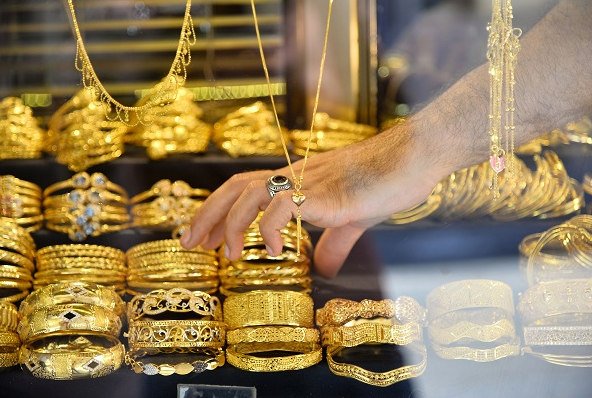
Gold rose 1.0 percent to a record high of $1,920.9 per ounce, surpassing a peak touched in September 2011, as Sino-US tensions boosted the allure of safe-haven assets, especially those not tied to any specific country.

The yellow metal is also helped by aggressive monetary easing adopted by many central banks around the world since the pandemic plunged the global economy into a recession.

Some investors fret such an unprecedented level of money-printing could eventually lead to inflation.

MORE STIMULUS

Hopes of a quick US economic recovery are fading as coronavirus infections showed few signs of slowing.

That means the economy could capitulate without fresh support from the government, with some of earlier steps such as enhanced jobless benefits due to expire this month.

Investors hope US Congress will agree on a deal before its summer recess but there are some sticking points including the size of the stimulus and enhanced unemployment benefits.

US Treasury Secretary Steve Mnuchin said the package will contain extended unemployment benefits with 70 percent "wage replacement".

Democrats, who control the House of Representatives, want enhanced benefits of $600 per week to be extended and look to much bigger stimulus compared with the Republicans' $1 trillion plan.

Investors are looking to corporate earnings from around the world for hints on the pace of recovery in the global economy.

"It looks like rising coronavirus cases are starting to slow down recovery in many countries," said Masahiro Ichikawa, senior strategist at Sumitomo Mitsui DS Asset Management.

Concerns about the US economic outlook started to weigh on the dollar, reversing its inverse correlation with the economic well-being over the past few months.

The dollar index dropped 0.3 percent to its lowest level in nearly two years.

The euro gained 0.3 percent to $1.1693, hitting a 22-month high of $1.16590 as sentiment on the common currency improved after European leaders reached a deal on a recovery fund in a major step towards more fiscal co-operation.

Against the yen, the dollar slipped 0.5 percent to 105.605 yen, a four-month low while the British pound hit a 4 1/2-month high of $1.2832.

Oil prices dipped on worries about the worsening Sino-US relations.

Brent futures fell 0.46 percent to $43.14 per barrel while US crude futures lost 0.44 percent to $41.11.

Comments

Add new comment

  • Coastaldigest.com reserves the right to delete or block any comments.
  • Coastaldigset.com is not responsible for its readers’ comments.
  • Comments that are abusive, incendiary or irrelevant are strictly prohibited.
  • Please use a genuine email ID and provide your name to avoid reject.