


Sharp fall in vegetable prices, lack of cash hit farmers, traders

[email protected] (News Network)
December 29, 2016

Bengaluru, Dec 29: Even though the sharp fall in the price of vegetables is a good news for common man, farmers and traders are distressed by the unexpected upheavals. On the other hand shortage of cash, a consequence of demonetisation, has had an adverse impact on vegetable business.
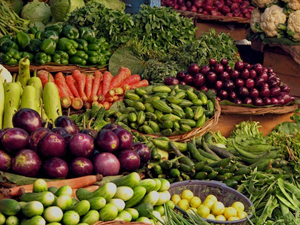
vegThe wholesale price of a few vegetables has declined by 50%. The president of vegetable merchants' association, RV Gopi attributed the drastic fall in prices to the surplus stock.

"As a result of demonetisation, farmers and merchants are in no position to send vegetables to Tamil Nadu, Kerala, Maharashtra and Andhra Pradesh. As a result, most of the stock is ending up at the local markets in Bengaluru. Consequently, the price of the vegetables has come down by 30% to 40% on average," Gopi said adding that farmers and merchants were hoping for a revival in January.

Paramesh V, a resident of Vidyaranyapura in north Bengaluru, is certainly not complaining. He stocks up on all the vegetables he needs for the entire week in one visit to the KR Market. "The vegetables here are fresh, and in comparison to the local markets, it is a lot cheaper. Moreover, the prices have dropped drastically in the past few weeks," he said.

Traders get vegetables to the city from Hoskote, De vanahalli, Anekal, Kanakapura, Mandya, Hassan and even Belagavi.

Nataraju MN, a vegetable trader, pointed out that merchants and farmers carried out most of their transactions in cash. "Not all farmers have bank accounts, and it takes time for everyone to get accustomed to cashless transactions. The cap on withdrawal from our bank accounts has impacted our earnings. Many traders send nearly 10 trucks to other states daily, and advance payment to truck drivers and others are made in cash. They need cash in lakhs," he added.

Comments

shaji
 - 
Thursday, 29 Dec 2016

Better send one load of vegetables to parliament and let bjp members enjoy it. Farmers should sacrifice for the demonetising policy of our PM as ache din will come soon.

Add new comment

  • Coastaldigest.com reserves the right to delete or block any comments.
  • Coastaldigset.com is not responsible for its readers’ comments.
  • Comments that are abusive, incendiary or irrelevant are strictly prohibited.
  • Please use a genuine email ID and provide your name to avoid reject.
News Network
January 29,2020

Newsroom, Jan 29: Karnataka’s capital has earned the unwelcome distinction of global capital of traffic congestion. According to a report by TomTom, the Netherlands-based global provider of navigation, traffic and map products, Bengaluru beat 415 other cities across 57 countries to earn the title of world's most traffic congested city in 2019.

“Bengaluru takes the top spot this year with drivers in the southern Indian city expecting to spend an average of 71% extra travel time stuck in traffic," TomTom said in the ninth edition of its annual Traffic Index.

Three other Indian cities, namely, Mumbai, Pune and New Delhi are also ranked in the 2019 edition of TomTom’s Traffic Index of the world’s most traffic-congested cities. 

The report released on Tuesday ranks cities by the average time added to a trip. TomTom index also includes details on when congestion is heaviest and lightest, how highways compare with surface streets, and how much time drivers wasted waiting for other drivers to get out of their way.

Following closely on the heels of Bengaluru is Manila, Philippines, with the similar 71% traffic congestion. Among the top five worst traffic affected cities are Mumbai and Pune from India at the fourth and fifth place respectively, while Bogota, Colombia is on third spot.

Delhi, the national capital of India is on the 8th spot, while Moscow (Russia), Lima (Peru), Istanbul (Turkey) and Jakarta (Indonesia) are on 6th, 7th, 9th and 10th spot respectively.

Mumbai recorded a 65% traffic congestion with 9th September, 2019 being the worst day. On an average, a Mumbaikar lost 209 hours in traffic congestion. Pune has 59% traffic congestion with 2nd August, 2019 being the worst day. 193 hours are lost due to congestion. Delhi, on the other hand, has 56% traffic congestion. 23rd October, 2019 was the worst day, while 190 hours are lost in traffic congestion.

Interestingly, among all the four Indian cities, Delhi has the most number of cars. Previous studies have concluded that Delhi has the best road conditions among the Metro cities of India.

If you are wondering what exactly the percentages mean, a 53% congestion level in Bangkok, for example, means that a trip will take 53% more time than it would during Bangkok’s baseline uncongested conditions.

TomTom calculates the baseline per city by analyzing free-flow travel times of all vehicles on the entire road network – recorded 24/7, 365 days a year. The report by Dutch navigation and mapping company ranks cities by the average time added to a trip. It also includes details on when congestion is heaviest and lightest, and how much time drivers wasted waiting for other drivers to get out of their way.

Comments

Add new comment

  • Coastaldigest.com reserves the right to delete or block any comments.
  • Coastaldigset.com is not responsible for its readers’ comments.
  • Comments that are abusive, incendiary or irrelevant are strictly prohibited.
  • Please use a genuine email ID and provide your name to avoid reject.
News Network
February 22,2020

Bengaluru, Feb 22: President Ram Nath Kovind on Saturday said an ideal trade-off needs to be reached between new media -- which is fast and popular -- and traditional media which has developed skills to authenticate a news report, which is a costly operation.

Addressing the fourth edition of ‘the Huddle’ – the annual thought conclave of the Hindu here, he asserted that the internet and social media had democratised journalism and revitalised democracy, but had also led to many anxieties.

While the new media was fast and popular and people could choose what they wanted to watch, hear or read, traditional media would have to introspect on its role in society and find ways to earn the reader’s full trust again as "the project of democracy was incomplete without informed citizens – which means, without unbiased journalism."

Debate and discussion were internalised in India’s social psyche to arrive at truth since time immemorial, he said.

"There is no doubt that perception of truth is conditioned by circumstances. The conditions that cloud the truth’s positions are effectively dispelled by a contestation of ideas through debate, discussion and scientific temper. Prejudices and violence vitiate the search for truth."

Expressing happiness to attend ‘The Huddle’ organised by The Hindu, he said the Hindu group of publications had been relentlessly aiming to capture the essence of this great country through its responsible and ethical journalism. He commended them for their insistence on sticking to the five basic principles of journalism – truth-telling, freedom and independence, justice, humaneness and contributing to the social good, an official release here said.

Mr Kovind said dogmas and personal prejudices distorted the truth. In the 150th year of Gandhiji’s birth, he asked all to ponder over this question: "will it not be proper to pursue truth itself as the ideology? Gandhiji has shown us the path by walking ceaselessly in search of truth which would ultimately encompass every positive attribute that enriches the universe."

Comments

Add new comment

  • Coastaldigest.com reserves the right to delete or block any comments.
  • Coastaldigset.com is not responsible for its readers’ comments.
  • Comments that are abusive, incendiary or irrelevant are strictly prohibited.
  • Please use a genuine email ID and provide your name to avoid reject.
News Network
February 18,2020

Bengaluru, Feb 18: Deputy chief minister Laxman Savadi was elected to the legislative council on Monday and although it was a done deal that he would win, a vote from across the aisle spiced up the election.

Counting was conducted soon after ballots were cast and Savadi polled 113 of the 120 votes cast, including the vote of disgruntled JD(S) legislator GT Devegowda. Seven votes were declared invalid. Members of the two opposition parties — Congress and JD(S) — abstained from voting.

The election was necessitated following the resignation of Rizwan Arshad of the Congress. Rizwan resigned after he was elected to the legislative assembly from the Shivajinagar constituency in the assembly bypolls held for 15 seats in December last year.

BR Anil Kumar, who was initially promised the support of both Congress and JD(S) was supposed to contest as an independent candidate. However, as both parties refused to support him at the last minute, he withdrew, paving the way for Savadi’s victory.

The BJP has 117 members in the 225-member assembly, but N Mahesh of the BSP and two independents, H Nagesh and Sharath Bachchegowda, besides GT Devegowda also voted, taking the total electorate to 120 (including the speaker). BJP’s SA Ramadas did not turn up because of health reasons.

“I would like to thank all those who were responsible for my victory. Special thanks to leaders of my party and chief minister BS Yediyurappa, who gave me the opportunity to be the BJP candidate,” said Savadi.

Winning this council election was crucial for Savadi to retain his ministry as he was not an elected member of either of the houses. Rules mandate that a non-member must get elected either to the assembly or council within six months after taking over as minister. February 20 was the deadline for Savadi, who had lost 2018 assembly polls from Athani, to get elected.

Officials in the assembly secretariat said seven votes were invalid because voters had wrongly marked their choices on ballot paper. According to norms, a voter has to mark numerical one, two and three against the names of the candidates in order of preference. Marking only numerical one is allowed. However, six ballots had a tick mark, while a voter had registered a cross mark. Since it was a secret ballot, it was not known who the MLAs were whose votes were invalid.

“The ballot papers bear serial numbers and they are randomly distributed. It is virtually impossible to say who a voter cast his or her vote for,” said assembly secretary MK Vishalakashi, the retuning officer for the bypoll.

Comments

Add new comment

  • Coastaldigest.com reserves the right to delete or block any comments.
  • Coastaldigset.com is not responsible for its readers’ comments.
  • Comments that are abusive, incendiary or irrelevant are strictly prohibited.
  • Please use a genuine email ID and provide your name to avoid reject.