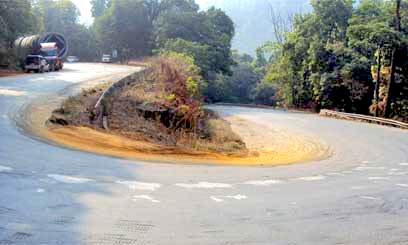
Shiradi Ghat stretch to be closed from January 2 for repair

[email protected] (CD Network)
December 31, 2014

Mangaluru, Dec 31: The Shiradi Ghat stretch of National Highway 75 that connects Bengaluru and Mangaluru will be closed from January 2, 2015 for repair.

Shiradi ghat bundh

Dakshina Kannada Deputy Commissioner AB Ibrahim made this announcement in the presence of minister for forest, environment and ecology B Ramanath Rai during a meeting held at deputy commissioner's office here on Tuesday.

The DC said that alternative arrangements in the form of traffic diversion have been made for the movement of vehicles between Mangaluru and Bengaluru.

All ordinary buses and light vehicles between Mangaluru and Bengaluru should ply through Charmadi Ghat.

Luxury buses to the destinations should take Madikeri route. Tankers, trucks and all types of heavy vehicles will be diverted via Honnavar - Bengaluru road, he said adding that the road will be reopened after the completion of work and the time frame will be announced later.

Earlier the district administration had decided to close the road for repair from December 25. However, the date has been extended due to technical reasons.

Comments

Amado
 - 
Wednesday, 8 Jun 2016

My partner and I stumbled over here different web address and thought I should
check things out. I like what I see so now i am following you.

Look forward to checking out your web page again.

Here is my homepage: Lorene: https://sambeanb.wordpress.com/

Add new comment

  • Coastaldigest.com reserves the right to delete or block any comments.
  • Coastaldigset.com is not responsible for its readers’ comments.
  • Comments that are abusive, incendiary or irrelevant are strictly prohibited.
  • Please use a genuine email ID and provide your name to avoid reject.
Agencies
May 8,2020

Washington D.C., May 8: The prime time for brain development in a child's life is the first year, where the infant spends most of the time asleep. It is the time when neural connections form and sensory memories are encoded.

However, when sleep is disrupted, as occurs more often among children with autism, brain development may be affected, too.

New research led by the University of Washington finds that sleep problems in a baby's first 12 months may not only precede an autism diagnosis but also may be associated with altered growth trajectory in a key part of the brain, the hippocampus.

The study, which was published in the American Journal of Psychiatry, researchers report that in a sample of more than 400 taken of 6- to 12-month-old infants, those who were later diagnosed with autism were more likely to have had difficulty falling asleep.

It also states that this sleep difficulty was associated with altered growth trajectories in the hippocampus.

"The hippocampus is critical for learning and memory, and changes in the size of the hippocampus have been associated with poor sleep in adults and older children.

As many as 80 per cent of the children with autism spectrum disorder have sleep problems," said Annette Estes, director of the UW Autism Center and senior author of the study.

"In our clinical experience, parents have a lot of concerns about their children's sleep, and in our work on early autism intervention, we observed that sleep problems were holding children and families back," added Estes, who is also a UW professor of speech and hearing sciences.

"It could be that altered sleep is part-and-parcel of autism for some children. One clue is that behavioural interventions to improve sleep don't work for all children with autism, even when their parents are doing everything just right. This suggests that there may be a biological component to sleep problems for some children with autism," said Estes.

To consider links among sleep, brain development, and autism, researchers at the IBIS Network looked at MRI scans of 432 infants, surveyed parents about sleep patterns, and measured cognitive functioning using a standardized assessment.

At the outset of the study, infants were classified according to their risk for developing autism: Those who were at higher risk of developing autism -- about two-thirds of the study sample -- had an older sibling who had already been diagnosed.

Infant siblings of children with autism have a 20 per cent chance of developing autism spectrum disorder -- a much higher risk than children in the general population.

In the current study, 127 of the 432 infants were identified as "low risk" at the time the MRI scans were taken because they had no family history of autism.

They later evaluated all the participants at 24 months of age to determine whether they had developed autism. Of the roughly 300 children originally considered "high familial risk," 71 were diagnosed with autism spectrum disorder at that age.

Problems with sleep were more common among the infants later diagnosed with an autism spectrum disorder, as were larger hippocampi. No other subcortical brain structures were affected, including the amygdala, which is responsible for certain emotions and aspects of memory, or the thalamus, a signal transmitter from the spinal cord to the cerebral cortex.

The authors note that while parents reported more sleep difficulties among infants who developed autism compared to those who did not, the differences were very subtle and only observed when looking at group averages across hundreds of infants.

Sleep patterns in the first years of life change rapidly as infants transition from sleeping around the clock to a more adult-like sleep/wake cycle. Until further research is completed, Estes said, it is not possible to interpret challenges with sleep as an early sign of increased risk for autism.


Comments

Add new comment

  • Coastaldigest.com reserves the right to delete or block any comments.
  • Coastaldigset.com is not responsible for its readers’ comments.
  • Comments that are abusive, incendiary or irrelevant are strictly prohibited.
  • Please use a genuine email ID and provide your name to avoid reject.
coastaldigest.com news network
July 20,2020

Mysuru, Jul 20: Police and the Bengaluru City Quarantine Squad apprehended quarantine breacher “Drone Boy” Prathap N M in Mysuru on Monday afternoon.

Police sources said that the 23-year-old youth agreed to surrender following negotiations with officers. 

“He agreed to turn himself in after realizing that he had no other alternative,” said an officer, speaking on the condition of anonymity.

A team of officers from the Quarantine Squad under Dr Prayag H S and police from the Talaghattapura Police Station under Inspector Ramappa Guttedar said they apprehended Prathap who was staying at a hotel in the Mandi Mohalla area at around 3 pm.

Prathap’s father accompanied the team to convince his son to surrender. Police said Prathap will be returned to the city to be placed into 14 days of institutional quarantine. 

With two cell phones at his disposal Prathap, who is accused of twice breaching home quarantine regulations, fled the city on Saturday. 

Police, who were initially aware of only one cell phone, lost track of the youth as he drove out of the city, turning his phone off near Kengeri.

However, after quizzing the fugitive’s family, police learned that Prathap had a second phone and sim card. “His whereabouts were established on Sunday evening by tracking this second phone,” an official source said.

Comments

Add new comment

  • Coastaldigest.com reserves the right to delete or block any comments.
  • Coastaldigset.com is not responsible for its readers’ comments.
  • Comments that are abusive, incendiary or irrelevant are strictly prohibited.
  • Please use a genuine email ID and provide your name to avoid reject.
News Network
February 7,2020

Mangaluru, Feb 7: In an attempt to promote menstrual hygiene among women, the Karnataka State Road Transport Corporation (KSRTC) has installed vending machines and incinerators to dispense and dispose off sanitary napkins at 10 bus stands of the state including Mangaluru.

The machines have been installed inside the women's washroom and women can purchase sanitary napkins from the vending machines by inserting five rupee coins.

Nearly 100 napkins can be stored in the vending machines at a time and housekeeping personnel have been instructed to replenish the stock, as and when required.

While directions on how to use the machine have been displayed near the machines, people can get seek assistance from housekeeping staff if needed.

Initially, the machines were installed at two depots in Bengaluru on a pilot basis and in the second phase it has been extended to 10 KSRTC bus depots.

Comments

Add new comment

  • Coastaldigest.com reserves the right to delete or block any comments.
  • Coastaldigset.com is not responsible for its readers’ comments.
  • Comments that are abusive, incendiary or irrelevant are strictly prohibited.
  • Please use a genuine email ID and provide your name to avoid reject.