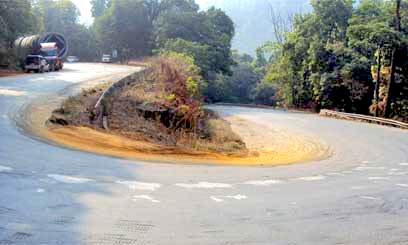
Shiradi Ghat stretch to be closed from January 2 for repair

[email protected] (CD Network)
December 31, 2014

Mangaluru, Dec 31: The Shiradi Ghat stretch of National Highway 75 that connects Bengaluru and Mangaluru will be closed from January 2, 2015 for repair.

Shiradi ghat bundh

Dakshina Kannada Deputy Commissioner AB Ibrahim made this announcement in the presence of minister for forest, environment and ecology B Ramanath Rai during a meeting held at deputy commissioner's office here on Tuesday.

The DC said that alternative arrangements in the form of traffic diversion have been made for the movement of vehicles between Mangaluru and Bengaluru.

All ordinary buses and light vehicles between Mangaluru and Bengaluru should ply through Charmadi Ghat.

Luxury buses to the destinations should take Madikeri route. Tankers, trucks and all types of heavy vehicles will be diverted via Honnavar - Bengaluru road, he said adding that the road will be reopened after the completion of work and the time frame will be announced later.

Earlier the district administration had decided to close the road for repair from December 25. However, the date has been extended due to technical reasons.

Comments

Amado
 - 
Wednesday, 8 Jun 2016

My partner and I stumbled over here different web address and thought I should
check things out. I like what I see so now i am following you.

Look forward to checking out your web page again.

Here is my homepage: Lorene: https://sambeanb.wordpress.com/

Add new comment

  • Coastaldigest.com reserves the right to delete or block any comments.
  • Coastaldigset.com is not responsible for its readers’ comments.
  • Comments that are abusive, incendiary or irrelevant are strictly prohibited.
  • Please use a genuine email ID and provide your name to avoid reject.
News Network
April 3,2020

New Delhi, April 3: Chairman of Lulu Group, Yusuffali MA on Thursday contributed Rs 25 crores to the Prime Minister's Citizen Assistance and Relief in Emergency Situations (PM-CARES) to combat coronavirus.

"I have humbly contributed INR 25 Crores to the PM Cares Fund to support all relief works in India's fight against the COVID-19," Yusuffali said in a tweet.

Last month, Prime Minister Narendra Modi had created PM CARES Fund and appealed to all the countrymen to show their support for the cause.
The prime minister is the chairman of the trust and its members include the defence minister, the home minister and the finance minister.

Comments

Add new comment

  • Coastaldigest.com reserves the right to delete or block any comments.
  • Coastaldigset.com is not responsible for its readers’ comments.
  • Comments that are abusive, incendiary or irrelevant are strictly prohibited.
  • Please use a genuine email ID and provide your name to avoid reject.
News Network
June 14,2020

Mumbai, Jun 14: Bollywood actor Sushant Singh Rajput committed suicide on Sunday, leaving all his fans and the industry in shock. While the reason behind him taking up the extreme step is still not clear, a look into Sushant’s social media feed suggests that things were not well for him for quite some time.

Sushant had been inactive on Twitter since months. His last tweet was on December 27, 2019. Since then, he did not even reply to any one on Twitter. Same is the case with his Facebook account as the last post on his timeline was on the same date. Interestingly, Sushant's Twitter cover picture is the popular painting - 'Starry Night', by Van Gogh, who had also reportedly committed suicide in 1890.

On Instagram, the young actor had last posted on June 3. It was a collage picture of him and his mother along with a cryptic caption that read, “Blurred past evaporating from teardrops Unending dreams carving an arc of smile And a fleeting life, negotiating between the two...#माँ”.

Was Sushant’s inactivity on Twitter, Facebook and his last cryptic post on Instagram a signal that the actor was having a tough time? Well, may be it will remain a mystery forever.

Comments

Add new comment

  • Coastaldigest.com reserves the right to delete or block any comments.
  • Coastaldigset.com is not responsible for its readers’ comments.
  • Comments that are abusive, incendiary or irrelevant are strictly prohibited.
  • Please use a genuine email ID and provide your name to avoid reject.
Agencies
July 5,2020

The deadly coronavirus that entered India while there was still nip in the air has beaten rising mercury, humid conditions, unique Indian genome and has entered monsoon season with more potency as fresh cases are only breaking all records in the country.

India recorded a single-day spike of record 24,850 new coronavirus cases on Sunday, taking its total tally to 6.73 lakh corona-positive cases.

Top Indian microbiologists were hopeful in March that after the 21-day lockdown, as summer approaches, the rise in temperature would play an important role in preventing the drastic spread of COVID-19 virus in India.

Several virologists hinted that by June this year, the impact of COVID-19 would be less than what it appeared in March-April.

The claims have fallen flat as the virus is mutating fast, becoming more potent than ever.

According to experts, the novel coronavirus is a new virus whose seasonality and response to hot humid weather was never fully understood.

"The theory was based on the fact that high temperatures can kill the virus as in sterilisation techniques used in healthcare. But these are controlled environment conditions. There are many other factors besides temperature, humidity which influence the transmission rate among humans," Dr Anu Gupta, Head, Microbiologist and Infection Control, Fortis Escorts Heart Institute, told IANS.

There is no built-up immunity to COVID-19 in humans.

"Also, asymptomatic people might be passing it to many others unknowingly. New viruses tend not to follow the seasonal trend in their first year," Gupta emphasized.

Globally, as several countries are now experiencing hot weather, the World Health Organization (WHO) reported a record hike in the number of coronavirus cases, with the total rising by 2,12,326 in 24 hours in the highest single-day increase since COVID-19 broke out.

So far over 11 million people worldwide have tested positive for the disease which has led to over 5,25,000 deaths, according to data from Johns Hopkins University. The US remained the worst-hit country with over 28 lakh cases, followed by Brazil with 15.8 lakh.

According to Sandeep Nayar, Senior Consultant and HOD, Respiratory Medicine, Allergy & Sleep Disorders, BLK Super Speciality Hospital in New Delhi, whether temperature plays a role in COVID-19 infection is highly debated.

One school of thought said in the tropical regions of South Asia, the virus might not thrive longer.

"On the other hand, another school of thought has found that novel Coronavirus can survive in a hot and humid environment and tropical climate does not make a difference to the virus. According to them, this is what distinguishes the novel coronavirus from other common viruses, which usually wane in hot weather," stressed Nayar.

Not much has been studied in the past and no definite treatment or vaccine is available to date.

"Every day, new properties and manifestation of the disease come up. As of now, the only way to prevent this monster is by taking appropriate precautions. Hand hygiene, social distancing, cough etiquette and face masks definitely reduce spread of COVID-19 infection," Nayar told IANS.

Not just top Indian health experts, even Indian-American scientists had this theory in mind that sunshine and summer may ebb the spread of the coronavirus.

Ravi Godse, Director of Discharge Planning, UPMC Shadyside Pennsylvania in the US told IANS in April: "In the summer, the humidity can go up as well, meaning more water drops in the air. If the air is saturated with water and somebody sneezes virus droplets into such air, it is likely that the droplets will fall to the ground quicker, making them less infectious. So the short answer is yes, summer/sunshine could be bettera.

According to Dr Puneet Khanna, Head of Respiratory Medicine and Pulmonology, Manipal Hospital, Delhi, COVID-19 death rates are not too different in tropical countries but since the disease affected them late it was yet to show its peak in these areas.

"The virus can survive well in hot and humid countries and this is proven now," he stressed.

Comments

Add new comment

  • Coastaldigest.com reserves the right to delete or block any comments.
  • Coastaldigset.com is not responsible for its readers’ comments.
  • Comments that are abusive, incendiary or irrelevant are strictly prohibited.
  • Please use a genuine email ID and provide your name to avoid reject.