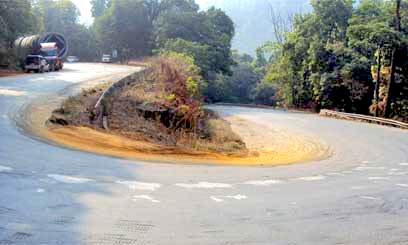
Shiradi Ghat stretch to be closed from January 2 for repair

[email protected] (CD Network)
December 31, 2014

Mangaluru, Dec 31: The Shiradi Ghat stretch of National Highway 75 that connects Bengaluru and Mangaluru will be closed from January 2, 2015 for repair.

Shiradi ghat bundh

Dakshina Kannada Deputy Commissioner AB Ibrahim made this announcement in the presence of minister for forest, environment and ecology B Ramanath Rai during a meeting held at deputy commissioner's office here on Tuesday.

The DC said that alternative arrangements in the form of traffic diversion have been made for the movement of vehicles between Mangaluru and Bengaluru.

All ordinary buses and light vehicles between Mangaluru and Bengaluru should ply through Charmadi Ghat.

Luxury buses to the destinations should take Madikeri route. Tankers, trucks and all types of heavy vehicles will be diverted via Honnavar - Bengaluru road, he said adding that the road will be reopened after the completion of work and the time frame will be announced later.

Earlier the district administration had decided to close the road for repair from December 25. However, the date has been extended due to technical reasons.

Comments

Amado
 - 
Wednesday, 8 Jun 2016

My partner and I stumbled over here different web address and thought I should
check things out. I like what I see so now i am following you.

Look forward to checking out your web page again.

Here is my homepage: Lorene: https://sambeanb.wordpress.com/

Add new comment

  • Coastaldigest.com reserves the right to delete or block any comments.
  • Coastaldigset.com is not responsible for its readers’ comments.
  • Comments that are abusive, incendiary or irrelevant are strictly prohibited.
  • Please use a genuine email ID and provide your name to avoid reject.
News Network
April 19,2020

Kasaragod, Apr 19: Kasaragod, Kerala's COVID-19 hotspot, is the only district in the southern state lacking adequate health infrastructure.

In spite of treating the highest number of COVID-19 patients in the state with meagre infrastructural facilities and even without the support of a medical college in the north Kerala district, no deaths have been reported due to coronavirus.

The state health department views the performance of M Kunhiraman and his team, consisting of Janardhana Naik and Krishna Naik, at the General hospital in Kasaragod as a success story.

"Not only did they control the situation quickly with minimum infrastructure, they also started turning out a large number of negative cases within a few weeks and creditably ensured zero mortality.

This can be showcased as a best global model," Chairman of the Information Education and Communication (IEC) Committee and Project Director Kerala State Aids Control Society, R Ramesh said.

Recalling the ordeal, Janardhana Naik said his first major challenge was the physical examination of a patient with suspected COVID-19.

"Even with the PPE kit, nobody knew how effective they were and it took a whole 30 minutes to wear them properly.

But as time passed, we got accustomed to it," he said.

The traditional method of dealing with a patient involved knowing his or her history, observation and physical examination.

For hundreds of years, the hands-on body approach has been the soul of the doctor-patient relationship -- taking the pulse, tapping on and listening to the chest, feeling lumps.

With the onset of COVID-19 all that has changed.

"In fact, the whole exercise was fraught with grave risks because everything connected with COVID-19 was new.

Doctors have to keep a distance even though the physical examination wearing a Personal Protective Equipment (PPE) is difficult.

Sounds from the body are inaudible, vision is blurred through the smog-covered goggles and a stethoscope seldom has any use," Janardhana Naik said.

It was from March 15 that the hospital started receiving COVID-19 patients, primarily from Dubai.

By the time the first person came, the hospital was ready for him.

Soon, patient numbers began to swell and in a couple of weeks they reached about 91.

From then on, it was teamwork.

Committees were formed for each and every task, including the help desk, IT, treatment, medical board, training, food, waste disposal and data maintenance.

Initially, patients had many misgivings about the hospital.

"Some were disillusioned and even aggressive. Some were not happy with the facilities the hospital had to offer.

But gradually through good treatment and counselling by a psychiatrist, who visited the hospital on alternate days, the confidence and mood of the patients changed and they became friendly with the staff," Naik elaborated.

Counselling was also given to the concerned family members of the patients.

Besides treatment, the medical staff had to spend a considerable amount of time clearing the doubts of patients.

When they got discharged some patients insisted on seeing the faces of the medical staff, who till then were anonymous entities covered from head to toe.

Some even wanted to take selfies with them.

However, the medical team politely turned down their requests and preferred to remain hidden in their work attires.

The mood of the patients also rubbed off on the doctors and hospital staff.

All the physicians and hospital staff are now more confident of dealing with contagious diseases after treating COVID-19 patients.

"Our previous experience of treating H1N1, Chikungunya and Dengue cases helped us a lot.

Words of encouragement from the Health Minister K K Shailaja, Health Principal Secretary Dr Rajan N Khobragade and Health Services Director Dr Sarita R L gave us the impetus to build up confidence.

Moreover, the field health workers did a wonderful job in containing the viral spread," Naik added.

As the number of coronavirus cases rose, the state government on April 5 deputed a 26-member medical team from Thiruvananthapuram to set up a COVID-19 hospital in the district.

They turned a block of the under construction Government Medical College as a hospital-like facility, setting up a 200 bed facility to treat coronavirus patients.


Comments

Add new comment

  • Coastaldigest.com reserves the right to delete or block any comments.
  • Coastaldigset.com is not responsible for its readers’ comments.
  • Comments that are abusive, incendiary or irrelevant are strictly prohibited.
  • Please use a genuine email ID and provide your name to avoid reject.
Media Release
May 6,2020

Mangaluru, May 6: The Kanara Chamber of Commerce and Industry has urged the government to consider erstwhile undivided Dakshina Kannada (now DK & Udupi) as one unit for the purpose of movement of people. KCCI president Isaac Vas has written a letter to Karnataka chief secretary T M Vijay Bhaskar in this regard. 

Mr Vas said: Even though the erstwhile Dakshina Kannada district was bifurcated in 1997 for administration purposes, the two districts are actually an urban agglomeration with most of the population residing in suburbs/towns. Office Staff, technical crew and labour of many industries reside in either district and commute daily for work within an efficient transport system.

The present restriction on Inter-district movement in view of the Lockdown is hindering the kick starting of industries and commerce. Workers are deprived of their livelihood and Industry and business owners are finding it challenging to move forward. To add to this, the migrant labour is moving back to their native places further aggravating the situation. Many Industries and Commercial establishments have requested us to take up this matter with the government, he said.

“Hence, we kindly request you to consider these two districts as one geographical area for the movement of people and private vehicles,” he said adding that this would facilitate movement of people for employment and business in either districts of Dakshina Kannada & Udupi.

He pointed out that Bangalore Rural, Bangalore Urban, Ramanagara, Chikkaballapur and Kolar are considered as a single unit as per your order No. RD158/TNR 2020 dt 03/05/2020 (Clause 2(a)).

Comments

Add new comment

  • Coastaldigest.com reserves the right to delete or block any comments.
  • Coastaldigset.com is not responsible for its readers’ comments.
  • Comments that are abusive, incendiary or irrelevant are strictly prohibited.
  • Please use a genuine email ID and provide your name to avoid reject.
News Network
April 12,2020

New Delhi, Apr 12: Ramping up efforts to "stamp out" coronavirus cases in the state, Kerala Finance Minister Thomas Isaac has said that not only lockdown but intense testing of people and tracing of their contacts are also equally important in the fight against the outbreak.

Kerala, which was the first state in the country to report a coronavirus infection in late January, has also prepared a time table for coming out of the lockdown and there would be district-specific strategies to tackle the situation while the number of cases are on the decline.

In efforts to curb spreading of coronavirus infections, the country is under a 21-day lockdown till April 14 and many states have sought an extension amid rising number of cases. Kerala has proposed extending the lockdown and gradual phasing out after proper assessment.

"Lockdown should go on till we stamp out entire infections. Now, it is not enough to have lockdown. Equally important is that we should have intense testing, tracing and isolating (of people with coronavirus infections)," he said in a telephonic interview.

The government is closely monitoring the situation and there would be region-specific or district-specific strategies in place to tackle the outbreak, he said.

Against the backdrop of the lockdown that has also disrupted economic activities, Isaac said an exit strategy is being prepared and restrictions are being relaxed in certain segments, including agriculture.

Coronavirus India update: State-wise total number of confirmed cases, deaths on April 12

"The number of patients is coming down (in the state). We hope that in the coming days, the decline will be much more faster," he said during the interview late Friday.

On Saturday, the Kerala government said there were a total of 373 confirmed cases of coronavirus infections and 228 patients were under treatment in various hospitals in the state.

Keeping the trend in the last few days, the number of people under observation has come down to 1,23,490. So far, 14,613 samples from people with symptoms were sent for testing and the results of 12,818 samples have come negative, the government said in a statement on Saturday.

Indicating that there would be a calibrated exit from the lockdown, Isaac said the withdrawal would depend on three main factors, including the count of cases and the percentage of people who are under observation.

While emphasising that people must also be fed during the lockdown period, Isaac also said a time table is being prepared by the state to come out of the lockdown.

Even as strict measures are being implemented to deal with the current situation, the state is also preparing for a possible third wave of coronavirus cases.

Three students, who had returned from the Chinese city of Wuhan, were tested positive. They were also the first such cases, to be reported in January-February period, and have recovered. Wuhan was the epicentre of coronavirus infections before it spread to other countries.

Later, there was a second wave of infections in Kerala.

According to the minister, the possibility of a third wave has also been considered for the exit strategy.

"A lot of Malayalees are expected to come back from outside the state. We will welcome them... before that, we want to stamp out all Covid cases in Kerala. Flatten the curve completely so that when these people from outside, they will be quarantined, they will be tested and only then they will be able to integrate with the rest of the community," he said.

The Kerala government's measures, including extensive testing and efforts to trace people who came in contact with coronavirus-infected persons, have helped in curbing spreading of infections.

The state's public healthcare system has also been appreciated in various quarters.

"People are health conscious. There is a demand for quality healthcare services and the response to this demand has been strengthening of the public healthcare system. We have a robust public healthcare system," the minister emphasised.

On April 9, Isaac tweeted about low level of coronavirus spreading in the state.

"International norm for Covid spread is 2.6 per 1 Covid patient. Total number of primary Covid infected who arrived in Kerala from abroad is 254. The secondary spread has been limited to 91. The international mortality rate is 5.75. With just 2 deaths, rate in Kerala is 0.58," he had tweeted.

Death toll due to the coronavirus increased to 273 and the number of cases to 8,356 in the country on Sunday.

Comments

Add new comment

  • Coastaldigest.com reserves the right to delete or block any comments.
  • Coastaldigset.com is not responsible for its readers’ comments.
  • Comments that are abusive, incendiary or irrelevant are strictly prohibited.
  • Please use a genuine email ID and provide your name to avoid reject.