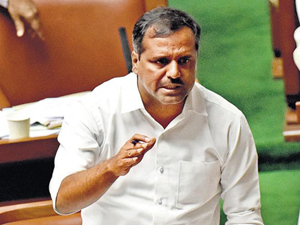
Shobha’s brazen lies a disgrace to Karnataka, says UT Khader

coastaldigest.com news network
July 19, 2017

Mangaluru, Jul 19: Food and Civil Supplies Minister U T Khader has said that the “politically motivated lies” of BJP leader Shobha Karandlaje has brought disgrace to entire Karnataka.khader 2

Mr Khader’s comment comes after the Udupi-Chikkamagaluru MP’s controversial letter to the Union Home Minister Rajanath Singh triggered a controversy in the state.

Karandlaje had enclosed a list of 23 Hindus murdered in the state in the last four years of Congress rule with her letter which held “jihadist elements” responsible for all these murders. Ironically, the list includes the name of living person. She has also portrayed some of the victims of Sangh Parivar as the victims of jihadist elements.

Mr Khader, who was earlier accused by Karandlaje of promoting unrest in coastal Karnataka, said that her provocative and absurd statements always caused embarrassment to people of the state.

“This time she has defamed Karnataka at national level by openly telling lies to the Centre,” Mr Khader said.

He also slammed the double standard of Karandlaje, who deliberately skipped the names of Vinayak Baliga, Harish Poojary and Praveen Poojary, who were murdered by Sangh Parivar activists.

Also Read: Killing of ‘Hindus’: Shobha Karandlaje’s ‘murderous’ lies exposed

Comments

ranjith shetty
 - 
Saturday, 22 Jul 2017

baghdadi brothers are starving nowadays

Add new comment

  • Coastaldigest.com reserves the right to delete or block any comments.
  • Coastaldigset.com is not responsible for its readers’ comments.
  • Comments that are abusive, incendiary or irrelevant are strictly prohibited.
  • Please use a genuine email ID and provide your name to avoid reject.
coastaldigest.com news network
June 2,2020

Bengaluru, June 2: A television anchor allegedly committed suicide after her boyfriend refused to marry her.

29-year-old Chandana V K made a selfie video before taking the extreme step, in which she blamed her boyfriend Dinesh for her decision.

The Suddaguntepalya police have taken up a case of abetment to suicide against Dinesh and his family, including his father Lokappa Gowda, mother Gayatri, sister Shyla and uncle Swamy alias Dayananda. The police have formed a team to nab the accused who are absconding.

Chandana, who used to also appear in real estate advertisements, was a resident of Krishnamurthy Layout in Tavarekere. She hailed from Belur in Hassan district.

According to a preliminary investigation, Chandana consumed poison after making the video.

In the video clip addressed to Dinesh, she says: "You said if I die, it is good for you. So, I am ending my life and you are the reason for it, Dinesh." She sent the clip to Dinesh, his parents, her parents and friends around 2.30 pm on May 28.

On seeing the video, Chandana's parents alerted her neighbours and asked them to go check on her. They took her to a private hospital where she died while undergoing treatment around 12.30 am on May 30.

In his police complaint, Chandana’s father said his daughter and Dinesh were in a relationship for the past five years. Dinesh had promised to marry her and both the families were aware of the relationship.

Dinesh had borrowed Rs 5 lakh from Chandana. But for the past few months, he began avoiding her and even refused to marry her. His family members told Chandana that they would get him married to someone else, the complaint said. The police said action would be initiated taken against Dinesh and his family.

Comments

Add new comment

  • Coastaldigest.com reserves the right to delete or block any comments.
  • Coastaldigset.com is not responsible for its readers’ comments.
  • Comments that are abusive, incendiary or irrelevant are strictly prohibited.
  • Please use a genuine email ID and provide your name to avoid reject.
News Network
January 31,2020

Bengaluru, Jan 31: Senior IPS officer Praveen Sood is the new Head of Police Force in Karnataka as the current DG and IG Neelamani Raju today retired.

Praveen Sood, the DIG of CID’s Economic Offences Wing, introduced several reforms that sped up investigation processes. He introduced the Crime and Criminal Tracking Network System all over the state by networking all police stations in the country and ensuring data entry and retrieval of all information in police stations and higher police officers online.

Born in 1964, Sood graduated from IIT Delhi and joined the Indian Police Service in 1986. He kicked off his career as the Assistant Superintendent of Police in Mysuru in 1989. He has served as the SP of Ballari and Raichur before being posted as the Deputy Police Commissioner (Law and Order) of Bengaluru.

In 1999, he served as the police officer on foreign deputation as the police advisor to the Government of Mauritius for 3 years.  He was posted as Police Commissioner of Mysuru City between 2004 and 2007.

He took over as the Additional Commissioner of Police (Traffic) in Bengaluru in 2008 and continued in the post till 2011. He has won the Chief Minister’s Gold Medal for excellence in service in 1996, the Police Medal for Meritorious Service in 2002  and the President’s Police Medal in 2011.

During 2013-14 he took over as Managing Director of Karnataka State Police Housing Corporation. He later worked as the Principal Secretary to the Home  Department as the Additional Director General of Police (Karnataka State Reserve Police) and the ADGP of Administration.

In 2017, he was appointed the Bengaluru Police Commissioner. He was also instrumental in launching “Suraksha” App and “Pink Hoyasalas” managed by all-women police officers.

As the DIG of the CID, Economic offences and Special Units, he is credited for opening the Centre for Cyber-crime Investigation, Training and Research for training police officers, prosecutors and the judiciary in handling cyber crime cases.

Comments

Add new comment

  • Coastaldigest.com reserves the right to delete or block any comments.
  • Coastaldigset.com is not responsible for its readers’ comments.
  • Comments that are abusive, incendiary or irrelevant are strictly prohibited.
  • Please use a genuine email ID and provide your name to avoid reject.
Media Release
February 14,2020

Veteran journalist P. Sainath has said that the nation is in a crisis. And this crisis is not limited to just the rural area. It has become a national crisis at various areas such as agriculture, education, economy, job creation etc.

He was delivering the endowment lecture on the topic ‘Indian democracy at the post-liberalization and post-truth era’ at Media Manthan 2020 organized by the PG department of journalism and mass communication at St Aloysius College (Autonomous). 

Mr Sainath said that the many policies adopted in the 90s led to India becoming unusually unequal. Referring to the speech Ambedkar had made at the Constituent Assembly while handing over the draft of the Constitution, Mr Sainath said, “Ambedkar had warned about the weakness of Indian democracy that liberty without equality allows the supremacy of a few over the multitude. Liberty, equality and fraternity must be kept together as we cannot have one without the other.” 

Mr Sainath stated that the agrarian crisis was no longer about the loss of productivity, employment or about farmer suicide; it was a societal, civilizational crisis. Commenting on the lopsided policies such as cow-slaughter ban, he explained how cow slaughter ban had adversely affected many industries due to their interdependency. While Muslims who slaughtered cows were rendered helpless, the cattle traders who were mostly OBCs lost their earnings as the cattle prices crashed. An important industry like Kolhapur sandals industry in Maharashtra went bankrupt as a result of the cow slaughter ban in Maharashtra. He said the policymakers had no idea how the rural industries were interconnected. Demonetisation too devastated the rural economy as 98 percent of rural transactions happen through cash. 

Mr Sainath also spoke about the crisis of inequality which affects the Dalits and the Adivasis far more than anyone else as 90 percent of the rural households take home less than Rs 10,000/- per month. “Women are yet another group whose labour is never counted in the gross domestic product. Women and girls globally do unpaid work which amounts to about 12.5 billion working hours per year. Monetarily speaking, this is worth 10.8 trillion dollars,” Mr Sainath added. 

Speaking about the crisis of jobs Mr Sainath said that major companies were laying off employees just to create more profits for the investors and the adoption of artificial intelligence in the industry would further destroy millions of jobs.

Rector of St Aloysius College Institutions Fr Dionysius Vaz SJ, Principal Dr (Fr) Praveen Martis SJ, HOD of Journalism and Mass Communication department Dr (Fr) Melwyn Pinto SJ were present.

‘Veerappan and Vijay Mallya’s business models are interesting!’

Addressing the gathering during his endowment lecture on Friday, Mr Sainath made an interesting comment on the so called ‘revenue model’. “Whenever I visit IIMs and IITs for lectures on my PARI project, the students there ask me what my revenue model for my project is. I tell them that I do not have a revenue model. In fact, journalism does not begin with a revenue model. Gandhiji, Ambedkar, Bhagat Singh were all great journalists. But they did not have a revenue model,” Mr Sainath said.

On a lighter note, he said that the best revenue model that he liked was that of forest brigand Veerappan and liquor baron Vijay Mallya. “Veerappan ruled the forest for forty years and from the top ministers to the villagers he could dictate terms and liver royally. Similarly, Mallya’s revenue model was to steal the banks and run away abroad and live like a king,” Mr Sainath added.

Journalism is not and can never be a business. It is a calling, he opined. While newspaper can be a business, television can be a business, journalism per se cannot be reduced to a business. “Unfortunately today, journalists are recruited on a contract basis and they have no bargaining power; and there are no unions to fight for their cause. Hence, they are at the mercy of the corporate media houses for their survival and are made to write stories that cannot be called journalism,” Mr Sainath said.

Answering a question as to the pressures he faced as a journalist, he said that external pressures from the government or others could be very well handled. It is the internal pressures from once own media house that journalists find it difficult to manage.


 

Comments

Add new comment

  • Coastaldigest.com reserves the right to delete or block any comments.
  • Coastaldigset.com is not responsible for its readers’ comments.
  • Comments that are abusive, incendiary or irrelevant are strictly prohibited.
  • Please use a genuine email ID and provide your name to avoid reject.