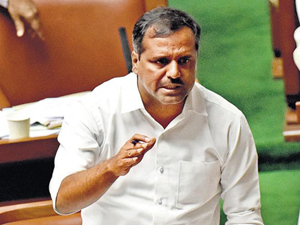
Shobha’s brazen lies a disgrace to Karnataka, says UT Khader

coastaldigest.com news network
July 19, 2017

Mangaluru, Jul 19: Food and Civil Supplies Minister U T Khader has said that the “politically motivated lies” of BJP leader Shobha Karandlaje has brought disgrace to entire Karnataka.khader 2

Mr Khader’s comment comes after the Udupi-Chikkamagaluru MP’s controversial letter to the Union Home Minister Rajanath Singh triggered a controversy in the state.

Karandlaje had enclosed a list of 23 Hindus murdered in the state in the last four years of Congress rule with her letter which held “jihadist elements” responsible for all these murders. Ironically, the list includes the name of living person. She has also portrayed some of the victims of Sangh Parivar as the victims of jihadist elements.

Mr Khader, who was earlier accused by Karandlaje of promoting unrest in coastal Karnataka, said that her provocative and absurd statements always caused embarrassment to people of the state.

“This time she has defamed Karnataka at national level by openly telling lies to the Centre,” Mr Khader said.

He also slammed the double standard of Karandlaje, who deliberately skipped the names of Vinayak Baliga, Harish Poojary and Praveen Poojary, who were murdered by Sangh Parivar activists.

Also Read: Killing of ‘Hindus’: Shobha Karandlaje’s ‘murderous’ lies exposed

Comments

ranjith shetty
 - 
Saturday, 22 Jul 2017

baghdadi brothers are starving nowadays

Add new comment

  • Coastaldigest.com reserves the right to delete or block any comments.
  • Coastaldigset.com is not responsible for its readers’ comments.
  • Comments that are abusive, incendiary or irrelevant are strictly prohibited.
  • Please use a genuine email ID and provide your name to avoid reject.
News Network
May 6,2020

Bengaluru, May 6: More than a month after international flights have been barred, Karnataka government is preparing to quarantine all 10,823 of the state''s people poised to return home from overseas amid the Covid pandemic, an official said on Tuesday.

"The state has planned to quarantine all 10,823 passengers coming back to Karnataka. The quarantine guidelines framed as below would be applicable," said Health Commissioner Pankaj Kumar Pandey in a statement.

According to the Government of India, 10,823 Karnataka residents have been stranded abroad by April 30, comprising 4,408 tourists, 3,074 students, 2,784 migrants and professionals and 557 ship crew.

Out of the 10,823 people, the state government is expecting 6,100 to return early as the government has decided to allow Indians stuck abroad to return.

"All the passengers arriving at points of entry (airports and seaports) will be compulsorily screened for symptoms of Covid-19," said Pandey.

Point of entry screening will include self-reporting form verification, thermal screening, pulse oximeter reading, briefing with instructions, categorisation, stamping for some and downloading of Aarogya Setu, Quarantine Watch and Apthamitra apps.

Arriving passengers are also required to declare existing comorbidities such hypertension, diabetes, asthma or any lung disease, organ transplantations, cancer, tuberculosis and other ailments.

Passengers will be categorised into three groups: Category A (symptomatic on arrival), Category B (asymptomatic with co-morbidity or aged above 60 years) and Category C (rest of asymptomatic passengers).

Depending on the category into which the people fall, their quarantine place and time will be determined.

Category A arrivals will be subjected to institutional quarantine for a fortnight, Category B one week quarantine at a hotel or hostel, followed by another week at home, and Category C home quarantine for a fortnight.

Karnataka government is making elaborate arrangements and logistical means, deploying healthcare, police and several other departments into action to handle the huge influx of Kannadigas and state residents.

Pandey has issued a 21-page elaborate standard operating procedure (SOP) guidelines on how to face the international returnees.

Comments

Add new comment

  • Coastaldigest.com reserves the right to delete or block any comments.
  • Coastaldigset.com is not responsible for its readers’ comments.
  • Comments that are abusive, incendiary or irrelevant are strictly prohibited.
  • Please use a genuine email ID and provide your name to avoid reject.
coastaldigest.com news network
May 22,2020

Mangaluru, May 22: An elderly cardiac patient from Dakshina Kannada, who was stranded in Saudi Arabia due to covid-19 lock-down, has finally reached his homeland thanks to the timely intervention by Humanity Forum Jubail and Indian Social Forum.

The elderly man hailing from Kadaba area of Dakshina Kannada was admitted to a hospital in Madinah. However, his condition continued to worsen due to lack of proper treatment. The efforts by his family members to bring him back home had not yielded results.

Meanwhile, one of the relatives of the patient, Ansari Suratkal, who happens to be a DKSC activist, brought the issue to the notice of the Karnataka unit of the Indian Social Forum in Dammam. ISF contacted Humanity Forum president Zakariya Jokatte, who helped the patient to speak directly union minister D V Sadananda Gowda in a video conference organised by coastaldigest.com.

Humanity Forum also persuaded the Indian Embassy to allow the stranded cardiac patient to fly back to India through Dammam-Bengaluru repatriation flight on May 20. 

However, it was not easy for the patient to travel from Madinah to Dammam International Airport due to lock-down and curfew. ISF not only obtained travel permission for him but also arranged vehicle. Jeddah and Riyadh units of ISF helped in obtaining permission letter in their respective places in spite of travel ban imposed by the police. Madinah unit of ISF arranged vehicle for transportation. Zakariya Jokatte bore the air ticket and other expenses of the patient.

Comments

Add new comment

  • Coastaldigest.com reserves the right to delete or block any comments.
  • Coastaldigset.com is not responsible for its readers’ comments.
  • Comments that are abusive, incendiary or irrelevant are strictly prohibited.
  • Please use a genuine email ID and provide your name to avoid reject.
Agencies
February 6,2020

Even more than three years after demonetisation and all-out efforts to make most transactions through electronic, cash is still king, as it thrives in a digital India, said fintech start-up Paytm founder Vijay Sekhar Sharma.

"While cashless economy is not possible in India, less cash economy will be in the future. Less cash is the only solution, not the elimination of cash," Sharma told IANS in an interview after unveiling an all-in-one payment gateway on Tuesday.

Asserting that it would take 5-10 years for India to make the transition to digital payments from the traditional mode of cash, Sharma, 41, said the e-payment industry benefitted more from the November 8, 2016 note ban and withdrawal of old Rs 1,000 and Rs 500 denominations.

"I think it (demonetisation) helped the industry despite lack of specific help. But the world has changed since then. It is about the scale of distribution of merchants that is what is propelling digital payments," said Sharma.

Most of the cash not only came back into circulation, but also remains as the mode of payment for the majority due to its convenience for the people used to such transactions.

Expounding Paytm's zero service charge, Sharma said the strategy is sustainable as it leads to acquiring more customers and merchants, enabling newer business opportunities.

Paytm also does not levy a service charge to small merchants for its payments services, unlike organised players like Uber.

"Though there is a monetisation model, the merchants who are small shopkeepers, become our financial services customers as they open a bank account, which is profitable."

Paytm secured a Payments Bank license from the Reserve Bank of India to offer a savings bank account, Rupay debit card and money transfer services.

"We are banking on payment services acquiring customers and merchants who avail banking, lending, insurance, wealth and software services like billing software and business ledger software services eventually," Sharma noted.

The mobile first bank services include zero balance and zero digital transaction charge accounts.

"Basically, payments, cloud, commerce and financial services are a cohort we follow. So, payments is our customer as well as merchant acquisition. If it breaks even, we are happy because other line items make more money, he affirmed.

Noting that in a market like India, one cannot price services at a premium unlike in a developed country like the US, the billionaire businessman said a consumer in a developing country would not be able to afford such a hefty charge.

Forbes ranked Sharma as India's youngest billionaire in 2017, with a net worth of $2.1 billion.

While several countries operate on the model of higher service charges, Sharma said newer business models have to be discovered in India, as customer lifecycle value is accounted for more stages than in other nations.

Asked about an upscale retailer like Zara not giving a wallet payment option during its recent end of season sale in Bengaluru, Sharma said Paytm was addressing such hiccups with its all-in-one payment solutions.

"It's an opportunity, because if the retailer has our all-in-one point of sale machine, where in they enter the amount, it shows both the Quick Response code (QR) and card payment options," he observed.

Sharma compared older swiping payment machine to feature phones and modern ones to feature-rich smartphones.

"If you notice, they look like feature phones and the modern day card machine is more a smartphone like. You can add the smatphone components, which can add the features," reiterated Sharma.

Though Paytm's all-in-one QR point of sale machine integrates the billing system, its chief executive said it was not ideal to have an independent QR feature.

Paytm has 16 million strong merchant user base, which Sharma aims to raise to 26 million base in the next one year.

Sharma has launched in this tech city an all-in-one payment gateway and Paytm Business Payments solution, which enable digital payments through multiple methods for small and medium enterprises (SMEs) and an Android point of sale machine.

With the new gateway solution, collecting digital payments through multiple methods can be achieved seamlessly while Paytm Business Payments solution enables automated vendor payments, including employee salaries and customer refunds among others.

The One97 Communications-owned Paytm aims to help SMEs streamline and digitise their business activities using its new solutions, which enhance the overall efficiency of both accepting and making payments.

Paytm has a data bank of over 200 million saved cards and bank accounts, a feature which enables partner apps to shorten transaction times and propel faster conversions while using the all-in-one payment gateway.

Complementing the two solutions, Sharma also launched an all-in-one Android point of sale machine, which can accept payments through all forms such as cards, wallets, UPI apps and even cash.

The device has a QR code that supports all contact and contactless payments, coming with integrated billing software customized solutions for different sectors such as catering, ticketing, parking and others.

The handheld Android device is equipped with an in-built printer, scanner and can also generate bills.

Valued at $16 billion, Paytm is not alone in the fiercely competitive Indian fintech space where a dozen players like PhonePe, MobiKwik, Kotak 811 and deep pocketed international giants Google Pay and Amazon Pay are in the fray.


Comments

Add new comment

  • Coastaldigest.com reserves the right to delete or block any comments.
  • Coastaldigset.com is not responsible for its readers’ comments.
  • Comments that are abusive, incendiary or irrelevant are strictly prohibited.
  • Please use a genuine email ID and provide your name to avoid reject.