


Shocking: India's richest 1% corner 73% of wealth generation

Agencies
January 22, 2018

Davos, Jan 22: The richest 1 per cent in India cornered 73 per cent of the wealth generated in the country last year, a new survey showed today, presenting a worrying picture of rising income inequality.

Besides, 67 crore Indians comprising the population's poorest half saw their wealth rise by just 1 per cent, as per the survey released by the international rights group Oxfam hours before the start of the annual congregation of the rich and powerful from across the world in this resort town.

The situation appears even more grim globally, where 82 per cent of the wealth generated last year worldwide went to the 1 per cent, while 3.7 billion people that account for the poorest half of population saw no increase in their wealth.

The annual Oxfam survey is keenly watched and is discussed in detail at the World Economic Forum Annual Meeting where rising income and gender inequality is among the key talking points for the world leaders.

Last year's survey had showed that India's richest 1 per cent held a huge 58 per cent of the country's total wealth -- higher than the global figure of about 50 per cent.

This year's survey also showed that the wealth of India's richest 1 per cent increased by over Rs 20.9 lakh crore during 2017 -- an amount equivalent to total budget of the central government in 2017-18, Oxfam India said.

The report titled 'Reward Work, Not Wealth', Oxfam said, reveals how the global economy enables wealthy elite to accumulate vast wealth even as hundreds of millions of people struggle to survive on poverty pay.

"2017 saw an unprecedented increase in the number of billionaires, at a rate of one every two days. Billionaire wealth has risen by an average of 13 per cent a year since 2010 -- six times faster than the wages of ordinary workers, which have risen by a yearly average of just 2 per cent," it said.

In India, it will take 941 years for a minimum wage worker in rural India to earn what the top paid executive at a leading Indian garment firm earns in a year, the study found.

In the US, it takes slightly over one working day for a CEO to earn what an ordinary worker makes in a year, it added.

Citing results of the global survey of 70,000 people surveyed in 10 countries, Oxfam said it demonstrates a groundswell of support for action on inequality and nearly two-thirds of all respondents think the gap between the rich and the poor needs to be urgently addressed.

With Prime Minister Narendra Modi attending the WEF meeting in Davos, Oxfam India urged the Indian government to ensure that the country's economy works for everyone and not just the fortunate few.

It asked the government to promote inclusive growth by encouraging labour-intensive sectors that will create more jobs; investing in agriculture; and effectively implementing the social protection schemes that exist.

Oxfam also sought sealing of the "leaking wealth bucket" by taking stringent measures against tax evasion and avoidance, imposing higher tax on super-rich and removing corporate tax breaks.

The survey respondents in countries like the US, UK and India also favoured 60 per cent pay cut for CEOs.

The key factors driving up rewards for shareholders and corporate bosses at the expense of workers' pay and conditions, Oxfam said, include erosion of workers' rights; excessive influence of big business over government policy- making; and the relentless corporate drive to minimise costs in order to maximise returns to shareholders.

About India, it said the country added 17 new billionaires last year, taking the total number to 101. The Indian billionaires' wealth increased to over Rs 20.7 lakh crore -- increasing during last year by Rs 4.89 lakh crore, an amount sufficient to finance 85 per cent of the all states' budget on health and education.

It also said India's top 10 per cent of population holds 73 per cent of the wealth and 37 per cent of India's billionaires have inherited family wealth. They control 51 per cent of the total wealth of billionaires in the country.

Oxfam India CEO Nisha Agrawal said it is alarming that the benefits of economic growth in India continue to concentrate in fewer hands.

"The billionaire boom is not a sign of a thriving economy but a symptom of a failing economic system. Those working hard, growing food for the country, building infrastructure, working in factories are struggling to fund their child's education, buy medicines for family members and manage two meals a day. The growing divide undermines democracy and promotes corruption and cronyism," she said.

The survey also showed that women workers often find themselves at the bottom of the heap and nine out of 10 billionaires are men.

In India, there are only four women billionaires and three of them inherited family wealth.

"It would take around 17.5 days for the best paid executive at a top Indian garment company to earn what a minimum wage worker in rural India will earn in their lifetime (presuming 50 years at work)," Oxfam said.

Comments

Ajay
 - 
Monday, 22 Jan 2018

In reality only 1% understand the value of money, rest 99% are busy with padmaavati to be released or not or celebrating the victory in bhima koreogaon

Babu Gowda
 - 
Monday, 22 Jan 2018

The black money held by some sections of the population in India might not have been accounted in the 73% money made by 1% of population. If all the money is accounted, it could be much more than 82%. In poorer countries like India, disparity between the rich and poor will be very high and widening year after year. It is a time bomb. 

Mohan
 - 
Monday, 22 Jan 2018

Still government says ...working for Poor ... but reality is opposite ...Working for rich and corporates .. 

Ravi
 - 
Monday, 22 Jan 2018

Increasing disparity always lead to social disorder and sometime revolts and civil war too !!! Rich''s should at their own should deploy their wealth for upliftment of downtrodden people else their wealth would not remain secured

Ganesh
 - 
Monday, 22 Jan 2018

it is evident that the nexus between politicians taking favourable decisions to benefit business tycoons and most of them are from same state where top leaders from! Why the hell other states are ignored!!

Chakravarthy
 - 
Monday, 22 Jan 2018

Rich save for generation and corner money where as poor do not know what will be their financial position tomorrow.The wide gap is not good for the country.

Karthik
 - 
Monday, 22 Jan 2018

Modi, what you have done?

Jinesh
 - 
Monday, 22 Jan 2018

A study should be done how this one percent spend their money, whether this wealth is getting invested in India or taken abroad

Add new comment

  • Coastaldigest.com reserves the right to delete or block any comments.
  • Coastaldigset.com is not responsible for its readers’ comments.
  • Comments that are abusive, incendiary or irrelevant are strictly prohibited.
  • Please use a genuine email ID and provide your name to avoid reject.
coastaldigest.com news network
August 4,2020

Mangaluru, Aug 4: The Kasaragod district administration has decided to restore the e-pass system for daily commuters between Kasaragod and Mangaluru amid covid-19 crisis. 

As covid-19 cases began to increase in Dakshina Kannada, the Kasargod district administration had unilaterally newly introduced of daily pass system on July 6 for entry and exit from Talapady border. This had inconvenienced hundreds of employees, who visited Mangaluru daily to eke a living. 

The decision to resume the pass system was taken in a video conference of Kerala Revenue Minister Chandrasekharan with officials and elected representatives on August 3.

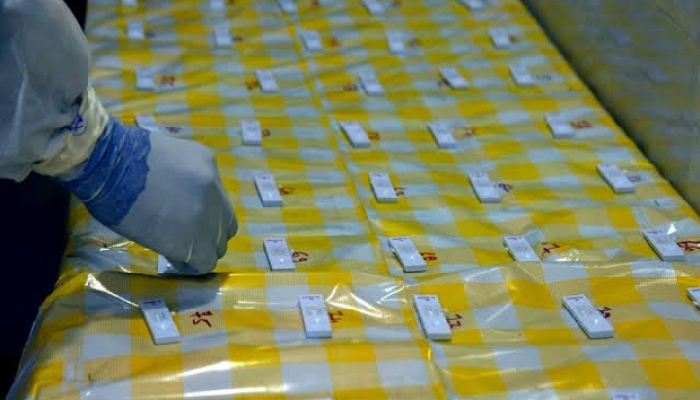
The minister said the Kasaragod district administration will resume issuing of passes for daily commuters between Kasaragod and Mangaluru. But they should undergo rapid antigen test for every week to renew their passes.

"Similarly, one-time interstate passes will be issued for those who want to take part in marriages, funeral and other functions in both states. Even they should undergo antigen test after returning from the functions,” the minister added.

As per the previous order, daily commuters, especially employees, had to stay in Mangaluru for 28 days before returning to Kasargod. Later, Kerala government relaxed rules on July 23 allowing only bank employees from Kasaragod to travel daily in their private vehicles to their workplace in Dakshina Kannada.

Comments

Add new comment

  • Coastaldigest.com reserves the right to delete or block any comments.
  • Coastaldigset.com is not responsible for its readers’ comments.
  • Comments that are abusive, incendiary or irrelevant are strictly prohibited.
  • Please use a genuine email ID and provide your name to avoid reject.
News Network
April 18,2020

Kochi, Apr 18: The Centre on Friday informed the Kerala High Court that there was no immediate plan to bring back the Indian citizens stranded in the Gulf countries due to the novel coronavirus outbreak and that the expatriates had been granted visa extension.

The counsel for the central government made the submission before a division bench comprising justices Rajavijayaraghavan and T R Ravi during the hearing of a plea seeking a direction to bring back Indians stranded in the UAE.

Permission of the Gulf countries was required to send medical teams there to carry out medical examination of the stranded Indians, the counsel said when the court sought to know the Centre's view on Kerala government sending medical teams to the Gulf countries to deal with the issue of COVID-19 disease among Malayalees there.

The court posted the plea for April 21 for consideration after the Central government informed that a similar petition is under consideration of the Supreme Court.

In its plea, Kerala Muslim Cultural Centre (KMCC) in Dubai, the organisation for non-resident Indians from Kerala, sought directions to the Ministries of External Affairs and Civil Aviation to provide exemptions in the international air travel ban to bring back Indians stranded in the UAE.

The petitioners noted that those who return could be kept in quarantine as per the protocol of the World Health Organisation (WHO).

Comments

Add new comment

  • Coastaldigest.com reserves the right to delete or block any comments.
  • Coastaldigset.com is not responsible for its readers’ comments.
  • Comments that are abusive, incendiary or irrelevant are strictly prohibited.
  • Please use a genuine email ID and provide your name to avoid reject.
News Network
January 27,2020

Jehanabad, Jan 27: The police here carried out a raid at the ancestral house of anti-CAA activist Sharjeel Imam, who has been slapped with a sedition case in the national capital for alleged inflammatory speeches he gave at Shaheen Bagh and the Jamia Milia Islamia, a senior official said on Monday.

According to Superintendent of Police, Jehanabad, Manish Kumar, Imams house in Kako police station area was raided late on Sunday night following "help sought by central agencies" which are investigating the cases lodged against the JNU research scholar.

Imam was not found at his house but two of his relatives and their driver were detained for interrogation and let off thereafter, the SP said.

A graduate in computer science from IIT-Mumbai, Sharjeel Imam had shifted to Delhi for pursuing research at the Centre for Historical Studies, JNU.

He was slapped with a sedition case after his alleged speeches went viral on the social media wherein he was heard speaking about Assam's possible secession from the country in the wake of the Citienship (Amendment) Act (CAA).

Earlier, he had been booked on similar charges at a police station in Aligarh for a speech he delivered on the AMU campus.

Besides, a case under the stringent anti-terror law UAPA has been registered against him at Assam.

Imams late father Akbar Imam was a local JD(U) leader who had unsuccessfully contested an assembly election in his lifetime.

Reacting to the developments, his distraught mother Afshan Rahim told the media, "My son is innocent. He is a bright young man and not a thief or a pickpocket. I swear in the name of God that I do not know about his whereabouts. But I can guarantee that upon learning about the cases, he will appear before the investigating agencies and fully cooperate in the probe."

She said that it has been a long time since she met her son though she had a telephonic conversation with him a few weeks ago.

"He was obviously disturbed by the CAA and fears of the National Register of Citiznes (NRC) about being implemented across the country which, he said, would affect not just Muslims but all poor people," she said.

In fact, after 15 days of Shaheen Bagh protest, he had asked the agitators there to withdraw and watch the situation for a month, and then decide on the further course of action, she said. "But they refused to relent. He was calling for a 'chakkajam' (road blockade). He is just a kid and not capable of instigating people for secession," she added.

Comments

Add new comment

  • Coastaldigest.com reserves the right to delete or block any comments.
  • Coastaldigset.com is not responsible for its readers’ comments.
  • Comments that are abusive, incendiary or irrelevant are strictly prohibited.
  • Please use a genuine email ID and provide your name to avoid reject.