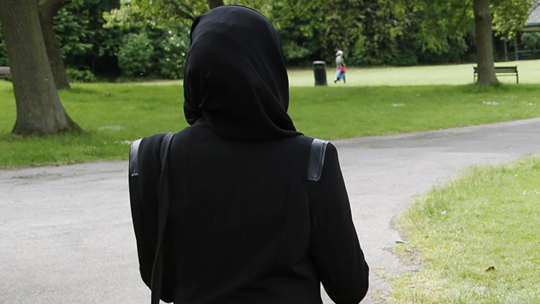
Shocking video appears of Hijab-clad woman abused in New Zealand

February 13, 2017

Melbourne, Feb 13: A Hijab-clad Muslim woman and her friends in New Zealand were targets of foul-mouthed racist comments at a rest stop with a woman yelling expletives and throwing beer cans at them.

Hijabclab

Mehpara Khan, 28, a communications consultant, and her four friends were returning to Auckland from a road trip when they stopped in Huntly to use the bathroom and were abused by a woman walking by.

Khan has posted a video on Twitter that shows another woman flinging cans of what appears to be alcohol at her and yelling expletive-laden abuse.

“All of a sudden this woman comes out of the bathroom and starts swearing at us and telling us that we don’t belong there and that we are Muslim b......, that need to F-off, basically,” Khan was quoted as saying by Nea Zealand Herald.

“She then threw a beer can at me and two at my two friends. I’m covered in beer - I feel disgusting,” Khan wrote.

“We weren’t doing anything, we didn’t actually even initially realise she was talking to us,” she said.

“Once she threw in the line of Muslim b-words that’s when we realised she was yelling at us,” she said.

“At this point I decided to start filming her.”

The 27-year-old woman who carried out the attack is shown in the recording ordering Khan and her friends to get back.

A police spokesman said they were “aware” of the video and a formal complaint had been laid.

“Police are assessing the information,” the spokesman said

Islamic Women’s Council’s spokeswoman Anjum Rahman said she was appalled, but not entirely surprised, by the abuse.

“A small number of New Zealanders behaved in that way. She would like to meet with the woman filmed swearing and hurling abuse to help change her attitude towards Muslims,” Rahman said.

However, Khan has received an outpouring of support after posting the video.

“Thanks everyone for your comments and support - this is so overwhelming. I’m still with the police - will try and respond once I’m done,” Khan tweeted.

“My phone is over run with positive messages right now. So good to know that we as Kiwis don’t accept this as our NZ,” she said.

Comments

Lloyd Dsouza
 - 
Wednesday, 15 Feb 2017

You are talking about Muslims in Newzealand , what about Christians in Saudi, Pakistan etc etc? Why their freedom is stopped by their Govt. Answer it 1st then poke out at others.

Zumbi Sasha
 - 
Monday, 13 Feb 2017

media should find out exact reason for her act..

Naren kotian
 - 
Monday, 13 Feb 2017

third rated people , shameless ... if there is no respect why go there ? why cannot u build a new world in islamic world . i see many from one particular community they are ready to do toilet cleaning job abroad ... why ? dont u have self respect ...islamaphobia is every where ... it is justiofied also , many burqa clas women hid suicide bombs and explode ...

Add new comment

  • Coastaldigest.com reserves the right to delete or block any comments.
  • Coastaldigset.com is not responsible for its readers’ comments.
  • Comments that are abusive, incendiary or irrelevant are strictly prohibited.
  • Please use a genuine email ID and provide your name to avoid reject.
News Network
July 8,2020

Bengaluru, Jul 8: The expert committee constituted by the Karnataka government to look into imparting online education in the wake of the COVID-19 lockdown submitted its report on Tuesday to the Minister for Primary and Secondary Education, S Suresh Kumar.

Amid growing pressure by educational institutions to allow them to run online classes for the students, the government set up the committee headed by noted educationist M K Sridhar.

The Minister told reporters that some schools wanted to run online classes, including for LKG and UKG students. It had also come to the government's notice that schools were reportedly charging hefty fees in the name of online teaching, he added.

"To address the concerns of parents, schools, and the future of the children, the committee was formed,"Kumar said. He further said that the government would study the recommendations and hold discussions with officials and various stakeholders before arriving at a decision.

The Education Department said that the committee, in its report, titled "Continuation of Learning in School Education of Karnataka: Guidelines During COVID-19 Pandemic for Technology Enabled Education and Beyond", has recommended teaching online or by using printed material. The committee suggested that children in the age group of three to six be taught online by way of story-telling, rhymes and games strictly in the presence of parents thrice a week just for one session a day For students from class one to three, it advised two periods a day and three days a week for online teaching.

Students from class three to five would have classes five days a week and two classes for 30 minutes a day. For students from class six to eight, there could be three classes a day for a duration of 30 minutes to 45 minutes each, while for students of class nine and 10 there would be four sessions a day between 30 and 45 minutes each.

The committee also suggested usage of Doordarshan and Akashwani for the government school children. Suresh Kumar said there were a few petitions filed in the Karnataka High Court regarding online teaching to the children.

Comments

Add new comment

  • Coastaldigest.com reserves the right to delete or block any comments.
  • Coastaldigset.com is not responsible for its readers’ comments.
  • Comments that are abusive, incendiary or irrelevant are strictly prohibited.
  • Please use a genuine email ID and provide your name to avoid reject.
Ram Puniyani
January 14,2020

In the beginning of January 2020 two very disturbing events were reported from Pakistan. One was the attack on Nankana Sahib, the holy shrine where Sant Guru Nanak was born. While one report said that the place has been desecrated, the other stated that it was a fight between two Muslim groups. Prime Minister of Pakistan Imran Khan condemned the incident and the main accused Imran Chisti was arrested. The matter related to abduction and conversion of a Sikh girl Jagjit Kaur, daughter of Pathi (One who reads Holy Guru Granth Sahib in Gurudwara) of the Gurudwara. In another incident one Sikh youth Ravinder Singh, who was out on shopping for his marriage, was shot dead in Peshawar.

While these condemnable attacks took place on the Sikh minority in Pakistan, BJP was quick enough to jump to state that it is events like this which justify the Citizenship Amendment Act (CAA). Incidentally CAA is the Act which is discriminatory and relates to citizenship with Religion, which is not as per the norms of Indian constitution. There are constant debates and propaganda that population of Hindus has come down drastically in Pakistan and Bangla Desh. Amit Shah, the Home minister stated that in Pakistan the population of Hindus has come down from 23% at the time of partition to 3.7% at present. And in Bangla Desh it has come down from 22% to present 8%.

While not denying the fact that the religious minorities are getting a rough deal in both these countries, the figures which are presented are totally off the mark. These figures don’t take into consideration the painful migrations, which took place at the time of partition and formation of Bangla Desh later. Pakistan census figures tell a different tale. Their first census was held in 1951. As per this census the overall percentage of Non Muslim in Pakistan (East and West together) was 14.2%, of this in West Pakistan (Now Pakistan) it was 3.44 and in Eat Pakistan it was 23.2. In the census held in Pakistan 1998 it became 3.72%. As far as Bangla Desh is concerned the share of Non Muslims has gone down from 23.2 (1951) to 9.6% in 2011.

The largest minority of Pakistan is Ahmadis, (https://minorityrights.org/country/pakistan/) who are close to 4 Million and are not recognised as Muslims in Pakistan. In Bangla Desh the major migrations of Hindus from Bangla Desh took place in the backdrop of Pakistan army’s atrocities in the then East Pakistan.

As far as UN data on refugees in India it went up by 17% between 2016-2019 and largest numbers were from Tibet and Sri Lanka.  (https://www.un.org/en/development/desa/population/migration/publication…)

The state of minorities is in a way the index of strength of democracy. Most South Asian Countries have not been able to sustain democratic values properly. In Pakistan, the Republic began with Jinnah’s classic speech where secularism was to be central credo of Pakistan. This 11th August speech was in a way what the state policy should be, as per which people of all faiths are free to practice their religion. Soon enough the logic of ‘Two Nation theory” and formation of Pakistan, a separate state for Muslim took over. Army stepped in and dictatorship was to reign there intermittently. Democratic elements were suppressed and the worst came when Zia Ul Haq Islamized the state in collusion with Maulanas. The army was already a strong presence in Pakistan. The popular formulation for Pakistan was that it is ruled by three A’s, Army, America and Allah (Mullah).

Bangla Desh had a different trajectory. Its very formation was a nail in the coffin of ‘two nation theory’; that religion can be the basis of a state. Bangla Desh did begin as a secular republic but communal forces and secular forces kept struggling for their dominance and in 1988 it also became Islamic republic. At another level Myanmar, in the grip of military dictatorship, with democratic elements trying to retain their presence is also seeing a hard battle. Democracy or not, the army and Sanghas (Buddhist Sang has) are strong, in Myanmar as well. The most visible result is persecution of Rohingya Muslims.

Similar phenomenon is dominating in Sri Lanka also where Budhhist Sanghas and army have strong say in the political affairs, irrespective of which Government is ruling. Muslim and Christian minorities are a big victim there, while Tamils (Hindus, Christians etc.) suffered the biggest damage as ethnic and religious minorities. India had the best prospect of democracy, pluralism and secularism flourishing here. The secular constitution, the outcome of India’s freedom struggle, the leadership of Gandhi and Nehru did ensure the rooting of democracy and secularism in a strong way.

India so far had best democratic credentials amongst all the south Asian countries. Despite that though the population of minorities rose mainly due to poverty and illiteracy, their overall marginalisation was order of the day, it went on worsening with the rise of communal forces, with communal forces resorting to identity issues, and indulging in propaganda against minorities.

While other South Asian countries should had followed India to focus more on infrastructure and political culture of liberalism, today India is following the footsteps of Pakistan. The retrograde march of India is most visible in the issues which have dominated the political space during last few years. Issues like Ram Temple, Ghar Wapasi, Love Jihad, Beef-Cow are now finding their peak in CAA.

India’s reversal towards a polity with religion’s identity dominating the political scene was nicely presented by the late Pakistani poetess Fahmida Riaz in her poem, Tum bhi Hum Jaise Nikle (You also turned out to be like us). While trying to resist communal forces has been an arduous task, it is becoming more difficult by the day. This phenomenon has been variously called, Fundamentalism, Communalism or religious nationalism among others. Surely it has nothing to do with the religion as practiced by the great Saint and Sufi traditions of India; it resorts mainly to political mobilization by using religion as a tool.


Comments

Ashi
 - 
Tuesday, 14 Jan 2020

If Malaysia implement similar NRC/CAA, India and China are the loser.

Add new comment

  • Coastaldigest.com reserves the right to delete or block any comments.
  • Coastaldigset.com is not responsible for its readers’ comments.
  • Comments that are abusive, incendiary or irrelevant are strictly prohibited.
  • Please use a genuine email ID and provide your name to avoid reject.
News Network
June 16,2020

Bengaluru, Jul 16: Karnataka chief minister BS Yediyurappa on Tuesday said he would request Prime Minister Narendra Modi for more relaxations, as he made it clear that Covid-19 lockdown measures were not required in the state anymore.

"The lockdown is not required for Karnataka, we will request for more relaxations," Yediyurappa said in response to a question about video conferencing with the Prime Minister.

Speaking to reporters here, he said, "I will request him (PM) to make way for- people to lead a normal life and for the improvement in the economic situation."

Several services such as metro, theatres, gyms, swimming pools, bars among others continue to remain restricted under unlock 1.0 that is currently in place.

Modi is scheduled to hold a video conference with chief ministers of various states on Tuesday and Wednesday. Yediyurappa is scheduled to take part in the video conferencing on Wednesday.

The chief minister, who took part in the special pooja organised at Shankar Math here to pray for the control of Covid-19, said, the government was making all efforts to control the spread.

"We are taking strong measures and all of us should fight this together," he said, as he highlighted that the government has released the financial assistance amount that was announced for farmers, and was ensuring that it reaches them.

Comments

Add new comment

  • Coastaldigest.com reserves the right to delete or block any comments.
  • Coastaldigset.com is not responsible for its readers’ comments.
  • Comments that are abusive, incendiary or irrelevant are strictly prohibited.
  • Please use a genuine email ID and provide your name to avoid reject.