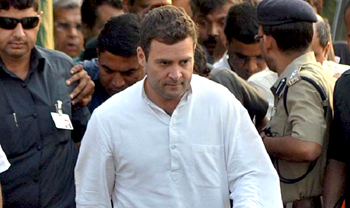
Shoe thrown at Rahul Gandhi during 'Kisan Yatra' in UP

September 26, 2016

New Delhi: Congress vice-president Rahul Gandhi on Monday faced ire from a local during a road show.

rahulA man hurled shoe at the Congress vice-president during a road show in Uttar Pradesh's Sitapur. The shoe missed the mark.

The man who hurled the shoe has been identified as Hari Om Mishra. He is a local journalist.

He has been detained by police.

Reportedly, the shoe attacker was upset with Rahul Gandhi's Kisan Yatra as he feels that the Congress vice-president is aware of ground reality and plight of farmers in Uttar Pradesh.

Kisan Yatra

Rahul Gandhi is on 'Kisan Yatra' in poll-bound Uttar Pradesh.

BJP had mocked Rahul Gandhi's Kisan Yatra, dismissing it as "seasonal expression of sympathy in the season of elections" and claimed that while states ruled by it have seen maximum agricultural growth, those by Congress were known for cases of "land-grab".

Comments

Alfred Dmello
 - 
Monday, 26 Sep 2016

All byri from mangalore will go and take those shoes back....and offer it

Add new comment

  • Coastaldigest.com reserves the right to delete or block any comments.
  • Coastaldigset.com is not responsible for its readers’ comments.
  • Comments that are abusive, incendiary or irrelevant are strictly prohibited.
  • Please use a genuine email ID and provide your name to avoid reject.
Agencies
July 20,2020

Kolkata, Jul 20: As many as 13 migrant workers who came to their native village in West Bengal's Bankura district were denied entry at the quarantine centre by the locals.

As a result, the workers had to set up a tent accommodation at a nearby Beraban forest area and lived together in a single tent there, without adequate food, drinking water and basic facilities.

The migrant labourers came from Rajasthan after four months of COVID-19 lockdown which was imposed nationwide on March 25 to contain the spread of coronavirus.

When they arrived at Jagadalla village in the Bankura district and tried to put up at a village school building for two weeks self-quarantine, angry villagers vehemently protested against their entry fearing Covid infections in their village.

Sources said that local police and panchayat members also failed to make the villagers understand the fact that if the labourers strictly stayed in self-quarantine there would be no chance of any further infection.

"The school is located quite within our neighbourhood. If they stay there and tested positive, they might spread Covid infections in the village. We cannot allow them to stay in the school building," said Aniket Goswami, a villager.

Comments

Add new comment

  • Coastaldigest.com reserves the right to delete or block any comments.
  • Coastaldigset.com is not responsible for its readers’ comments.
  • Comments that are abusive, incendiary or irrelevant are strictly prohibited.
  • Please use a genuine email ID and provide your name to avoid reject.
News Network
March 6,2020

New Delhi, Mar 6: Shares of YES Bank and State Bank of India came under huge selling pressure on Friday as developments unfolded regarding SBI picking stake in the private lender. Shares of the lender hit record low of Rs 5.55, plunging 85 per cent, and were trading below its previous low of Rs 8.16 hit on March 9, 2009.

SBI, on the other hand, slumped 11 per cent to Rs 257.35 on the BSE. The benchmark S&P BSE Sensex was trading with a cut of over 3 per cent at 37,251.37 level.

In the past three months, share price of the private lender has plunged 41 per cent, while the state-owned lender has slipped 14 per cent. In comparison, the S&P BSE Sensex has dipped 5.6 per cent till Thursday.

On Thursday, the Reserve Bank of India superseded the board of troubled private sector lender YES Bank and imposed a 30-day moratorium on it “in the absence of a credible revival plan” amid a “serious deterioration” in its financial health.

During the moratorium, which came into effect from 6 pm on Thursday, YES Bank will not be allowed to grant or renew any loans, and “incur any liability”, except for payment towards employees’ salaries, rent, taxes and legal expenses, among others.

This is the first time that a bank of this size will be put under a moratorium by the RBI.

“The financial position of YES Bank had undergone a steady decline “largely due to inability of the bank to raise capital to address potential loan losses and resultant downgrades, triggering invocation of bond covenants by investors, and withdrawal of deposits,” RBI said in a statement.

“After the moratorium, the next step will be to infuse to money and keep the bank afloat. So from shareholders’ point of view, the future is certainly hazy as the capital requirement is huge. The good part, however, is that the RBI has stepped in and depositors don't have to worry,” says Siddharth Purohit, a research analyst at SMC Securities.

Meanwhile, analysts at Nomura believe that placing the Bank under moratorium implies that equity value in the bank would be negligible, and that the chances of private capital participating in future capital raising plan are near zero.

"Any resolution for Yes Bank is more proposed from the perspective of deposit holders and systemic stability, and not from the perspective of Yes Bank equity investors or even perpetual bond holders," they wrote in a note dated March 6.

In another development, SBI’s Board Thursday gave in-principle approval to consider an “investment opportunity” in YES Bank, even as it said “no decision had yet been taken to pick up stake in the bank”.

According to a  report, highly-placed sources indicated a rescue plan involving SBI and Life Insurance Corporation of India (LIC) was being discussed and an announcement in this regard might be made soon.

“While the finer details of the deal are being worked out, it is anticipated that both SBI and LIC together will take a 51 per cent stake in the bank, with a one-year lock-in period,” the report said.

Most analysts believe it is a positive step for the Indian financial sector as the government has tried to avoid a repeat of IL&FS-like crisis.

“The move is a positive step for the financial sector as a whole. By this, the government has tried to avoid a repeat of IL&FS-like crisis and has saved the depositors,” said AK Prabhakar, Head of Research at IDBI Capital. While we know that YES Bank has a huge pile of bad loans, SBI is the only bank that has the capacity to absorb it, he added.

However, the valuation at which YES bank would be taken over remains a cause of concern.

Global brokerage firm JP Morgan Thursday cut its target price for YES Bank on Thursday to Rs 1 per share, taking into account the potential fall in the lender’s net worth due to stressed assets.

“We believe forced bailout investors will likely want the bank to be acquired at near-zero value to account for risks associated with the stress book and likely loss of deposits. We think the bank will need to be recapitalised at nominal equity value and could test dilution of additional tier 1 (AT1) capital. We remain underweight and cut our target price to Rs 1 as we believe net worth is largely impaired,” JP Morgan said in a note.

Global brokerage firm Nomura estimates a need of Rs 25,000-44,000 crore and adjusted for Rs 7,400 crore of current coverage, if the current stress of Rs 65,000-70,000 crore faces 70 per cent loss given default (LGD).

"It implies Rs 18,000-37,000 crore needed for provisioning against the current net worth of Rs 25,700 crore Also, to run as going concern, the bank would require over Rs 20,000 crore of CET-1 capital as well," the note said.

YES Bank has registered slippages of Rs 12,000 crore so far in FY20, while it has placed Rs 30,000 crore of loan assets under the watch list. Its deposits stood at Rs 2.09 trillion on September 30, 2019, while its advances totalled Rs 2.24 trillion. The bank has delayed publishing its December quarter results by a month to March 14.


Comments

Add new comment

  • Coastaldigest.com reserves the right to delete or block any comments.
  • Coastaldigset.com is not responsible for its readers’ comments.
  • Comments that are abusive, incendiary or irrelevant are strictly prohibited.
  • Please use a genuine email ID and provide your name to avoid reject.
News Network
January 12,2020

New Delhi, Jan 12: As many as 109 children were sexually abused every day in India in 2018, according to the data by the National Crime Records Bureau, which showed a 22 per cent jump in such cases from the previous year.

According to the recently released NCRB data, 32,608 cases were reported in 2017 while 39,827 cases were reported in 2018 under the Protection of Children from Sexual Offences Act (POCSO).

POCSO Act, 2012 is a comprehensive law to provide for the protection of children from offences of sexual assault, sexual harassment and pornography. It requires special treatment of cases relating to child sexual abuse such as setting-up of special courts, special prosecutors, and support persons for child victims.

As many as 21,605 child rapes were recorded in 2018 which included 21,401 rapes of girls and 204 of boys, the data showed.

The highest number of child rapes were recorded in Maharashtra at 2,832 followed by Uttar Pradesh at 2023 and Tamil Nadu at 1457, the data showed.

Overall crimes against children has increased steeply over six times in the decade over 2008-2018, from 22,500 cases recorded in 2008 to 1,41,764 cases in 2018, according to the NCRB data from 2008 and 2018.

In 2017, 1,29,032 cases of crime against children were recorded.

Priti Mahara, Director of Policy Research and Advocacy at CRY – Child Rights and You (CRY) said, that while on the one hand, the increasing numbers of crimes against children are extremely alarming, it also suggests an increasing trend in reporting which is a positive sign as it reflects people's faith in the system.

"It also provides a direction in which government interventions must be made and evidence needs to be created. While some major efforts have been taken to ensure child protection, a lot more is needed to see expected results on the ground," Mahara said.

In percentage terms, major crime against children during 2018 were kidnapping and abduction which accounted for 44.2 per cent followed by cases under POCSO, which accounted for 34.7 per cent, the data showed.

A total of 67,134 children (19,784 male,47,191 female and 159 transgender) were reported missing in 2018. During the year 2018, a total of 71,176 children (22,239 male, 48,787 female and 150 transgender) were traced, the NCRB data said.

As many as 781 cases of use of child for pornography or storing child pornography material was also recorded in 2018, more than double that of  2017 when 331 such cases were recorded, the data showed.

The state-wise segregation of crimes against children reveals Uttar Pradesh, Madhya Pradesh, Maharashtra, Delhi and Bihar accounted for 51 per cent of all crimes in the country, the data said.

While Uttar Pradesh tops the list with 19,936 recorded crimes against children (14 per cent of total crimes), Madhya Pradesh and Maharashtra are the close second and third with 18,992 and 18,892 crimes registered respectively.

The report also showed that cases of sexual harassment in shelter homes against women and children reportedly increased by 30 per cent, from 544 cases recorded in 2017 to 707 cases in 2018.

Mahara suggested that financial investments must be adequately increased with a focus on prevention of crimes against children and the identification of vulnerable children and families.

"Strengthening community-level child protection system is also a key to prevention. While there is growing evidence of the precarious lives that children in India are leading, it is essential that this evidence is used to effectively inform policy and programme initiatives," she said.

As many as 501 incidences were also recorded under The Prohibition of Child Marriage Act, a 26 per cent jump from 2017 when 395 cases were reported under the Act.

Comments

Add new comment

  • Coastaldigest.com reserves the right to delete or block any comments.
  • Coastaldigset.com is not responsible for its readers’ comments.
  • Comments that are abusive, incendiary or irrelevant are strictly prohibited.
  • Please use a genuine email ID and provide your name to avoid reject.