


Shortage of staff leaves Udupi RTO lame

[email protected] (Abhijith D)
June 3, 2013
Udupi, Jun 3: Manpower crunch is faced by almost every sector and government departments are no exception. Udupi district has witnessed commendable progress over the last few years and if one looks at the revenue of RTO, then it is easier to imagine the growth that the region has experienced.

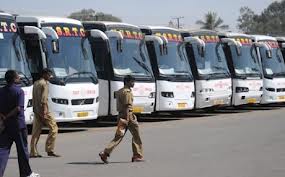
ksrtcThe Regional Transport Office, which had  revenue of Rs 3 crore way back in 1984 today has a revenue of Rs 90 crores.  However, the startling fact is that the department earning such huge income has only 8 officials for the district. The number of employees sanctioned by the government about 30 years ago has been faithfully maintained till date, without taking into consideration the quantum jump in revenue and number of vehicles in the region.

The result is that the existing handful of employees has been overtly burden. There are 2.50 lakh vehicles estimated to be plying in the RTO limits here. Large section of these vehicle owners frequent to the RTO for issue of license, renewal of license or various other reasons. Due to scarcity of manpower the vehicle owners are either sent back to return after a few days or they are made to wait in the pipeline for several months. The employees here are undoubtedly unable to handle pressure.

Vacancies

Though the RTO has been given a spacious office at Rajathadri in Manipal, when it comes to number of persons working in the department, the office looks way larger than what was needed.

One of the most important posts, the post of Assistant RTO itself is lying vacant since several years. While a Regional Transport Officer has been working, there are three sanctioned posts for Senior Inspector of Motor Vehicles, out of which only one post has been filled.

There are three posts of Office Superintendents, out of which two are lying vacant. Two posts of second division clerks are yet to be filled. Posts of one stenographer and one typist are vacant. One post of driver is lying vacant.

Density of vehicles

According to data available with the department there are 2,48,875 vehciles registered in Udupi. On an average 50 to 60 two-wheelers are registered every day. Amidst the pressure of performing various responsibilities in the office, the staffs are expected to hold camp every Tuesday at Kundapur and every Thursday at Karkala. Every third Saturday the camp is held at Padubidri where the officials have to be present without fail. Everyday 250-300 applicants for new license are to be tested on various yardsticks by the officials concerned. Due to this three inspectors have to be in Udupi throughout the day. The RTO officials are working 16 hours a day.

Kundapur office

It is said that 60 per cent of the department's income comes from Kundapur taluk. Further, the officials of the department are available here only on Tuesday. Hence the vehicle owners of Kundapur, Byndoor, Kollur and nearby areas have to depend on Udupi invariably. The locals have floated a demand to start a sub office in Kundapur.

Comments

sandeep
 - 
Thursday, 21 Apr 2016

i have a diploma in computer science and completed six month course of hardware maintenance & networking technologies.
also worked as data card machine operator for 10 months at manipal cards & technologies, contact 9845054361

Add new comment

  • Coastaldigest.com reserves the right to delete or block any comments.
  • Coastaldigset.com is not responsible for its readers’ comments.
  • Comments that are abusive, incendiary or irrelevant are strictly prohibited.
  • Please use a genuine email ID and provide your name to avoid reject.
News Network
July 17,2020

Bengaluru, Jul 17: The Karnataka State Board of AUQAF has ordered that management committees at Muslim Khabarastans, shall not refuse burial to Muslims died due to COVID-19.

"...in exercise the powers conferred under Waqf Act 1995, it is hereby ordered that management Committees/Muthawallies/Administrators responsible for the management of Muslim Khabarastans in the state of Karnataka irrespective of registered or unregistered in the Waqf, shall not refuse the burial of Muslims died due to COVID-19 pandemic," read an order from the Karnataka State Board of AUQAF on Thursday.

"They shall co-operate with all the Nodal Officers designated for this purpose regarding the decent burial. Non co-operation or refusal on the part of the management will be construed as an insult committed to the deceased. Any violation of the above order will attract the punitive provision of Indian Penal Code and removal from the management as per the provisions of the Waqf Act 1995," the order read.

It further said that the Waqf Officers, District Wakf Advisory Committees of the state, shall ensure the adherence of this order, and circulate the same to all the Khabarastan managements, registered or unregistered in the state.

"No further deliberation in this regard is solicited except compliance of the order in letter and spirit. Any dereliction in this regard will be viewed seriously," it read.

Giving a background on the issue of burial of COVID-19 deceased, the order read, "It is observed that, number of deaths are being occurred in various Districts of Karnataka, due to COVID-19 pandemic and it is reported that, some of the management committees of Khabarastan, are not cooperating to bury the dead bodies of COVID-19."

"A decent burial is a right of the dead person" as per the law of the land and the Islamic jurisprudence. It is needless to emphasize the importance of burial of Muslim dead bodies in Shariah. The dead body of a Muslim is treated with the utmost respect by the Ummah, joining in the funeral (Tadfeen), participating in the Namaz-e-Janaza and the burial are considered as Farz-e-Kifaya in Muslim law. According to the tradition of Islam, the person who participates in the funeral is entitled to Mountain sized reward (Sawaab)," the order read.

As per the order, the board, in its earlier circular had also cautioned the management of Waqf institutions and Khabarastan which were reluctant to allow the decent burial in the Khabarastan would be punished under the provisions of Indian Penal Code and the punitive provisions of the Waqf Act 1995 as well.

"The District Magistrates and the Superintendent of Police in the districts have been requested to prosecute the erring management committees who are responsible for non co-operation in this regard. Hence, the following order," it added.

Comments

Add new comment

  • Coastaldigest.com reserves the right to delete or block any comments.
  • Coastaldigset.com is not responsible for its readers’ comments.
  • Comments that are abusive, incendiary or irrelevant are strictly prohibited.
  • Please use a genuine email ID and provide your name to avoid reject.
coastaldigest.com web desk
June 14,2020

Benglauru, June 14: Even as schools are divided over providing online education, the state Higher Education Department is stressing on continuing online education.

Deputy Chief Minister and Higher Education Minister Dr C N Ashwath Narayan has stressed the need for digital learning to eliminate educational inequalities.

Taking part in a Webinar on ‘Digitising Higher Education - Challenges and Opportunities,’ organised by the Padmashree Institute of Management, he asked educational institutions to give emphasis to digital learning.

“Digital learning is a means to ensure quality education to all sections of the society without discrimination on the basis of caste, region and religion. This is a solution to eliminate discrimination. Through digital learning, a student in a remote village will also get an opportunity to learn from an experienced and highly qualified teacher.”

In addition to this, students are getting study material in digital form. Keeping these important aspects in mind, all educational institutions should give stress to digital learning without wasting any time,’’ he said.

He, however, admitted that digital learning has its own challenges like - quality internet connectivity, laptops and mobile gadgets.

“We are trying to find a solution to it by raising funds through Corporate Social Responsibility or through government funds,” he said. “We are making efforts to provide 4G network across the State,” he said.

Comments

Add new comment

  • Coastaldigest.com reserves the right to delete or block any comments.
  • Coastaldigset.com is not responsible for its readers’ comments.
  • Comments that are abusive, incendiary or irrelevant are strictly prohibited.
  • Please use a genuine email ID and provide your name to avoid reject.
News Network
February 21,2020

Bengaluru, Feb 21: The Supreme Court in its interim order on Thursday allowed the plea of the Karnataka government for implementation of the final award by a tribunal for sharing of water between Goa, Karnataka and Maharashtra from the Mahadayi river.

The interim order was passed by a bench comprising Justice D Y Chandrachud and Justice Hemant Gupta after hearing the counsel from the three states. The bench said the final hearing in the matter will take place in July.

It also said the interim order is subject to the final outcome of the petitions filed by the three states against the tribunal's award.

The Mahadayi Water Dispute tribunal had passed the order on August 14, 2018, allocating 13.42 TMC ( Thousand Million Cubic Feet.) water (including 3.9 TMC for diversion into the depleted Malaprabha river basin) from the Mahadayi river basin to Karnataka.

Maharashtra was allotted 1.33 TMC water while Goa was given 24 TMC in the final decision of the tribunal. The UPA-2 government had constituted Mahadayi Water Disputes Tribunal in 2010.

Karnataka government, which has locked horns with the neighbouring Goa on the larger issue of sharing Mahadayi River water between both the states, had petitioned the tribunal seeking the release of 7.56 tmcft of water for the Kalasa-Banduri Nala project.

The Kalasa-Banduri Nala (diversion) project, which will utilise 7.56 tmcft of water from the inter-state Mahadayi river, is being undertaken by Karnataka to improve drinking water supply to the twin cities of Hubballi-Dharwad and the districts of Belagavi and Gadag.

It involves building barrages across Kalasa and Banduri, the tributaries of the Mahadayi River, to divert 7.56 tmc water to the Malaprabha river which fulfils the drinking water needs of the twin cities.

Comments

Add new comment

  • Coastaldigest.com reserves the right to delete or block any comments.
  • Coastaldigset.com is not responsible for its readers’ comments.
  • Comments that are abusive, incendiary or irrelevant are strictly prohibited.
  • Please use a genuine email ID and provide your name to avoid reject.