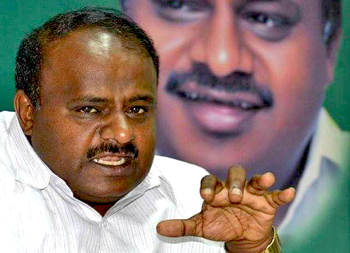
Siddaramaiah was blind to communal tension in DK: HDK

DHNS
July 12, 2017

Bengaluru, Jul 12: JD(S) leader H D Kumaraswamy on Tuesday accused Chief Minister Siddaramaiah of turning a blind eye to the communal tension in Dakshina

Kannada district for the past two months and asked him to clamp down on those who stir violence in society.HDK

“The chief minister gets daily briefing on the law and order situation from the Intelligence department. Situation has been tense in Dakshina Kannada for the past two months. Had the chief minister taken appropriate measures well in advance, the situation would not have turned bad to worse in the district,” Kumaraswamy said on Tuesday.

Siddaramaiah appears to have realised the seriousness of the situation only on Monday. He held a meeting with the police officers for the first time. Instead of directing them to act against those who try to stoke communal violence, he has asked the police to take action against communal forces. All those who speak against Siddaramaiah will now be targeted on the pretext of curbing communal forces, he said.

Kumaraswamy said the two national parties, the Congress and the BJP, were trying to take political mileage out of the situation in Dakshina Kannada. “It looks like the two parties are playing 20:20 cricket match in the district. And the match is fixed...Instead of taking measures to restore peace, leaders of the two parties are instigating people to indulge in violence,” he stated.

The JD(S) will soon take out a peace march from Mangaluru to Kalladka and a peace meeting will be held in the district, he added.

Comments

Add new comment

  • Coastaldigest.com reserves the right to delete or block any comments.
  • Coastaldigset.com is not responsible for its readers’ comments.
  • Comments that are abusive, incendiary or irrelevant are strictly prohibited.
  • Please use a genuine email ID and provide your name to avoid reject.
News Network
May 10,2020

Mangaluru, May 10: A special train carrying 1,140 migrant workers stranded here in the lockdown has left Mangaluru railway station for Jharkhand.

Dakshina Kannada MP Nalin Kumar Kateel and Vedavyas Kamath, MLA, were present at the railway station on Saturday night when the train left.

Kamath said the workers who had registered on the state governments Seva Sindhu portal were brought to the railway station in Karnataka State Road Transport Corporation buses.

A health check-up was carried out before they boarded the train.

The district administration also provided food packets and water to the migrants at the station.

Three more trains will leave from Mangaluru for Uttar Pradesh, Bihar, and Jharkhand soon, he said.

Meanwhile, in a statement, Dakshina Kannada Deputy Commissioner Sindhu P Rupesh said train services are being arranged for migrant workers who have registered their names on the Seva Sindhu portal.

The workers will be informed when trains are arranged to their destinations and they need not throng the railway station unnecessarily, she said.

Around 20,000 workers have so far registered themselves online, including 5,000 from Jharkhand, 3,000 from Uttar Pradesh and 4,000 from Bihar.

Hundreds of migrant workers had on Friday staged a protest at the central railway station here, demanding that they be sent back home.

The workers went back to their camps only after district authorities and police gave them assurance that trains will be arranged in three days.

Comments

Add new comment

  • Coastaldigest.com reserves the right to delete or block any comments.
  • Coastaldigset.com is not responsible for its readers’ comments.
  • Comments that are abusive, incendiary or irrelevant are strictly prohibited.
  • Please use a genuine email ID and provide your name to avoid reject.
coastaldigest.com news network
May 13,2020

Mangaluru, May 13: Coastal district of Dakshina Kannada today reported a fresh covid-19 positive case. According to sources, this case also linked to Manglauru’s First Neuro Hospital, which has emerged as the corona hub of coastal Karnataka.

Health and Family Welfare department in its today’s bulletin revealed that a 38-year-old woman from Darandabagilu near Someshwara in Mangaluru taluk of Dakshina Kannada was tested coronavirus positive.

It is said that the woman was in touch with P-507, an octogenarian, who was being treated for neurological issues at First Neuro Hospital.

With this the total number of coronavirus positive cases reported in Dakshina Kannada rose to 34. Among them only 26 are residents of Dakshina Kannada. Four are from Kasaragod, three from Udupi and one from Bhatkal.

Among 34, currently there only 17 active cases. The condition of two among them is said to be critical.

Comments

Add new comment

  • Coastaldigest.com reserves the right to delete or block any comments.
  • Coastaldigset.com is not responsible for its readers’ comments.
  • Comments that are abusive, incendiary or irrelevant are strictly prohibited.
  • Please use a genuine email ID and provide your name to avoid reject.
Agencies
May 8,2020

Washington D.C., May 8: The prime time for brain development in a child's life is the first year, where the infant spends most of the time asleep. It is the time when neural connections form and sensory memories are encoded.

However, when sleep is disrupted, as occurs more often among children with autism, brain development may be affected, too.

New research led by the University of Washington finds that sleep problems in a baby's first 12 months may not only precede an autism diagnosis but also may be associated with altered growth trajectory in a key part of the brain, the hippocampus.

The study, which was published in the American Journal of Psychiatry, researchers report that in a sample of more than 400 taken of 6- to 12-month-old infants, those who were later diagnosed with autism were more likely to have had difficulty falling asleep.

It also states that this sleep difficulty was associated with altered growth trajectories in the hippocampus.

"The hippocampus is critical for learning and memory, and changes in the size of the hippocampus have been associated with poor sleep in adults and older children.

As many as 80 per cent of the children with autism spectrum disorder have sleep problems," said Annette Estes, director of the UW Autism Center and senior author of the study.

"In our clinical experience, parents have a lot of concerns about their children's sleep, and in our work on early autism intervention, we observed that sleep problems were holding children and families back," added Estes, who is also a UW professor of speech and hearing sciences.

"It could be that altered sleep is part-and-parcel of autism for some children. One clue is that behavioural interventions to improve sleep don't work for all children with autism, even when their parents are doing everything just right. This suggests that there may be a biological component to sleep problems for some children with autism," said Estes.

To consider links among sleep, brain development, and autism, researchers at the IBIS Network looked at MRI scans of 432 infants, surveyed parents about sleep patterns, and measured cognitive functioning using a standardized assessment.

At the outset of the study, infants were classified according to their risk for developing autism: Those who were at higher risk of developing autism -- about two-thirds of the study sample -- had an older sibling who had already been diagnosed.

Infant siblings of children with autism have a 20 per cent chance of developing autism spectrum disorder -- a much higher risk than children in the general population.

In the current study, 127 of the 432 infants were identified as "low risk" at the time the MRI scans were taken because they had no family history of autism.

They later evaluated all the participants at 24 months of age to determine whether they had developed autism. Of the roughly 300 children originally considered "high familial risk," 71 were diagnosed with autism spectrum disorder at that age.

Problems with sleep were more common among the infants later diagnosed with an autism spectrum disorder, as were larger hippocampi. No other subcortical brain structures were affected, including the amygdala, which is responsible for certain emotions and aspects of memory, or the thalamus, a signal transmitter from the spinal cord to the cerebral cortex.

The authors note that while parents reported more sleep difficulties among infants who developed autism compared to those who did not, the differences were very subtle and only observed when looking at group averages across hundreds of infants.

Sleep patterns in the first years of life change rapidly as infants transition from sleeping around the clock to a more adult-like sleep/wake cycle. Until further research is completed, Estes said, it is not possible to interpret challenges with sleep as an early sign of increased risk for autism.


Comments

Add new comment

  • Coastaldigest.com reserves the right to delete or block any comments.
  • Coastaldigset.com is not responsible for its readers’ comments.
  • Comments that are abusive, incendiary or irrelevant are strictly prohibited.
  • Please use a genuine email ID and provide your name to avoid reject.