



Siddaramaiah?defends move to denotify parts of NHs to save liquor shops

June 9, 2017

Bengaluru, Jun 9: Chief Minister Siddaramaiah on Thursday strongly defended his government's move to denotify some stretches of national highways passing through urban local bodies in the state, saying that it is aimed at saving jobs of hundreds of people who are dependent on liquor stores.siddu
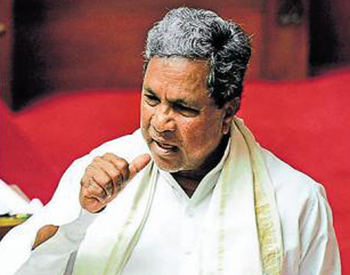
Replying to Pranesh and M?B?Bhanuprakash (BJP) in the Legislative Council, he denied accusation by the BJP members that the government is planning to circumvent the Supreme Court order to close down liquor shops along National Highways (NHs). “We have already issued notices to owners of liquor shops along NHs and asked them to close down the shops by June 30 this year, as per the Supreme Court order,” he stated.

“We have no intention to circumvent the Supreme Court order. All stretches of national highways passing through urban local bodies (ULBs) are being maintained by the respective ULBs. Hence, the government has decided to recommend to the Centre to denotify these stretches and declare them as local roads. Once it is done, jobs of a lot of people will be saved,” he stated, adding that the government has already filed a review petition in this regard.

The chief minister said that about 6,015 liquor shops are located along 858 km of national highways and state highways in the state.

V S Ugrappa (Congress) warned that the government's move amounts to defying the Constitution of India.

The Constitution says that any order given by the Supreme Court is the law of the land. So, the government should think twice before recommending to the Centre to denotify certain stretches of NHs.

The government will have a bitter experience if it goes ahead with its decision, he cautioned. The chief minister, however, reiterated that the move is not aimed at circumventing the apex court order. The BJP members said saving liquor shops will lead to harassment of women, especially in rural areas. Many of the states have already imposed prohibition. Karnataka government should follow suit, they demanded.

Siddaramaiah said it is not feasible to impose prohibition. Though the Gujarat government imposed prohibition over a decade ago, liquor is still being sold illegally in many places in that state. Prohibition will not only lead to illegal sale of liquor but also causes revenue loss to the government. But, the government is not encouraging people to consume liquor, he added.

The BJP members staged a walkout as they were not satisfied with the chief minister's reply.

Comments

Add new comment

  • Coastaldigest.com reserves the right to delete or block any comments.
  • Coastaldigset.com is not responsible for its readers’ comments.
  • Comments that are abusive, incendiary or irrelevant are strictly prohibited.
  • Please use a genuine email ID and provide your name to avoid reject.
News Network
July 23,2020

Bengaluru, Jul 23: The Siddi community in Karnataka got its first lawmaker as Governor Vajubhai Vala nominated five persons, including Shantharama Budna Siddi, to the Karnataka Legislative Council on Wednesday.

Shantharama Siddi had been working as a social worker and was a post holder at the Vanavasi Kalyan Prakalpa, a tribal welfare initiative of the Rashtriya Swayamsevak Sangh (RSS).

The Siddis, an ethnic group in India, are said to have descended from the people of the East African region. They are included in the list of Scheduled Tribes (ST) in Karnataka.

Apart from the Shantharama, the inclusion of CP Yogishwar, who had left Congress to join BJP in 2017 but failed to retain his seat in the 2018 Assembly polls, is also considered as a big decision.

Adagur H Vishwanath, another former JDS leader, who had quit his party and joined BJP but failed to retain his seat has also caught the attention of the people.

Further, Governor Vala has nominated Talwar Sabanna and Bharathi Shetty to the Upper House in the state.

Comments

Add new comment

  • Coastaldigest.com reserves the right to delete or block any comments.
  • Coastaldigset.com is not responsible for its readers’ comments.
  • Comments that are abusive, incendiary or irrelevant are strictly prohibited.
  • Please use a genuine email ID and provide your name to avoid reject.
News Network
May 19,2020

Bengaluru, May 19: Containment zones in Karnataka will be much smaller in size under the latest lockdown norms. However, rules and loopholes will be tightened and action against violators will be stringent in order to check the spread of the disease.

Revised guidelines issued by the Centre to the state, reveal containment zones are delineated based on mapping of cases and contacts. Intensive action will be carried out in these areas with the aim of breaking the chain of transmission. Therefore, the area of a containment zone should be appropriately defined by the district administration/local urban bodies with technical inputs at local level.

The health department is considering shrinking the size of containment zones from the existing 100 metres to open up more space for economic activities. Medical education minister K Sudhakar, also a member of the Covid taskforce, said additional chief secretary (health department) Javed Akthar will issue a new definition of a containment zone after the Covid-19 taskforce holds its next meeting.

“We are planning to further shrink it and restrict containment zones to an apartment complex, independent house or even a lane where the Covid-19 patient resides,” Sudhakar said. He went on to say bigger containment zones will impede businesses and normal activities in the vicinity, something which the government wants to avoid.

The minister said Karnataka will also do away with colour-coding districts. “With restrictions being relaxed for almost all activities, it does not make sense to pursue with colour codes. It is either containment zone or outside containment zone,” he said.

In rural areas, the minister said containment zones will be identified by the taluk heads. Government sources say it is difficult to restrict activities to certain areas or smaller location in rural areas as farmers and people will have to travel to the outskirts of their villages for their livelihood.

An official said, a containment operation (large outbreak or cluster) is deemed successful when no case is reported in 28 days from the containment zone.

Comments

Add new comment

  • Coastaldigest.com reserves the right to delete or block any comments.
  • Coastaldigset.com is not responsible for its readers’ comments.
  • Comments that are abusive, incendiary or irrelevant are strictly prohibited.
  • Please use a genuine email ID and provide your name to avoid reject.
Agencies
January 19,2020

Bengaluru, Jan 19: Technology hub Hyderabad has edged out 129 other cities in the world to emerge as the world's most dynamic city, according to the seventh edition of the City Momentum Index by global real estate services firm JLL.

The city has pushed Bengaluru to second place to regain the top position after a gap of one year. Chennai is at fifth and Delhi is at sixth place.

While Hyderabad and Bengaluru are the top two cities globally for socio-economic momentum, a more active real estate market helped elevate Hyderabad to first position in the overall ranking, says the report released by the US-based Jones Lang Lasalle (JLL) on Saturday night.

Hyderabad recorded the highest office net absorption in 2019 (as a proportion of existing stock) of any city globally, while it is also among the world's best-performing cities for prime office rental growth.

While all seven major Indian cities feature in this year's Global Top 20, cities in south India in particular - Hyderabad, Bengaluru and Chennai (5th) "are ahead of their northern peers, supported by favourable demographics and business climates".

"Their expanding tech industries and start-up cultures make them a magnet for young and ambitious talent from across the country, with Bengaluru having one of the world's largest concentrations of 'engine room' population (20-40-year-olds), typically the most dynamic and productive age cohort," says the report.

Kolkata and Mumbai made it to the top 20 and stood at the 16th and 20th positions. Despite an economic slowdown, India leads the 2020 Index with seven Indian cities in the top 20.

"Commercial real estate in south Indian cities is growing at a rapid pace. Hyderabad has seen tremendous growth in 2019 in line with that of Bengaluru. The city has actively embraced technology-driven economic growth and attracted large tech giants and e-commerce players. The state government's focus on business-friendly policies and provision of high-quality infrastructure along with availability of quality talent pool and superior quality business parks has given Hyderabad a competitive edge," said Ramesh Nair, CEO and Country Head - India, JLL.

Telangana's Minister for Information Technology and Industry K T Rama Rao said he was thrilled over Hyderabad not only regaining the top slot but also over the fact that it was competing with cities like Shenzhen and Shanghai in innovation economy.

The minister said 50 percent weightage from socio-economic indicators beside the remaining 50 percent from commercial and real estate was also heartening.

KTR, as the minister is popularly known, noted that in 2014 when Telangana attained statehood, Hyderabad was not even in the list. He recalled that when Telangana was formed there were many doubts as to what would happen to Hyderabad. "It entered the top 20 in 2015 and rose to fifth place in 2016 and third position in 2017. Hyderabad topped the list in 2018 and finished second the last year. This year it is back at the top," he said.

The JLL City Momentum Index identifies a number of key growth drivers, including talent attraction, the expansion of innovation hubs and better urban planning, that cities can employ to meet the challenges faced by rapid momentum.

Several cities in the top 20 stand out as they transform their urban environments in pursuit of a low-carbon future. In India, Hyderabad is looking at technology to reduce the demand for air conditioning with cool roofs that reflect sunlight and absorb less heat, it said.

"The growth of "micro-mobility" is another positive step, illustrated by Hyderabad's introduction of smart bikes and electric cars. Smart city solutions, such as bike rentals, improved quality of life, help increase inclusion and aid in the transition to a low carbon environment."

Comments

Add new comment

  • Coastaldigest.com reserves the right to delete or block any comments.
  • Coastaldigset.com is not responsible for its readers’ comments.
  • Comments that are abusive, incendiary or irrelevant are strictly prohibited.
  • Please use a genuine email ID and provide your name to avoid reject.