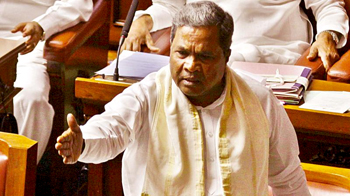
Siddu goes belligerent, says BJP targeting Muslim, Christian ministers

July 12, 2016

Bengaluru, Jul 12: Chief Minister Siddaramaiah on Monday accused the Opposition BJP of targeting ministers belonging to minority communities. “The BJP's agenda is to target minorities. You (BJP members) have been targeting K J George (Bengaluru Development Minister), Roshan Baig (Urban Development Minister) and Qamar-ul-Islam (former minister). You are anti-minorities,” he said in the Legislative Assembly, countering the BJP's demand for George's resignation following the suicide of DySP M K Ganapathi.

siddaramaiahThe chief minister insisted that George had nothing to do with the suicide, and said the BJP did not have the moral right to seek the resignation of any minister.

Siddaramaiah's belligerent reply came after Leader of Opposition Jagadish Shettar called him “arrogant”.

In 2013, the chief minister had reportedly defended the suspension of police inspector G N Mohan who had registered a case against Siddaramaiah's son.

Mohan, during his posting in Mysuru, had lodged a case against Siddaramaiah's son Rakesh during the 2013 Assembly elections.

The officer was suspended and later given a non-executive posting in Karwar. “The chief minister defended his son while speaking to the media. He asked if he should keep quiet if somebody troubles his son,” Shettar said, quoting media reports.

Siddaramaiah replied, “My statement has been twisted. He (Mohan) had filed a case against my son though he was not involved. It was a false case. So we took action against him.”

CM arrogant'

Shettar hit back, saying that it showed the chief minister' “arrogance”. Shettar also accused Siddaramaiah of “shielding” his aide K Marigowda who is accused of abusing Mysuru Deputy Commissioner C Shikha.

He said the government “failed” to arrest Marigowda. The chief minister is protecting him, so police are reluctant to arrest him, Shettar suggested. The Marigowda issue was also discussed in the Legislative Council.

Comments

Bori Basawa, Dubai
 - 
Tuesday, 12 Jul 2016

Election stunt... dont believe siddu toooo.

Add new comment

  • Coastaldigest.com reserves the right to delete or block any comments.
  • Coastaldigset.com is not responsible for its readers’ comments.
  • Comments that are abusive, incendiary or irrelevant are strictly prohibited.
  • Please use a genuine email ID and provide your name to avoid reject.
coastaldigest.com news network
March 27,2020

Mangaluru, Mar 27: In a shocking development, an infant with no travel history tests positive for the deadly novel coronavirus in Dakshina Kannada, taking the total coronavirus positive cases to six. 

The 10-month-old child, hailing from Sajipanadu Village in Bantwal Taluk was admitted to a hospital at Deralakatte in Mangaluru for treatment on March 23 as it had developed respiratory problems. 

On March 24, the child’s condition worsened and hence his throat swabs was sent for COVID-19 testing. Today, reports of the tests confirmed that the child was infected with COVID-19.

Comments

Add new comment

  • Coastaldigest.com reserves the right to delete or block any comments.
  • Coastaldigset.com is not responsible for its readers’ comments.
  • Comments that are abusive, incendiary or irrelevant are strictly prohibited.
  • Please use a genuine email ID and provide your name to avoid reject.
News Network
January 11,2020

Bengaluru, Jan 11: Scholar and writer M Chidanadamurthy passed away at a private hospital here on Saturday.

He was 88 and is survived by wife, son and daughter.
He was a well-known scholar in Karnataka specialising in the history of Kannada language and ancient Karnataka.

He was also known for his campaign to conserve the monuments Hampi and to secure classical language status to Kannada Language. Murthy has also articulated that uniform civil code and an anti-conversion law must be enacted by the Government in India.

Murthy was the head of the department of Kannada Bangalore University. He was also associated with Kannada Shakti Kendra. As a historian most of Murthy's work has focused on scientific study of the Kannada Inscriptions.

He has attempted to contextualise inscriptions in their socio cultural setup. He has produced many books on the history of Kannada language and Karnataka. He has guided many research students.

Murthy was recipient of Rajayothsava, Sathiya Academy Award , Papama award and Alava’s Nudisiri award.
His mortal remains were kept at his residence for his fellow mates and relatives.

Several dignatories like B S Yediyurappa, S L Bhyrappa, S Suresh Kumar, V Somanna expressed their condolences to the veteran's death.

The final rituals will be held on Sunday with state honour.

Comments

Add new comment

  • Coastaldigest.com reserves the right to delete or block any comments.
  • Coastaldigset.com is not responsible for its readers’ comments.
  • Comments that are abusive, incendiary or irrelevant are strictly prohibited.
  • Please use a genuine email ID and provide your name to avoid reject.
Agencies
May 8,2020

Washington D.C., May 8: The prime time for brain development in a child's life is the first year, where the infant spends most of the time asleep. It is the time when neural connections form and sensory memories are encoded.

However, when sleep is disrupted, as occurs more often among children with autism, brain development may be affected, too.

New research led by the University of Washington finds that sleep problems in a baby's first 12 months may not only precede an autism diagnosis but also may be associated with altered growth trajectory in a key part of the brain, the hippocampus.

The study, which was published in the American Journal of Psychiatry, researchers report that in a sample of more than 400 taken of 6- to 12-month-old infants, those who were later diagnosed with autism were more likely to have had difficulty falling asleep.

It also states that this sleep difficulty was associated with altered growth trajectories in the hippocampus.

"The hippocampus is critical for learning and memory, and changes in the size of the hippocampus have been associated with poor sleep in adults and older children.

As many as 80 per cent of the children with autism spectrum disorder have sleep problems," said Annette Estes, director of the UW Autism Center and senior author of the study.

"In our clinical experience, parents have a lot of concerns about their children's sleep, and in our work on early autism intervention, we observed that sleep problems were holding children and families back," added Estes, who is also a UW professor of speech and hearing sciences.

"It could be that altered sleep is part-and-parcel of autism for some children. One clue is that behavioural interventions to improve sleep don't work for all children with autism, even when their parents are doing everything just right. This suggests that there may be a biological component to sleep problems for some children with autism," said Estes.

To consider links among sleep, brain development, and autism, researchers at the IBIS Network looked at MRI scans of 432 infants, surveyed parents about sleep patterns, and measured cognitive functioning using a standardized assessment.

At the outset of the study, infants were classified according to their risk for developing autism: Those who were at higher risk of developing autism -- about two-thirds of the study sample -- had an older sibling who had already been diagnosed.

Infant siblings of children with autism have a 20 per cent chance of developing autism spectrum disorder -- a much higher risk than children in the general population.

In the current study, 127 of the 432 infants were identified as "low risk" at the time the MRI scans were taken because they had no family history of autism.

They later evaluated all the participants at 24 months of age to determine whether they had developed autism. Of the roughly 300 children originally considered "high familial risk," 71 were diagnosed with autism spectrum disorder at that age.

Problems with sleep were more common among the infants later diagnosed with an autism spectrum disorder, as were larger hippocampi. No other subcortical brain structures were affected, including the amygdala, which is responsible for certain emotions and aspects of memory, or the thalamus, a signal transmitter from the spinal cord to the cerebral cortex.

The authors note that while parents reported more sleep difficulties among infants who developed autism compared to those who did not, the differences were very subtle and only observed when looking at group averages across hundreds of infants.

Sleep patterns in the first years of life change rapidly as infants transition from sleeping around the clock to a more adult-like sleep/wake cycle. Until further research is completed, Estes said, it is not possible to interpret challenges with sleep as an early sign of increased risk for autism.


Comments

Add new comment

  • Coastaldigest.com reserves the right to delete or block any comments.
  • Coastaldigset.com is not responsible for its readers’ comments.
  • Comments that are abusive, incendiary or irrelevant are strictly prohibited.
  • Please use a genuine email ID and provide your name to avoid reject.