


Sikh student mistaken for Muslim, abused and harassed at US store

November 20, 2016

Boston, Nov 20: A 22-year-old Sikh, studying at the prestigious Harvard Law School, was allegedly abused and harassed at a store near the campus by a man who mistook him for a Muslim. Harmann Singh, a first year law student at the university, said he was shopping in a store in Cambridge, Massachusetts, while speaking on the phone with his mother, when a man walked in and said to the clerk behind the counter, "Oh look, there's a (expletive) Muslim."sikh
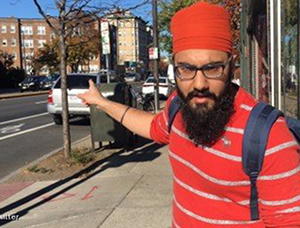
"Over the weekend, I was confronted by a man who called me a '(expletive) Muslim' and followed me around a store aggressively asking where I was from, and and no one in the store said a thing. I was on the phone with my mom the entire time, and we were both concerned for my safety as this man stood inches away from me," Singh wrote about his experience in The Boston Globe.

"While deeply painful, what happened to me pales in comparison to the hate and violence many of my brothers and sisters have faced across the country," he wrote. According to Singh, the man started following him around the store, harassing him and asking him where he was from. Singh, who is from Buffalo, New York, said he tried to ignore the man and continue his conversation with his mother, who was worried.

She could hear the man questioning Singh and told her son to leave the shop. Singh said the man followed him to the checkout counter. "I told him, 'Hey I'm actually from New York. I live here now down the street. Is there anything I can do to help you?'" Singh said.

The man did not respond and Singh left the store as quickly as possible. He said the most effective way to help people who feel marginalised is to "be there for each other in these moments". A bystander who checks in with the person being harassed in any situation can make all the difference, he said.

The owner of the store told Boston.com that he was going back and forth between the back and front of the shop at the time of the incident that took place on November 11 and saw the man who spoke to Singh come in. He said he had planned to ask the man to leave, but went to the back of the store when the incident occurred. Both Singh and the other man were gone when he returned.

He said he was shocked and sorry when his clerk told him what happened. "I don't know where that guy came from and I hope I don't see him again," said the owner, who did not want to be named. Over 200 incidents of hateful harassment and intimidation across the US have been reported since Donald Trump won the presidential election.

Comments

Wellwisher
 - 
Sunday, 20 Nov 2016

Dear All,
This not strange, if we go through the history ftom past 70yrs to till now
White skins are always with same mentlaity. Major part of their weslth are looted one.What Britishers done with India what america is doing now. We should depend on these kind of pepole or with their nation. We have to stick with give respect and take respect policy and nothing more than that.
Hope the Indian community will stand togther to fight against such incidents for the future without looking cast.
Jai Hind!

Add new comment

  • Coastaldigest.com reserves the right to delete or block any comments.
  • Coastaldigset.com is not responsible for its readers’ comments.
  • Comments that are abusive, incendiary or irrelevant are strictly prohibited.
  • Please use a genuine email ID and provide your name to avoid reject.
Media Release
February 12,2020

Mangaluru, Feb 11: Renowned journalist and winner of Magsaysay award, P Sainath will be in Mangaluru on February 14 & 15 at St. Aloysius College (Autonomous). He will speak on the topic ‘Indian democracy in post liberalisation and post truth era’.

P Sainath’s two-day visit to St. Aloysius College will also feature a workshop by the veteran journalist on his rural development project PARI (People’s Archives of Rural India). It is a part of the tenth edition of Media Manthan, a National level media fest organised by the post-graduate department of Journalism and Mass Communication of St. Aloysius College.

P. Sainath is a veteran journalist and media activist who has an avid interest in rural reporting. People’s Archives of Rural India (PARI), a digital journalism platform is an initiative put forward by him which aims to document rural Indian lives and livelihood. Sainath is also a teacher who has trained over 1000 media persons across 27 years.

Media Manthan is a media festival by the PG Department of Mass Communication of St. Aloysius College (Autonomous). Besides endowment lecture and workshop by P. Sainath, the fest holds various media-related competitions for the students of various colleges from across the state.

Comments

Add new comment

  • Coastaldigest.com reserves the right to delete or block any comments.
  • Coastaldigset.com is not responsible for its readers’ comments.
  • Comments that are abusive, incendiary or irrelevant are strictly prohibited.
  • Please use a genuine email ID and provide your name to avoid reject.
News Network
July 9,2020

Bengaluru,  Jul 9: Former Karnataka Chief Minister and Congress leader Siddaramaiah on Wednesday said that he was opposed to a tie-up with Janata Dal-Secular in the last Lok Sabha elections but the party high command did not listen to him.

"I had suggested that we should fight alone (in Lok Sabha elections) because JD-S votes would not have come to us and our votes would not have gone to JD-S," Siddaramaiah told reporters here.

Congress leader said that he was the only one to make the suggestion and he did not get support.

"I was the only one to raise a voice that's why it was not heard by (party) high command and I did not get support. We might have won over seven seats in parliament election if we had fought alone," he said.

After forming government in Karnataka in 2018 with support of JD-S, Congress had fought the 2019 general election in a pre-poll alliance with the party. Congress could only one seat of the 21 it contested and JD-S also won one seat of the seven it contested.

Comments

Add new comment

  • Coastaldigest.com reserves the right to delete or block any comments.
  • Coastaldigset.com is not responsible for its readers’ comments.
  • Comments that are abusive, incendiary or irrelevant are strictly prohibited.
  • Please use a genuine email ID and provide your name to avoid reject.
News Network
April 2,2020

The current physical distancing guidelines provided by the World Health Organisation (WHO) and by the US Centers for Disease Control and Prevention (CDC) may not be adequate to curb the coronavirus spread, according to a research which says the gas cloud from a cough or sneeze may help virus particles travel up to 8 metres. The research, published in the Journal of the American Medical Association, noted that the the current guidelines issued by the WHO and CDC are based on outdated models from the 1930s of how gas clouds from a cough, sneeze, or exhalation spread.

Study author, MIT associate professor Lydia Bourouiba, warned that droplets of all sizes can travel 23 to 27 feet, or 7-8 metres, carrying the pathogen.

According to Bourouiba, the current guidelines are based on "arbitrary" assumptions of droplet size, "overly simplified", and "may limit the effectiveness of the proposed interventions" against the deadly pandemic.

 She explained that the old guidelines assume droplets to be one of two categories, small or large, taking short-range semi-ballistic trajectories when a person exhales, coughs, or sneezes.

However based on more recent discoveries, the MIT scientist said, sneezes and coughs are made of a puff cloud that carries ambient air, transporting within it clusters of droplets of a wide range of sizes.

Bourouiba warned that this puff cloud, with ambient air entrapped in it, can offer the droplets moisture and warmth that can prevent it from evaporation in the outer environment.

"The locally moist and warm atmosphere within the turbulent gas cloud allows the contained droplets to evade evaporation for much longer than occurs with isolated droplets," she said.

"Under these conditions, the lifetime of a droplet could be considerably extended by a factor of up to 1000, from a fraction of a second to minutes," the researcher explained in the study.

The MIT scientist, who has researched the dynamics of coughs and sneezes for years, added that these droplets settle along the trajectory of a cough or sneeze contaminating surfaces, with their residues staying suspended in the air for hours.

"Even when maximum containment policies were enforced, the rapid international spread of COVID-19 suggests that using arbitrary droplet size cutoffs may not accurately reflect what actually occurs with respiratory emissions, possibly contributing to the ineffectiveness of some procedures used to limit the spread of respiratory disease," Bourouiba wrote in the study

Comments

Add new comment

  • Coastaldigest.com reserves the right to delete or block any comments.
  • Coastaldigset.com is not responsible for its readers’ comments.
  • Comments that are abusive, incendiary or irrelevant are strictly prohibited.
  • Please use a genuine email ID and provide your name to avoid reject.