



SKCM enters into strategic partnership with Gulf Medical University

coastaldigest.com news network
July 13, 2017

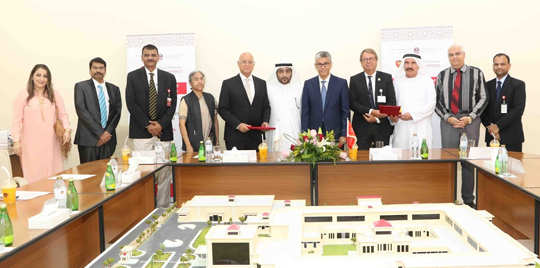
Sheikh Khalifa Medical City (SKMC), Ajman has joined hands with Gulf Medical University (GMU), Ajman, in an attempt to enhance the UAE’s ability to accelerate and expand research and education leading to significant improvements in care for patients with diabetics and lifestyle diseases.
2

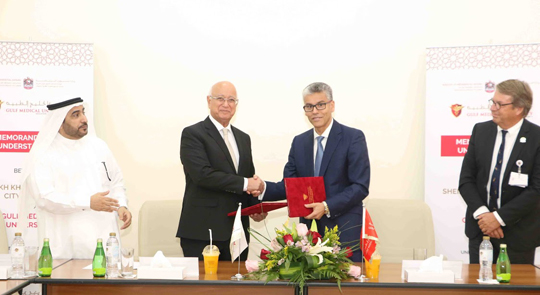
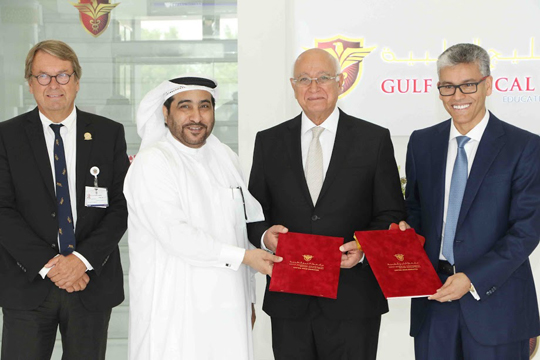
AMoU to this effect was signed on Tuesday, 11th July 2017 between the two institutions represented by Prof. SalahedeenAbusnana - Chief Medical Officer of SKMC and Prof. HossamHamdy - Chancellor of GMU, in the presence of H.E. HamadObaiedTaryam Al Shamsi – Director of Ajman Medical District. Also present at the signing ceremony were Dr. GoranLingman – Hospital Director of Sheikh Khalifa Women & Children Hospital and Prof. Gita Ashok Raj – Provost of GMU. With the signing of this MoU, SKMC will work closely with GMU for joint efforts to support scientific research, health services and knowledge dissemination.

According to the MoU, both the institutions would cooperate in the following: developing and training of all categories of human resources working in healthcare, collaboration and conducting joint research projects, organizing joint conferences and training, exchange of information and supporting thetraining of GMU students.

Expressing happiness at the strategic partnership between SKMC and GMU, H.E. HamadObaiedTaryam Al Shamsi said, “I am glad not only for the training which will now be available to GMU students, but also for the fact that SKMC is seeking to become an academic hospital. SKMC’s hospitals in Ajman and Masfout will be hosting the students of GMU’s medical college, for their internships. I also hope to see meaningful cooperation in research between SKMC’s research center and GMU’s Innovation & Research Center.”

Prof. Salahedeen said that SKMC was delighted to enter into a strategic alliance with GMU, one of the leading medical universities in the region. “For meaningful research, it is imperative to define the research strategy, prioritize and stay focused. It is very important for institutions to collaborate with each other, to ensure social responsibility and community engagement. I am sure that this partnership between SKMCA and GMU would lead to mutually beneficial opportunities like developing specialized courses and providing training programs to the healthcare workforce. This would also greatly benefit the patients and the students,” he added. He also expressed hope that by bringing together the scientists and clinician investigators from across the two institutions, the UAE would greatly expand the development of new technologies needed to tackle major health challenges.

Prof. HossamHamdy said that GMU was honored to develop a strategic alliance with SKMC. “We look forward to working closely with SKMC, a leading institution in the Gulf, renowned globally for its achievements in research and studies. This is a significant step for GMU as we advance towards becoming the first private academic health system in the region,” he said. He added that this partnership was in accordance with GMU’s new strategic plan emphasizing the importance of collaborative work with leading institutions in academics, healthcare and research. “With our strategic partnerships with SKMC as well as several industry partners, GMU is now positioned to broadly disseminate discoveries and to rapidly deliver treatments to patients,” he explained.

SKMC is a key healthcare provider catering to the healthcare needs of the citizens of Ajman and its neighboring Emirates. It is one of the initiatives of His Highness Sheikh Khalifa bin Zayed Al Nahyan, President of the UAE, and is affiliated to the Ministry of Presidential Affairs. SKMC’s vision is to be patient´s first choice and it offers general as well as specialist healthcare services, working in integrated units to make sure that patients receive proper attention and a comprehensive care through all stages of treatments.

Owned and operated by Thumbay Group, GMU was founded by Mr. ThumbayMoideen in 1998. With its own network of teaching hospitals and clinics, the University is on course to becoming the first private academic health system in the country. The Thumbay network of academic hospitals and family clinics treat patients from over 175 countries, and they focus on providing high quality healthcare at affordable costs.
1

3

Comments

Add new comment

  • Coastaldigest.com reserves the right to delete or block any comments.
  • Coastaldigset.com is not responsible for its readers’ comments.
  • Comments that are abusive, incendiary or irrelevant are strictly prohibited.
  • Please use a genuine email ID and provide your name to avoid reject.
Arab News
March 21,2020

Jeddah, Mar 21: Saudi government ministers on Friday announced a war chest of more than SR120 billion ($32 billion) to fight the “unprecedented” health and economic challenges facing the country as a result of the killer coronavirus pandemic.

During a press conference in Riyadh, finance minister and acting minister of economy and planning, Mohammed Al-Jadaan, unveiled a SR70 billion stimulus package to support the private sector, especially small- and medium-sized enterprises (SMEs) and businesses worst-hit by the virus outbreak.

And the Saudi Arabian Monetary Authority (SAMA) has also sidelined SR50 billion to help the Kingdom’s banking sector, financial institutions and SMEs.

Al-Jadaan said the government had introduced tough measures to protect the country’s citizens while immediately putting in place a financial safety net. He added that the Kingdom was moving decisively to address the global COVID-19 disease crisis and cushion the financial and economic impact of the outbreak on the country.

The SR70 billion package of initiatives revealed by the minister will include exemptions and postponement of some government dues to help provide liquidity for private-sector companies.

Minister of Health Dr. Tawfig Al-Rabiah noted the raft of precautionary measures that had been introduced by the Kingdom in cooperation with the private sector and government agencies to combat the spread of the coronavirus, highlighting the important contribution of the data communication services sector.

He reassured the Saudi public that the Kingdom would continue to do whatever was required to tackle the crisis.

“This pandemic has a lot of challenges. It’s difficult to make presumptions at this moment as we’ve seen; many developed countries did not expect the rate of transmission of this virus.

“We see that the reality of the situation is different from what many expected. The virus is still being studied and though we know the means of transmission, it is transmitted at a very fast rate, having spread to many countries faster than expected.

“We see that many countries have not taken the strong precautionary measures from the beginning of the crisis which led to the vast spread of the virus in these countries,” Al-Rabiah said.

He pointed out that social distancing would help slow the spread.

Al-Jadaan said the Saudi government had the financial and economic capacity to deal with the situation. “We have large reserves and large investments, but we do not want to withdraw from the reserves more than what was already announced in the budget. We do not want to liquidate any of the government’s investments so we will borrow.

“We have approval from the government after the finance committee raised its recommendations to increase the proportion of the domestic product borrowing from 30 percent to 50 percent. We do not expect to exceed 50 percent from now until the end of 2022,” he added.

The government would use all the tools available to it to finance the private sector, especially SMEs, and ensure its ongoing stability.

The finance minister said that at this stage it was difficult to predict the economic impact of the pandemic on the private sector, but he emphasized that international coordination, most notably through G20 countries and health organizations, was ongoing.

On recorded cases of the COVID-19 disease in the Kingdom, Al-Rabiah said: “Many of the confirmed cases are without symptoms, this is due to the precautionary measures being considered.

“As soon as a case is confirmed, we contact and examine anyone who was in direct contact with the patient. This epidemiological investigation, is conducted on a large scale to investigate any case that was in contact with the patient.”

Al-Jadaan also announced the formation of a committee made up of the ministers of finance, economy and planning, commerce, and industry and mineral resources, along with the vice chairman of the board of the Saudi National Development Fund, and its governor.

The committee will be responsible for identifying and reviewing incentives, facilities, and other initiatives led by the fund.

Committees had also been established, said Al-Jadaan, to study the impact and repercussions of the coronavirus crisis on all sectors and regions, and look at ways of overcoming them through subsidies or stimulus packages.

Comments

Add new comment

  • Coastaldigest.com reserves the right to delete or block any comments.
  • Coastaldigset.com is not responsible for its readers’ comments.
  • Comments that are abusive, incendiary or irrelevant are strictly prohibited.
  • Please use a genuine email ID and provide your name to avoid reject.
Agencies
July 8,2020

Jeddah, Jul 8: The Organization of Islamic Cooperation (OIC) writes to the members of the United Nations Security Council (UNSC), urging the body to come in the way of a plan announced by Israel for annexation of significant portions of the occupied West Bank.

The letter was addressed by the 57-member organization’s Secretary-General Yousef al-Othaimeen to the UNSC’s members as well as the members of the Middle East Quartet — the European Union, Russia, United Nations, and United States— the Arabic-language Rai al-Youm news website reported on Tuesday.

The letter urged the Council to adopt “the necessary measures” that would prevent the annexation and compel Israel to stop all its illegal activities.

The OIC also urged the UNSC to hold an emergency meeting to “salvage the [remaining] opportunities for peace, and revive attempts at reinstatement of the political process under international supervision.” Such meeting, it added, had to enable realization of “the two-state solution, and [creation of] a Palestinian state with East Jerusalem [al-Quds] as its capital.”

Israel’s Prime Minister Benjamin Netanyahu announced the plan to annex 30 percent of the occupied Palestinian territory — namely the areas upon which the regime has built its illegal settlements as well as the Jordan Valley — after US President Donald Trump backed the annexation in January.

Trump pledged the support while unveiling details of his Middle East scheme called the “deal of the century.”

The highly controversial scheme allegedly seeks to resolve the Palestinian-Israeli conflict, but is heavily tilted in favor of the occupying regime. As well as backing the annexation, the scheme re-endorses Washington’s incendiary recognition in late 2017 of al-Quds as “Israel’s capital,” although Palestinians want the occupied holy city’s eastern part to serve as the capital of their future state.

Palestinians have roundly rejected either the American design or the Israeli plan that is rooted in it.

Tel Aviv had previously announced July 1 as the date it sought to start implementing the annexation plan. It, however, is yet to get it off the ground amid far-and-wide international condemnation and speculation that the plan was announced in the first place to deflect attention from a massive corruption scandal involving Netanyahu.

Countries warn Israel of consequences to bilateral ties

Also on Tuesday, Egypt, France, Germany, and Jordan warned Israel against going ahead with the plan, saying that doing so could have consequences for their bilateral relations with the Tel Aviv regime.

In a statement distributed by the German Foreign Ministry, the countries said their foreign ministers had discussed how to restart talks between Israel and the Palestinian Authority.

Most other European countries have likewise communicated their objection to the plan.

“We concur that any annexation of Palestinian territories occupied in 1967 would be a violation of international law and imperil the foundations of the peace process,” the European and Middle Eastern foreign ministers said, referring to the year, when Israel occupied the West Bank.

“We would not recognize any changes to the 1967 borders that are not agreed by both parties in the conflict,” they added. “It could also have consequences for the relationship with Israel.”

Israel had no immediate response. In a separate statement, however, Netanyahu’s office communicated Tel Aviv’s intransigence on the matter.

The statement said the Israeli premier had told his British counterpart Boris Johnson on Monday that he was committed to Trump’s “realistic” plan.

“Israel is prepared to conduct negotiations on the basis of President Trump’s peace plan, which is both creative and realistic, and will not return to the failed formulas of the past,” the statement alleged.

Comments

Add new comment

  • Coastaldigest.com reserves the right to delete or block any comments.
  • Coastaldigset.com is not responsible for its readers’ comments.
  • Comments that are abusive, incendiary or irrelevant are strictly prohibited.
  • Please use a genuine email ID and provide your name to avoid reject.
Agencies
July 14,2020

Dubai, Jul 14: The UAE-based parents of children under 12 stranded in India are in a tight spot with multiple airlines refusing to accept unaccompanied minors.

Starting July 12, Indians wanting to return to the UAE have been given a 15-day window to travel back on the condition that they have valid residency permits. They also have to produce a negative Covid-19 test result.

But parents of minors said they are feeling helpless as children are unable to avail of the travel opportunity despite having return permits.

"It has been more than three months since my daughter has been stuck in India. We have GDRFA approval for her but the airlines are not accepting her booking, saying she is under 12," Poonam Sapre, a Dubai-based mother, told Khaleej Times.

Her daughter Eva Sapre, 10, is in Hyderabad and is awaiting a reunion with her parents.

"She is just 10 and it has already taken an emotional toll on her. She is eager to come back and is asking me every day about her return. This is so frustrating."

Barring Emirates and Etihad, other airlines including flydubai, Air Arabia and Air India Express are not accepting unaccompanied minors. With India extending the travel freeze till July 31, normal flights are yet to resume and only special flights are allowed between India and UAE under a bilateral agreement.

Sapre said only flydubai is flying the Hyderabad-Dubai route, and the carrier has restrictions on minors travelling alone. "My daughter is too young to fly through indirect routes," claims the mother.

When Khaleej Times reached out to the airlines for comment, they confirmed that such rules on unaccompanied minors were already in place even before Covid-19 travel restrictions came into effect.

Another Dubai-based distressed parent, who did not want to be named, said her eight-year-old son is in Kerala and is unable to fly due to airline policies on unaccompanied minors.

"I called up Air India Express and they said this has been their rule even before the Covid-19 outbreak. I am appealing to them to re-consider and make an exception during these trying times so that our children can come home safely," she said.

Faced with this eventuality, some parents are forced to fly out of the UAE so they can accompany their children on the flight back home.

An Indian mother, who is currently in Mumbai, said she flew out of Dubai on Monday morning solely for the purpose of bringing back her twin daughters, aged 10.

"I had no choice. Ideally, they could have travelled together, but under these circumstances I thought it best to get them with me personally," said the mother.

Comments

Add new comment

  • Coastaldigest.com reserves the right to delete or block any comments.
  • Coastaldigset.com is not responsible for its readers’ comments.
  • Comments that are abusive, incendiary or irrelevant are strictly prohibited.
  • Please use a genuine email ID and provide your name to avoid reject.
