



Smriti Irani resorted to blatant lies' in Parliament, says Rohith Vemula's mom

February 26, 2016

New Delhi, Feb 26: Dalit student Rohith Vemula's mother on Friday launched a scathing attack on HRD minister Smriti Irani, accusing her of resorting to "blatant lies" while talking in Parliament about her son's suicide and that "life imprisonment" will not be enough for her and others "responsible" for his death.rohith
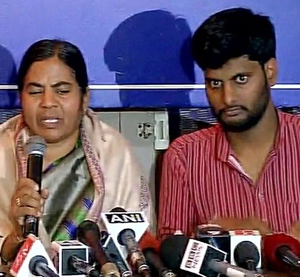
Radhika Vemula, flanked by her other son Raja, said BJP will be "decimated to the ground" if Prime Minister Narendra Modi does not take any action against Irani and her ministerial colleague Bandaru Dattatreya who had written multiple letters to her seeking action against Rohith, alleging anti-national activities.

"Irani, this is not a small screen to act, this is real life. Bring out the facts, don't fabricate them. How many parents you would like to suffer. Irani has lied multiple times while speaking on the issue in Parliament. Why has action not been taken against her?" she said in a news conference.

Speaking in Parliament, Irani had on Wednesday tried to deflect criticism and mounted a strident attack on the opposition accusing it of "politicizing" the PhD scholar's death.

She had said that the committee which acted against Rohith had a dalit representative and that doctors were not allowed to revive him after he was found hanging.

Rohith's brother Raja dubbed Irani's comments as "blatant lies", saying he reached the campus by 8.30pm and saw police and doctors where his body was kept.

"Even life imprisonment will not be enough for the ministers, vice-chancellor and the ABVP activists who were responsible for my son's death. BJP will be decimated to the ground if Modi does not address the issues. We demand formation of an SIT to probe the case," Radhika said.

Rohith's friend Prashant, who was also expelled by the Hyderabad University, cited minutes of the executive council meeting of Hyderabad University, claiming that action was taken against them "in response" to communication from the HRD ministry to not allow the students to continue academic activities.

26-year-old Rohith was found hanging at a hostel room in the university on January 17, days after punitive action was taken against him and four other students for allegedly attacking an ABVP functionary.

Students and Rohith's family have been alleging that Irani and Dattatreya had forced the university to take action against him and others.

The duty doctor at the University of Hyderabad on Thursday contradicted Irani's claim that no doctor was allowed near the body to revive him.

Prashant said Irani must be punished for misleading the nation and giving a false statement in Parliament which is "an offence" under the Constitution.

Comments

Rosalind
 - 
Saturday, 18 Jun 2016

I have learn a few just right stuff here. Definitely price bookmarking for revisiting.
I surprise how so much attempt you put to create this sort of wonderful informative website.

Here is my site ... Lavern: http://smithysingle.webnode.com/

Klandar
 - 
Saturday, 27 Feb 2016

She is an actress, now irani acts in Parliament...
E Daane Moolh Yanh Moole..
Yeregaviye Kiri Kiri....
Moolh Ragale ijji Parliment kulluth Act Malpuli.....

UMMAR
 - 
Saturday, 27 Feb 2016

SHE IS ACTOR IN STAR PLUS SOOO SHE KNOW HW TO ACT IN WCH CONDITION ,

FAKE GOV FAK FAKE MINISTER ,,,, INDIAN NEVER SEEN THIS TYPE OF GOVERMENT VERY VERY CHEAP...... REALY...

Add new comment

  • Coastaldigest.com reserves the right to delete or block any comments.
  • Coastaldigset.com is not responsible for its readers’ comments.
  • Comments that are abusive, incendiary or irrelevant are strictly prohibited.
  • Please use a genuine email ID and provide your name to avoid reject.
News Network
January 21,2020

Bengaluru, Jan 21: A private hospital in Bengaluru, the capital of Karnataka, on Tuesday claimed that it has successfully performed a live liver transplant on a Jehovah's Witness from Nigeria, by not using blood or blood products, in order to protect the patient's religious beliefs.

It is said that Jehovah's Witnesses are followers of a Christian faith that prohibits the use of blood or blood products during their treatment. Gehojadak (37), a Jehovah's Witness follower, had developed decompensated liver disease and visited more than three countries seeking treatment over the last four years but was turned away by most doctors due to the highly risky nature of surgery, Aster CMI Hospital said.

The surgery was challenging compared to a normal liver transplant because in order to protect the patient's religious beliefs, the medical team could not use blood or blood products (Fresh frozen plasma, Cryoprecipitate, Platelets etc), it said in a release, adding that very few such surgeries have been successfully conducted worldwide.

The patient's brother was the donor, the hospital said, adding, without a liver transplant, Gehojadak's chances of survival were less than 10 per cent over the next two years. A team of liver specialists from the Hospital thoroughly reviewed the patient's medical history before recommending a bloodless liver transplant and charted out a feasible pathway to make the surgery a success.

"This transplant was especially challenging as we did not have the safety net (of using blood) even if the patient's life was at risk due to their advance directive. We have performed other non-transplant liver surgeries in Jehovah's Witnesses and this gave us the confidence to take on Gehojadak's transplant," Dr Rajiv Lochan, Consultant Liver Transplant Surgeon, said.

The critical surgery took a 12-hour period to complete where two teams of specialists with close to 25 doctors including anaesthetists, intensivists worked in absolute sync with each other and Gehojadak finally received a life-saving liver transplant, the Hospital said. In a period of two weeks, the patient and his brother were fit enough to go home and were discharged from the hospital.

"Even if their haemoglobin levels dropped to life-threatening levels, the patients were clear that they would not accept a blood transfusion. Keeping the limitations in mind, the most effective treatment path was planned, and we spent close to two months preparing the patients for surgery," Arun V, Consultant Anesthesiologist said. The hospital arranged customised artificial products like synthetic drug molecules, to conduct a bloodless liver transplant, he added.

Comments

Add new comment

  • Coastaldigest.com reserves the right to delete or block any comments.
  • Coastaldigset.com is not responsible for its readers’ comments.
  • Comments that are abusive, incendiary or irrelevant are strictly prohibited.
  • Please use a genuine email ID and provide your name to avoid reject.
News Network
February 9,2020

Thiruvananthapuram, Feb 9: Kerala has sanctioned the setting up of 28 fast track courts for speedy trial in rape cases and other cases registered under the Protection of Children from Sexual Offences (POCSO) Act.

State Social Justice and Women and Child Development Minister KK Shailaja said the state government has decided to set up POCSO courts to ensure that the culprits get the punishment they deserve. She said the decision has been taken in the wake of rising violence against women and children.

"The Union Law Ministry has recently sanctioned the opening of 28 POCSO fast track special courts in Kerala at the request of the state government. The project will be implemented jointly by the High Court, Law and Home Departments under the leadership of the Department of Women and Child Development," the Minister said.

The four courts are alloted in Thiruvananthapuram district, three in Thrissur and Malappuram districts, two each in Kollam, Kottayam, Idukki, Ernakulam, Palakkad, Kozhikode and Kannur districts.

The Minister informed that POCSO courts are jointly established by the central and state governments and according to the High Court data, 12,234 POCSO and rape cases are pending in the state.

Comments

Add new comment

  • Coastaldigest.com reserves the right to delete or block any comments.
  • Coastaldigset.com is not responsible for its readers’ comments.
  • Comments that are abusive, incendiary or irrelevant are strictly prohibited.
  • Please use a genuine email ID and provide your name to avoid reject.
News Network
June 20,2020

Bengaluru, Jun 20: The Karnataka Health Department has issued guidelines on the admission of COVID-19 patients in private hospitals after clinical assessment, mandating that the district surveillance officer (DSO) should be first informed to initiate further procedures, an official said on Friday.

"A health team sent by the DSO should visit the home or hospital where the patient is staying. The team should conduct a rapid assessment of his or her health condition," said Karnataka's Additional Chief Secretary Jawaid Akhtar.

In the rapid health condition assessment, the team should first check the patient's body temperature, followed by SpO2 (oxygen saturation) level and confirm if there are any comorbidities such as hypertension, diabetes, tuberculosis, HIV, cancer, stroke etc.

Depending on the health condition of patients, Akhtar said, two categories have been made.

"Those who have body temperature greater than 37.5 degrees Celsius, SpO2 level below 94 percent, elderly (above 60 years) and suffering from known comorbid conditions should be taken to a dedicated Covid hospital (DCH)," he said.

"All other patients, even if older but not suffering from co-morbidities, those below 60 and suffering from co-morbidities and asymptomatic cases should be taken to a dedicated Covid health centre (DCHC) or a private hospital as opted by the patient," he added.

Private hospitals have been asked to pitch in due to the rising number of cases in Karnataka. Currently, there are 2943 active cases in the state after 337 cases were reported on Friday.

"The patients are assessed clinically and evaluated at DCHCs or private hospitals with appropriate diagnostic tests. After evaluation, if the patients are asymptomatic, they are shifted to a COVID Care Centre (CCC) for further management," said Akhtar.

CCCs are expected to be equipped with ventilated rooms, pulse oximeters, handheld thermal scanners and blood pressure apparatus.

A nurse has to be present round the clock for every 50 patients and should visit each patient twice a day for assessment whereas the medical officer has to visit the CCC once a day. He should also be available on call in case of an emergency.

Staff serving food and others should wear personal protective equipment and an N-95 mask. Explaining the procedures at DCHCs, Akhtar said general examinations for medical conditions like body temperature, BP, pulse, oxygen saturation and urine output should be in place.

Investigations such as complete blood count, fasting blood sugar, random blood sugar, liver function tests, renal function tests, ECG and chest X-ray facilities should be available.

"DCHCs should ensure that above examinations are over in an orderly timeline of 24 hours and depending on the examination, the patient is continued to be lodged at the DCHC or sent to DCH or CCC," said the senior officer.

Likewise, the discharge policy should be done as per the protocols issued by the Health Department from time to time.

The Karnataka government is yet to fix an upper limit on the cost of treating COVID-19 patients in private hospitals. While reports indicated that this could be capped at Rs 5200 per day, health officials are yet to specify this is the case. Private hospitals in the state have asked the government to take a collaborative approach in deciding the fixed cap on treatment cost.

Comments

Add new comment

  • Coastaldigest.com reserves the right to delete or block any comments.
  • Coastaldigset.com is not responsible for its readers’ comments.
  • Comments that are abusive, incendiary or irrelevant are strictly prohibited.
  • Please use a genuine email ID and provide your name to avoid reject.