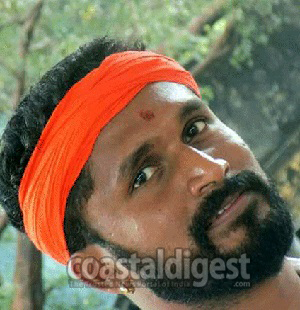
SP confirms arrest of Bajrang Dal leader Bharat in Ashraf murder case

CD Network
July 2, 2017

Mangaluru, Jul 2: Finally a senior police officer has confirmed the arrest of Bharat Kumar Kumdelu, a notorious criminal and Bajrang Dal leader, in connection with the coldblooded murder of SDPI activist Mohammed Ashraf Kalayi.gns

“We have arrested Bharat. Bharat will be produced in court after interrogation and police custody will be taken for further investigation,” said H Sudhir Kumar Reddy, superintendent of police of Dakshina Kannada.

Confirming arrest of prime accused Bharat Kumdelu, 30, a resident of Bantwal, C H Sudhir Kumar Reddy, superintendent of police, DK said that he is secured and is being interrogated. Bharat will be produced in court after interrogation and police custody will be taken for further investigation.

Ashraf (33), president of SDPI’s Ammunje zonal unit, was hacked to death by a gang of miscreants at Benjanapadavu in Bantwal taluk in broad daylight on June 21. Police have already arrested six persons in connection with the case and most of them have close ties with Hindutva organizations.

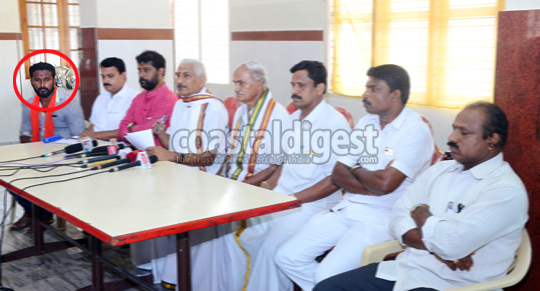
30-year-old Bharat had shared dais with RSS leader Prabhakar Bhat at a press meet in Mangaluru on May 28 wherein the latter had justified the attack on two Muslim passersby by rowdysheeters in Kalladka.

According to highly place sources, Bharat had planned the murder in Benjanapadavu. He himself had also collected weapons like sickle, knives and given to other accused.

Police said they had an intention to create communal violence after the incident. The murder plot was hatched by two rowdy sheeters - Dhivyaraj Shetty, who was arrested earlier, and Bharat Kumdelu.

The other accused are Pavan Kumar, 24, Pudu village, Bantwal; Santosh, 23, Thumbay village; Shivaprasad, 24, Bollari house, Thumbay; Ranjith, 28, resident of Pudu village and Abhin Rai, 23, Thenkabellur village.

Barring Santosh all the other have criminal cases registered against them. Abhin Rai was booked during Tipu Jayanthi violence in Bantwal, last year and a case was booked against Pavan in 2012 for placing pig head at a mosque in Bantwal to create communal tension.

ashrafmurder1 copy

Comments

mohammad.n
 - 
Friday, 7 Jul 2017

GST forgotten! These MPs and leaders fill their stomach at the cost of poor people's life. Poor people kill and poor people die. Rich will be rich always. I dont know when the people will wake up. May be someday US , Russia and others countries will come and say they will solve our problem as they do in the middle east. May be then we can wake up

Harish vamachara
 - 
Friday, 7 Jul 2017

nice coverage Coastaldigest.com, thanks alot for the support.

Add new comment

  • Coastaldigest.com reserves the right to delete or block any comments.
  • Coastaldigset.com is not responsible for its readers’ comments.
  • Comments that are abusive, incendiary or irrelevant are strictly prohibited.
  • Please use a genuine email ID and provide your name to avoid reject.
News Network
June 24,2020

Bengaluru, Jun 24: Former Karnataka Chief Minister and Congress leader Siddaramaiah criticised the current state government rates for COVID-19 treatment in private hospitals and said that the patients must be treated free of charge in all hospitals.

"The state government has fixed rates for treating COVID-19. The current rates are shocking to the people," Siddaramaiah said.
Questioning the state government, he said, "Where can people pay these rates fixed by the government per day? Looking at these rates can be heartbreaking for the people. This raises the question of whether the government is sensitive to people's issues."

"The government must promptly announce free treatment and set up a standard treatment protocol. The government should appoint a panel of experts to continuously monitor whether treatment is being properly administered and create an environment where the public is free from anxiety," Siddaramaiah added.

Karnataka on Tuesday reported 322 fresh COVID-19 positive cases and eight deaths.
According to the state health department, the total number of positive cases has mounted to 9,721 and 150 deaths. So far, 6,004 people have been discharged. 

Comments

Add new comment

  • Coastaldigest.com reserves the right to delete or block any comments.
  • Coastaldigset.com is not responsible for its readers’ comments.
  • Comments that are abusive, incendiary or irrelevant are strictly prohibited.
  • Please use a genuine email ID and provide your name to avoid reject.
Media Release
February 14,2020

Veteran journalist P. Sainath has said that the nation is in a crisis. And this crisis is not limited to just the rural area. It has become a national crisis at various areas such as agriculture, education, economy, job creation etc.

He was delivering the endowment lecture on the topic ‘Indian democracy at the post-liberalization and post-truth era’ at Media Manthan 2020 organized by the PG department of journalism and mass communication at St Aloysius College (Autonomous). 

Mr Sainath said that the many policies adopted in the 90s led to India becoming unusually unequal. Referring to the speech Ambedkar had made at the Constituent Assembly while handing over the draft of the Constitution, Mr Sainath said, “Ambedkar had warned about the weakness of Indian democracy that liberty without equality allows the supremacy of a few over the multitude. Liberty, equality and fraternity must be kept together as we cannot have one without the other.” 

Mr Sainath stated that the agrarian crisis was no longer about the loss of productivity, employment or about farmer suicide; it was a societal, civilizational crisis. Commenting on the lopsided policies such as cow-slaughter ban, he explained how cow slaughter ban had adversely affected many industries due to their interdependency. While Muslims who slaughtered cows were rendered helpless, the cattle traders who were mostly OBCs lost their earnings as the cattle prices crashed. An important industry like Kolhapur sandals industry in Maharashtra went bankrupt as a result of the cow slaughter ban in Maharashtra. He said the policymakers had no idea how the rural industries were interconnected. Demonetisation too devastated the rural economy as 98 percent of rural transactions happen through cash. 

Mr Sainath also spoke about the crisis of inequality which affects the Dalits and the Adivasis far more than anyone else as 90 percent of the rural households take home less than Rs 10,000/- per month. “Women are yet another group whose labour is never counted in the gross domestic product. Women and girls globally do unpaid work which amounts to about 12.5 billion working hours per year. Monetarily speaking, this is worth 10.8 trillion dollars,” Mr Sainath added. 

Speaking about the crisis of jobs Mr Sainath said that major companies were laying off employees just to create more profits for the investors and the adoption of artificial intelligence in the industry would further destroy millions of jobs.

Rector of St Aloysius College Institutions Fr Dionysius Vaz SJ, Principal Dr (Fr) Praveen Martis SJ, HOD of Journalism and Mass Communication department Dr (Fr) Melwyn Pinto SJ were present.

‘Veerappan and Vijay Mallya’s business models are interesting!’

Addressing the gathering during his endowment lecture on Friday, Mr Sainath made an interesting comment on the so called ‘revenue model’. “Whenever I visit IIMs and IITs for lectures on my PARI project, the students there ask me what my revenue model for my project is. I tell them that I do not have a revenue model. In fact, journalism does not begin with a revenue model. Gandhiji, Ambedkar, Bhagat Singh were all great journalists. But they did not have a revenue model,” Mr Sainath said.

On a lighter note, he said that the best revenue model that he liked was that of forest brigand Veerappan and liquor baron Vijay Mallya. “Veerappan ruled the forest for forty years and from the top ministers to the villagers he could dictate terms and liver royally. Similarly, Mallya’s revenue model was to steal the banks and run away abroad and live like a king,” Mr Sainath added.

Journalism is not and can never be a business. It is a calling, he opined. While newspaper can be a business, television can be a business, journalism per se cannot be reduced to a business. “Unfortunately today, journalists are recruited on a contract basis and they have no bargaining power; and there are no unions to fight for their cause. Hence, they are at the mercy of the corporate media houses for their survival and are made to write stories that cannot be called journalism,” Mr Sainath said.

Answering a question as to the pressures he faced as a journalist, he said that external pressures from the government or others could be very well handled. It is the internal pressures from once own media house that journalists find it difficult to manage.


 

Comments

Add new comment

  • Coastaldigest.com reserves the right to delete or block any comments.
  • Coastaldigset.com is not responsible for its readers’ comments.
  • Comments that are abusive, incendiary or irrelevant are strictly prohibited.
  • Please use a genuine email ID and provide your name to avoid reject.
News Network
April 19,2020

Belagavi, Apr 19: Veteran writer and Translator Chandrakanth Kusnoor passed away in his house on Sunday due to age-related disease.

He was 90.

He was survived by wife, four sons and one daughter.

According to family sources, the last rites were held in the wee hours of Sunday.

Mr Kushnoor, a multi-faceted personality, maybe the one of the few who had won the Karnataka Nataka Academy, Karnataka Lalitha Kala Academy and Karnataka Sahitya Academy awards for his works as writer, translator, novelist, poet, playwright, painter, art critic and institution builder.

He had translated many books from Kannada (late U R Ananthmurthy and Srikrishna Alanahalli) into Hindi, and other books into Marathi and Urdu.

He was among the pioneering abstract writers in Kannada. His plays like Dindi, Vidushaka, Ratto Ratto Rayara Magale and Ani Bantu Ondu Ani, were widely performed.

His biographical novel Gohar Jan chronicles the growth of professional theatre music tradition.

He had converted his home in Channamma Nagar into a mini art gallery and used to paint till recently. He hailed from Kalaburagi where he worked as a college professor for some years. He had settled in Belagavi after his retirement as the Deputy Director of Kannada and culture.

He had won the Karnataka Rajyotsava Award.

Comments

Add new comment

  • Coastaldigest.com reserves the right to delete or block any comments.
  • Coastaldigset.com is not responsible for its readers’ comments.
  • Comments that are abusive, incendiary or irrelevant are strictly prohibited.
  • Please use a genuine email ID and provide your name to avoid reject.