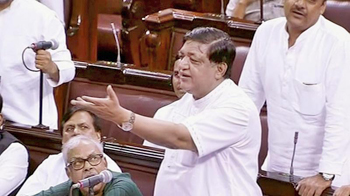
SP MP Naresh links Hindu gods to alcohol, apologises after outrage

Agencies
July 20, 2017

New Delhi, Jul 20: Samajwadi Party lawmaker Naresh Agarwal had the government benches in the Rajya Sabha up in angry protest today when he referred to Hindu Gods in comments that have been expunged or removed from records. The Upper House of Parliament had to be adjourned amid loud protests.Naresh

Mr Agarwal has since expressed regret.

Since the comments have been expunged, they cannot be reported. The Samajwadi Party lawmaker was speaking in a fractious debate in the house on recent incidents of mob lynching and murders in the name of cow protection when he made the comments.

"He has linked each of the Hindu Gods with a brand of alcohol. If he would have made this statement outside Parliament, he would've been booked. Do you have the audacity of repeating this in relation to any other religious denomination? Would you do this?" said Union Finance Minister Arun Jaitley, demanding an apology.

Mr Agarwal later said he had "not meant to hurt anyone."

Earlier in the debate, he alleged that people linked to the BJP were behind recent mob attacks by cow vigilantes, which was firmly rejected by Minister of State for Home affairs Hansraj Gangaram Ahir.

The minister drew protests from the opposition when he said states have all the powers to deal with such incidents and that there was no need to change existing laws. He said the home ministry has already issued an advisory to all states to immediately start registering FIRs in such cases and asked them to take action and arrest culprits. He also pointed out that the Prime Minister has spoken against killings in the name of cow protection which will not be tolerated.

Samajwadi Party members came to the Well or Centre of the house and raised slogans expressing dissatisfaction over the government's reply to questions on the steps taken by the Centre to stop the mob murders.

Comments

V Girisha
 - 
Sunday, 23 Jul 2017

Sir, you will overcome your health issues very soon.

Add new comment

  • Coastaldigest.com reserves the right to delete or block any comments.
  • Coastaldigset.com is not responsible for its readers’ comments.
  • Comments that are abusive, incendiary or irrelevant are strictly prohibited.
  • Please use a genuine email ID and provide your name to avoid reject.
Ram Puniyani
February 10,2020

Noam Chomsky is one of the leading peace workers in the world. In the wake of America’s attack on Vietnam, he brought out his classic formulation, ‘manufacturing consent’. The phrase explains the state manipulating public opinion to have the public approve of it policies—in this case, the attack of the American state on Vietnam, which was then struggling to free itself from French colonial rule.

In India, we are witness to manufactured hate against religious minorities. This hatred serves to enhance polarisation in society, which undermines India’s democracy and Constitution and promotes support for a Hindu nation. Hate is being manufactured through multiple mechanisms. For example, it manifests in violence against religious minorities. Some recent ghastly expressions of this manufactured hate was the massive communal violence witnessed in Mumbai (1992-93), Gujarat (2002), Kandhamal (2008) and Muzaffarnagar (2013). Its other manifestation was in the form of lynching of those accused of having killed a cow or consumed beef. A parallel phenomenon is the brutal flogging, often to death, of Dalits who deal with animal carcasses or leather.

Yet another form of this was seen when Shambhulal Regar, indoctrinated by the propaganda of Hindu nationalists, burned alive Afrazul Khan and shot the video of the heinous act. For his brutality, he was praised by many. Regar was incited into the act by the propaganda around love jihad. Lately, we have the same phenomenon of manufactured hate taking on even more dastardly proportions as youth related to Hindu nationalist organisations have been caught using pistols, while police authorities look on.

Anurag Thakur, a BJP minster in the central government recently incited a crowd in Delhi to complete his chant of what should happen to ‘traitors of the country...” with a “they should be shot”. Just two days later, a youth brought a pistol to the site of a protest at Jamia Millia Islamia university and shouted “take Azaadi!” and fired it. One bullet hit a student of Jamia. This happened on 30 January, the day Nathuram Godse had shot Mahatma Gandhi in 1948. A few days later, another youth fired near the site of protests against the CAA and NRC at Shaheen Bagh. Soon after, he said that in India, “only Hindus will rule”.

What is very obvious is that the shootings by those associated with Hindu nationalist organisations are the culmination of a long campaign of spreading hate against religious minorities in India in general and against Muslims in particular. The present phase is the outcome of a long and sustained hate campaign, the beginning of which lies in nationalism in the name of religion; Muslim nationalism and Hindu nationalism. This sectarian nationalism picked up the communal view of history and the communal historiography which the British introduced in order to pursue their ‘divide and rule’ policy.

In India what became part of “social common sense” was that Muslim kings had destroyed Hindu temples, that Islam was spread by force, and that it is a foreign religion, and so on. Campaigns, such as the one for a temple dedicated to the Hindu god Rama to be built at the site where the Babri masjid once stood, further deepened the idea of a Muslim as a “temple-destroyer”. Aurangzeb, Tipu Sultan and other Muslim kings were tarnished as the ones who spread Islam by force in the subcontinent. The tragic Partition, which was primarily due to British policies, and was well-supported by communal streams also, was entirely attributed to Muslims. The Kashmir conflict, which is the outcome of regional, ethnic and other historical issues, coupled with the American policy of supporting Pakistan’s ambitions of regional hegemony, (which also fostered the birth of Al-Qaeda), was also attributed to the Muslims.

With recurring incidents of communal violence, these falsehoods went on going deeper into the social thinking. Violence itself led to ghettoisation of Muslims and further broke inter-community social bonds. On the one hand, a ghettoised community is cut off from others and on the other hand the victims come to be presented as culprits. The percolation of this hate through word-of-mouth propaganda, media and re-writing of school curricula, had a strong impact on social attitudes towards the minorities.

In the last couple of decades, the process of manufacturing hate has been intensified by the social media platforms which are being cleverly used by the communal forces. Swati Chaturvedi’s book, I Am a Troll: Inside the Secret World of the BJP’s Digital Army, tells us how the BJP used social media to spread hate. Whatapp University became the source of understanding for large sections of society and hate for the ‘Other’, went up by leaps and bounds. To add on to this process, the phenomenon of fake news was shrewdly deployed to intensify divisiveness.

Currently, the Shaheen Bagh movement is a big uniting force for the country; but it is being demonised as a gathering of ‘anti-nationals’. Another BJP leader has said that these protesters will indulge in crimes like rape. This has intensified the prevalent hate.

While there is a general dominance of hate, the likes of Shambhulal Regar and the Jamia shooter do get taken in by the incitement and act out the violence that is constantly hinted at. The deeper issue involved is the prevalence of hate, misconceptions and biases, which have become the part of social thinking.

These misconceptions are undoing the amity between different religious communities which was built during the freedom movement. They are undoing the fraternity which emerged with the process of India as a nation in the making. The processes which brought these communities together broadly drew from Gandhi, Bhagat Singh and Ambedkar. It is these values which need to be rooted again in the society. The communal forces have resorted to false propaganda against the minorities, and that needs to be undone with sincerity.

Combating those foundational misconceptions which create hatred is a massive task which needs to be taken up by the social organisations and political parties which have faith in the Indian Constitution and values of freedom movement. It needs to be done right away as a priority issue in with a focus on cultivating Indian fraternity yet again.


Comments

Add new comment

  • Coastaldigest.com reserves the right to delete or block any comments.
  • Coastaldigset.com is not responsible for its readers’ comments.
  • Comments that are abusive, incendiary or irrelevant are strictly prohibited.
  • Please use a genuine email ID and provide your name to avoid reject.
News Network
July 1,2020

Bengaluru, Jul 1: The Meteorological Department has issued a yellow alert and forecasted heavy rains for three coastal districts and 12 more in the south interior Karnataka region, an official said on Tuesday afternoon.

"Thunderstorm with lightning is likely to occur at isolated places over south interior Karnataka from Tuesday to Wednesday," said a Met official.

For Bengaluru city, the Met department has forecast a generally cloudy sky with light rain for the next three days.

Coastal Karnataka -- Dakshina Kannada, Udupi and Uttara Kannada districts have been issued a yellow alert for the next two days with thundershowers and gusty winds.

Winds blowing at speed of 40-50 km per hour are expected on the coast and the Met department warned fishermen against venturing into the sea.

Meanwhile, heavy showers on Sunday night in Vijayapura district gave rise to flash floods in the Doni river and Sogali stream.

An overflowing Doni river submerged the Talikote - Hadaginal bridge, a remnant from the colonial era, and also submerged some agricultural lands. Only recently, these agricultural lands were sown with toor dal plants.

Similarly, many SSLC students also struggled to cross the bridge to reach their examination centres on Monday.

Many houses were also flooded due to the rainfall at Nalatwad and Talikote taluk. Muddebihal, Basavana Bagewadi and Sindagi taluks also witnessed heavy rainfall.

A 40-year-old farmer from Dharwad district was washed away in the Tuppari Halla stream, which is prone to flood during the monsoon season.

Likewise, a truck carrying cotton also got washed away in a stream in Yadgir district.

"There is an offshore trough and a circulation, because of which rain will continue in the coastal area. Only Malnad has not got sufficient rain this year. Probably after two days, Malnad may get some rains," Karnataka State Natural Disaster Monitoring Centre (KSNDMC) Director Srinivas Reddy said. Otherwise, entire state got normal rainfall, said Reddy, though it is not active over Malnad.

Comments

Add new comment

  • Coastaldigest.com reserves the right to delete or block any comments.
  • Coastaldigset.com is not responsible for its readers’ comments.
  • Comments that are abusive, incendiary or irrelevant are strictly prohibited.
  • Please use a genuine email ID and provide your name to avoid reject.
News Network
January 24,2020

Mangaluru, Jan 24: Aditya Rao, who was arrested for planting Improvised explosive device (IED) at Mangaluru airport on January 20, was brought to the airport on Friday for recreation of the crime scene as part of the investigation process.

Yesterday, one more case was registered against Rao in connection with a hoax call to the terminal manager of the airport on January 20, police said.

"One more case has been registered against Aditya Rao at Bajpe Police station for a hoax call to the terminal manager of Mangaluru International Airport on January 20," said PS Harsha, Mangalore Commissioner of Police on Thursday.

Earlier, Harsha informed that Rao, who surrendered before the Bengaluru Police, is now in the custody of Mangaluru Police.

"Our investigation team arrested Aditya Rao in Bengaluru in connection with the planting of an explosive device at Mangaluru airport. We produced the accused before Bengaluru's first JMFC court and the court issued a transit warrant," Harsha said.

"We have brought him to Mangaluru from Bengaluru and now the accused is in our custody. Our investigation team will interrogate him. We will investigate all aspects. He will be produced before Mangaluru 6th JMFC Court," he added.

Rao hails from Udupi and has engineering and MBA degrees.

According to the police, the IED was recovered from a bag at the Mangaluru airport. It was later defused in an open field by the personnel of the bomb disposal squad.

Comments

Add new comment

  • Coastaldigest.com reserves the right to delete or block any comments.
  • Coastaldigset.com is not responsible for its readers’ comments.
  • Comments that are abusive, incendiary or irrelevant are strictly prohibited.
  • Please use a genuine email ID and provide your name to avoid reject.