



SP MP Naresh links Hindu gods to alcohol, apologises after outrage

Agencies
July 20, 2017

New Delhi, Jul 20: Samajwadi Party lawmaker Naresh Agarwal had the government benches in the Rajya Sabha up in angry protest today when he referred to Hindu Gods in comments that have been expunged or removed from records. The Upper House of Parliament had to be adjourned amid loud protests.Naresh
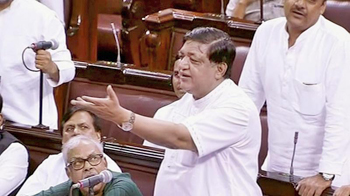
Mr Agarwal has since expressed regret.

Since the comments have been expunged, they cannot be reported. The Samajwadi Party lawmaker was speaking in a fractious debate in the house on recent incidents of mob lynching and murders in the name of cow protection when he made the comments.

"He has linked each of the Hindu Gods with a brand of alcohol. If he would have made this statement outside Parliament, he would've been booked. Do you have the audacity of repeating this in relation to any other religious denomination? Would you do this?" said Union Finance Minister Arun Jaitley, demanding an apology.

Mr Agarwal later said he had "not meant to hurt anyone."

Earlier in the debate, he alleged that people linked to the BJP were behind recent mob attacks by cow vigilantes, which was firmly rejected by Minister of State for Home affairs Hansraj Gangaram Ahir.

The minister drew protests from the opposition when he said states have all the powers to deal with such incidents and that there was no need to change existing laws. He said the home ministry has already issued an advisory to all states to immediately start registering FIRs in such cases and asked them to take action and arrest culprits. He also pointed out that the Prime Minister has spoken against killings in the name of cow protection which will not be tolerated.

Samajwadi Party members came to the Well or Centre of the house and raised slogans expressing dissatisfaction over the government's reply to questions on the steps taken by the Centre to stop the mob murders.

Comments

V Girisha
 - 
Sunday, 23 Jul 2017

Sir, you will overcome your health issues very soon.

Add new comment

  • Coastaldigest.com reserves the right to delete or block any comments.
  • Coastaldigset.com is not responsible for its readers’ comments.
  • Comments that are abusive, incendiary or irrelevant are strictly prohibited.
  • Please use a genuine email ID and provide your name to avoid reject.
News Network
January 22,2020

Kochi, Jan 22: Rail passengers from Kerala are a happy lot as the state’s traditional food items such as appam and eggcurry, puttu and kadala curry have found their way back to the revised menu of the Railways in the wake of protests over reports that they were replaced by north indian delicacies.

The popular Kerala dishes were reinstated to the list following social media backlash over the Indian Railway Catering and Tourism Corporation’s reported decision to replace the favorite cuisine of Malayalis from its menu with north Indian dishes such as Kachori and Chole Bhature.

Ernakulam MP Hibi Eden, who had shot off a letter to Railway Minister Piyush Goyal raising the issue of alleged discrimination against Keralites, got an assurance from the IRCTC officials that popular items, including snacks such as unniyappam and sukhiyan will be served through its outlets in the state.

Eden said the IRCTC officials who visited him at his home on Wednesday morning have presented him with the list of delicacies to be served by its local vendors in Kerala. In his letter to the minister, the MP had stated that dishes which are very important to Malayalis for breakfast such as appam, egg curry, porotta, dosa, steam cake (puttu) were excluded along with snacks such as banana fry (pazham pori), kozhukkatta, unniyappam, neyyappam and sukhiyan.  He had also raised the issue of hike in price of food items.

According to him, price of meals has been increased from RS 35 to 70 and that ofsnacks such as vada from Rs 8 to 15.  While the price of vada has not been reduced, the fare of snack meal like parotta, chappathi, idiyappam, appam and puttu with kadala curry or egg curry will be served at Rs 50.  According to IRCTC, a passenger will have to shell out Rs 20 for unniyappam/sukhiyan/neyyappam, 2 numbers each.  Informing Goyal of the changes in menu, he said Malayalis are discriminated in trains and railway refreshment rooms by the food which is the right of every passenger.

He had sought urgent intervention of the Minister and speedy action in the matter.

Comments

Add new comment

  • Coastaldigest.com reserves the right to delete or block any comments.
  • Coastaldigset.com is not responsible for its readers’ comments.
  • Comments that are abusive, incendiary or irrelevant are strictly prohibited.
  • Please use a genuine email ID and provide your name to avoid reject.
News Network
March 28,2020

Bengaluru, Mar 28: Sun Tsu, in 'The Art of War' speaks of a skilful general who can subdue his enemy without any fighting. This constitutes the ultimate triumph which is referred to as stratagem. Today, we would need one such when we are faced with the '21-day corona challenge' for India.
Nearly four weeks back, Dr Jyothsna Rao, Dr Gururaj Rao and I sat across the OPD in the afternoon at HCG Bengaluru discussing our ongoing cancer immunology research. While on this topic, we drifted into the discussion on the coronavirus. During this engaging discussion, we wondered the similarity of the enigma between the virus and cancer. I paused to ask Dr Jyothsna and Dr Guru - how we wish we could do something against this virus.
Dr Jyothsna is a PhD from NCBS and had worked under Dr Ralph Steinman, physician and researcher from Rockefeller University, who won the Nobel Prize for his discovery of the dendritic cell and its role in adaptive immunity in 2011. Dr Gururaj is a molecular and cell biologist who did his PhD at the Chapel Hill, University of North Carolina and is the Director of iCrest.
Jyothsna while hearing our perplexing conversation on the covid intervened, "Yes, surely. I think we should take a break from cancer and focus on the innate and adaptive immunity role in COVID-19."
Thus began this sincere attempt to relook the human immune system from the eyes of the COVID-19.
We have 10 types of immune cells at the least which are widely dispersed in millions across the body. When our body is invaded by a foreign organism (bacteria, fungi or virus), these cells work with each other to destroy the invader.
Now, the question is - how do the immune cells talk to each other? They use small-molecule substances called cytokines (cyto means cells; kine means movement). There are many cytokines that are involved in work on the immune system. The most relevant for viruses are interferons.
Interferons (IFN) as the name reflects have an ability to interfere with the viral activity and stop their multiplication. These specialised signal proteins are released by our cells in response to a viral attack to forewarn other cells. They help build the antiviral proteins within the cells to kill the virus as it tries to invade the new cells.
Historically, interferons are a group of cytokines known to be potent antiviral agents against viruses and a hallmark cytokine induced by the host upon viral infections. Interferons possess unique immunoregulatory activities and are signature cytokines released by (TH1) T immune cells, which are crucial in viral infections.
As the outbreak of COVID-19 grapples us, an urgent need for finding strategies to combat the virus is growing. Coronaviruses (CoVs) are a group of RNA viruses. In patients infected with coronavirus, it was indicated that the activation of the IFN does not occur until 48 hours post-infection. Thus the delayed IFN-related antiviral response by the healthy cells leads to coronavirus evade the immune response.
Numerous studies have presented the success in defeating CoVs by the direct administration of IFNs. In a combination as a concoction, it was shown to synergistically inhibit the virus replication in vitro.
Moreover, it is understood that the earlier induction of IFNs in children although they have a less developed immune system could be the reason behind the children being least affected.
The key to success in reducing the disease fatality might be the stimulation of the immune responses to trigger IFN production at the very early stages of the disease, which might be done through the administration of IFN. Despite the evidence for the efficacy of IFNs in treating CoV-induced infections, the proper dosing and ideal timing for such interventions needs to be verified in clinical trials.
For the later stages of the diseases in advance stages where patients are on ventilator and have developed respiratory distress, we propose to utilise the mesenchymal cells derived from donor bone marrow that have been known to treat acute respiratory syndrome. Mesenchymal cells are known to possess anti-inflammatory activity and thus used often in autoimmune diseases.
With this scientific background, we have activated T cells from healthy donors, in a cGMP facility at iCrest - HCG hospital with an enriched cocktail of cytokines rich in Interferons. Injections of this cocktail we believe will result in a surge of cytokines in the body of the infected person and will boost his ability to fight the virus in the early phases. We are in the initial phases of this study and hope to be ready in the coming weeks with meaningful data on its potential utility.
Currently, it awaits government approvals (Union and state) and we have applied to central drugs authority for their initial evaluation and further directions.
As my Guru often expounded the philosophy of 'Seva' - the goal of education is knowledge, the end goal of knowledge is service. In this attempt to serve our fellow humans at this brink of unprecedented crisis, medical fraternity stands with you and promises to do our best for your safety.
We assure to exhaust every bit of our spirit in this fight against coronavirus. We have lost the sight of shores and travelled thus far, but that is the mandatory first step to cross the ocean. Are we going to succeed in this battle, is something only time will answer. 

Comments

Add new comment

  • Coastaldigest.com reserves the right to delete or block any comments.
  • Coastaldigset.com is not responsible for its readers’ comments.
  • Comments that are abusive, incendiary or irrelevant are strictly prohibited.
  • Please use a genuine email ID and provide your name to avoid reject.
News Network
June 15,2020

Mangaluru, Jun 15: A father and his four-year-old son were killed when their motorcycle was hit by a lorry from behind at Bakampady junction on the outskirts of the city.

The Police said the deceased has been identified as Abdul Bhasheer, a resident of Krishnapura and his son Shayan. 

On Sunday evening, Bahseer was going from Mangaluru to Krishnapura by the motorcycle along with wife and son when a speeding lorry "dashed into the motorcycle from behind and knocked them down''.

The four-year-old son died on the spot while Basher and his wife were rushed to the hospital. However, the husband succumbed to injuries at the hospital on Monday. Local police registered a case in this connection.

Comments

Add new comment

  • Coastaldigest.com reserves the right to delete or block any comments.
  • Coastaldigset.com is not responsible for its readers’ comments.
  • Comments that are abusive, incendiary or irrelevant are strictly prohibited.
  • Please use a genuine email ID and provide your name to avoid reject.