


Spin legend Shane Warne bitten by anaconda in TV show

February 18, 2016

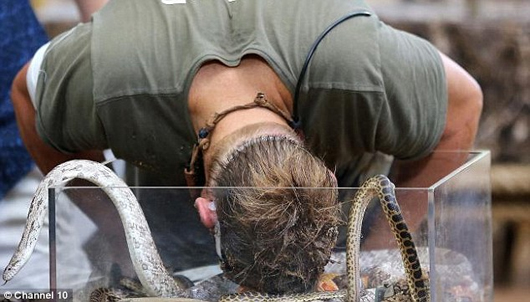
Melbourne, Feb 18: Never the one to shy away from a bit of adventurism, Australian spin legend Shane Warne ended up getting bitten on his head by an anaconda during his ongoing stint on a reality TV show here.
sw

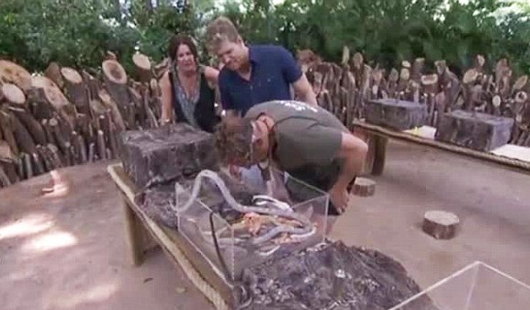
According to a report on news.com.au, Warne, while performing a task on the show 'I'm A Celebrity...Get Me Out Of Here!', Warne was bitten by a non-venomous anaconda.

"After bravely facing boxes filled with African clawed frogs, scorpions, Madagascan hissing cockroaches and rats in search of stars, Shane is presented with a box of snakes," the report stated.

"Host Dr Chris Brown warns the legendary spinner that with the scent of rat on his skin, the snakes could easily think he is their next meal. As Shane — who once cried because his daughter would not let him watch the Vince Vaughn comedy Dodgeball - lowers his head into the box, an aggressive anaconda strikes," it added.

Warne was treated for his injury and is being monitored for any sign of infection.
"Shane has made no secret that snakes are one of his greatest fears so it's amazing that after being bitten he bravely continued with the trial," executive producer Stephen Tate told the 'Daily Telegraph'.

"The box contained anacondas, rat snakes and corn snakes. The juvenile anaconda is the one that actually struck Shane. It's non-venomous but very aggressive. Anacondas have 100 rear-facing teeth. Being bitten by one is like getting 100 hypodermic needles at once," a Network Ten spokesperson told 'news.com.au'.

sw2

Comments

Narvante
 - 
Thursday, 18 Feb 2016

Anoconda bite is nothing for him. coz he has survived bites of thousands of women during his glorious cricketing career.

Add new comment

  • Coastaldigest.com reserves the right to delete or block any comments.
  • Coastaldigset.com is not responsible for its readers’ comments.
  • Comments that are abusive, incendiary or irrelevant are strictly prohibited.
  • Please use a genuine email ID and provide your name to avoid reject.
News Network
February 28,2020

Bengaluru, Feb 28: Historian S. Shettar, 85, breathed his last early on February 28 in Bengaluru. He was suffering from respiratory problems and was hospitalised for over a week.

Shettar was known for his multi-disciplinary work, encompassing linguistics, epigraphy, anthropology, the study of religions and art history. He had extensively worked on the Jain practice of ritual death in Karnataka and Asoka edicts. He had studied and compiled early edicts in Kannada and worked extensively on the growth of Kannada language down the ages.

Born in 1935 at Hampasagara, Ballari district, he went on to study at Cambridge University and started his career as a Professor of History at Karnatak University, Dharwad, his alma mater. He later headed the National Museum Institute of the History of Art, Conservation and Museology in 1978 and Indian Council for Historical Research in 1996. He was also a visiting professor at the National Institute of Advanced Studies, Bengaluru.

He was a bilingual historian who wrote in English for most of his career, but started writing in Kannada in later years. In the last two decades, he developed a keen interest in linguistics and wrote multiple books on classical Kannada and Prakrit. His 2007 book “Shangam Tamilagam” is considered a seminal work in the study of the early period of Dravidian languages. It won him Bhasha Samman from Central Sahitya Akademi. He later wrote two works on Halegannada, classical Kannada. His most recent work was “Prakrita Jagadvalaya” in 2018.

Comments

Add new comment

  • Coastaldigest.com reserves the right to delete or block any comments.
  • Coastaldigset.com is not responsible for its readers’ comments.
  • Comments that are abusive, incendiary or irrelevant are strictly prohibited.
  • Please use a genuine email ID and provide your name to avoid reject.
News Network
March 30,2020
Mangaluru, Mar 30: Kanachur Institute of Medical Sciences, Natekal, has started online tele-consultation service in the constituent Kanachur Hospital & Research Centre amid fear of corona spread.
 
A statement issued here on Monday said, under this service people can contact the doctors sitting in their home. The doctors will give tele-consultation and medical advice for their health problems through WhatsApp. As per the Kanachur Hospital announcement for this purpose the specialist doctors of nine departments will give their tele-consultation from 0900 hrs to 1600 hrs.
 
The people who are not having the social media service (WhatsApp) from rural areas they can directly contact the concerned department specialists over phone by informing the disease details and obtain advises from the doctors through the hospital landline number 0824-2888000.

Comments

Add new comment

  • Coastaldigest.com reserves the right to delete or block any comments.
  • Coastaldigset.com is not responsible for its readers’ comments.
  • Comments that are abusive, incendiary or irrelevant are strictly prohibited.
  • Please use a genuine email ID and provide your name to avoid reject.
News Network
January 29,2020

Newsroom, Jan 29: Karnataka’s capital has earned the unwelcome distinction of global capital of traffic congestion. According to a report by TomTom, the Netherlands-based global provider of navigation, traffic and map products, Bengaluru beat 415 other cities across 57 countries to earn the title of world's most traffic congested city in 2019.

“Bengaluru takes the top spot this year with drivers in the southern Indian city expecting to spend an average of 71% extra travel time stuck in traffic," TomTom said in the ninth edition of its annual Traffic Index.

Three other Indian cities, namely, Mumbai, Pune and New Delhi are also ranked in the 2019 edition of TomTom’s Traffic Index of the world’s most traffic-congested cities. 

The report released on Tuesday ranks cities by the average time added to a trip. TomTom index also includes details on when congestion is heaviest and lightest, how highways compare with surface streets, and how much time drivers wasted waiting for other drivers to get out of their way.

Following closely on the heels of Bengaluru is Manila, Philippines, with the similar 71% traffic congestion. Among the top five worst traffic affected cities are Mumbai and Pune from India at the fourth and fifth place respectively, while Bogota, Colombia is on third spot.

Delhi, the national capital of India is on the 8th spot, while Moscow (Russia), Lima (Peru), Istanbul (Turkey) and Jakarta (Indonesia) are on 6th, 7th, 9th and 10th spot respectively.

Mumbai recorded a 65% traffic congestion with 9th September, 2019 being the worst day. On an average, a Mumbaikar lost 209 hours in traffic congestion. Pune has 59% traffic congestion with 2nd August, 2019 being the worst day. 193 hours are lost due to congestion. Delhi, on the other hand, has 56% traffic congestion. 23rd October, 2019 was the worst day, while 190 hours are lost in traffic congestion.

Interestingly, among all the four Indian cities, Delhi has the most number of cars. Previous studies have concluded that Delhi has the best road conditions among the Metro cities of India.

If you are wondering what exactly the percentages mean, a 53% congestion level in Bangkok, for example, means that a trip will take 53% more time than it would during Bangkok’s baseline uncongested conditions.

TomTom calculates the baseline per city by analyzing free-flow travel times of all vehicles on the entire road network – recorded 24/7, 365 days a year. The report by Dutch navigation and mapping company ranks cities by the average time added to a trip. It also includes details on when congestion is heaviest and lightest, and how much time drivers wasted waiting for other drivers to get out of their way.

Comments

Add new comment

  • Coastaldigest.com reserves the right to delete or block any comments.
  • Coastaldigset.com is not responsible for its readers’ comments.
  • Comments that are abusive, incendiary or irrelevant are strictly prohibited.
  • Please use a genuine email ID and provide your name to avoid reject.