Sri Ram Sena slams Pejawar seer, asks him to step down from Paryaya Peetha

CD Network | Photos by Chakravarthi
June 29, 2017

Mangaluru, Jun 29: The Hindutva hardliners have upped the ante against Sri Vishwesha Teertha, the chief pontiff of Paryaya Pejawar Mutt for hosting an iftar meet at Krishna temple during Ramadan and promoting communal harmony.

shivsena 1

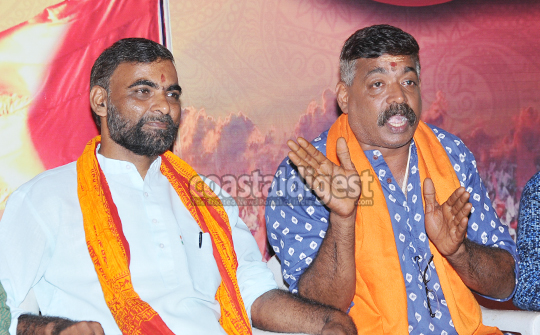
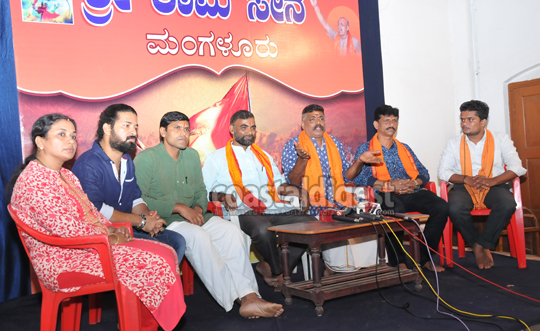
In a joint press meet on Thursday Sri Ram  Sena and Hindu Maha Sabha accused the senior pontiff of betraying Hindu activists fighting for Hindutva by feeding Muslims in Krishna Temple and allowing them to offer namaz.

They have demanded the Seer to step down from the Paryaya peetha and hand over power to his next successor. "Age is catching up with the Seer. It's high time for him to retire. He should seek apology with Hindus for his act," they demanded. "This is a political gimmick as elections are round the corner," alleged Praveen Walke, state general secretary of the Sene.

Walke pointed out they are not against Muslim community, but organsing an Iftar get-together without consulting any Hindu leader has hurt their sentiments. "If the seer started organising Iftar decades ago, there wouldn't have communal disharmony among Hindus and Muslims. After the Ram Mandir and Babri Masjid issue, there is a misunderstanding between both the communities," noted Walke.

They also demanded similar gesture from Muslims to foster amity by allowing them inside Mosque for chanting bhajans and insisted Pejwar seer should arrange for it.

Walke termed that seers and religious leaders were responsible for destroying the future young Hindu youths in the name of Hinduism.

Pointing out at the recent Kalladka violence, they said this is the outcome of how Hindu youths are used by religious leaders. Dharmendra, state spokesperson of Hindu Maha Sabha alleged that Iftar inside temple is to score brownie points politically. He said that five years ago when Congress leader Janardhan Poojary celebrated Iftar in Kudroli Temple, BJP condemned and protested but there was silence this time.

Sri Rama Sene will hold protest condemning Sri Vishvesha Teertha organising Iftar in temple, on July 2.

shivsena 2

Comments

Ahmed Ali K
 - 
Wednesday, 5 Jul 2017

These b***shits should be hanged in public place to make others who are engaged in this type of business a lesson.

Add new comment

  • Coastaldigest.com reserves the right to delete or block any comments.
  • Coastaldigset.com is not responsible for its readers’ comments.
  • Comments that are abusive, incendiary or irrelevant are strictly prohibited.
  • Please use a genuine email ID and provide your name to avoid reject.
Ram Puniyani
January 14,2020

In the beginning of January 2020 two very disturbing events were reported from Pakistan. One was the attack on Nankana Sahib, the holy shrine where Sant Guru Nanak was born. While one report said that the place has been desecrated, the other stated that it was a fight between two Muslim groups. Prime Minister of Pakistan Imran Khan condemned the incident and the main accused Imran Chisti was arrested. The matter related to abduction and conversion of a Sikh girl Jagjit Kaur, daughter of Pathi (One who reads Holy Guru Granth Sahib in Gurudwara) of the Gurudwara. In another incident one Sikh youth Ravinder Singh, who was out on shopping for his marriage, was shot dead in Peshawar.

While these condemnable attacks took place on the Sikh minority in Pakistan, BJP was quick enough to jump to state that it is events like this which justify the Citizenship Amendment Act (CAA). Incidentally CAA is the Act which is discriminatory and relates to citizenship with Religion, which is not as per the norms of Indian constitution. There are constant debates and propaganda that population of Hindus has come down drastically in Pakistan and Bangla Desh. Amit Shah, the Home minister stated that in Pakistan the population of Hindus has come down from 23% at the time of partition to 3.7% at present. And in Bangla Desh it has come down from 22% to present 8%.

While not denying the fact that the religious minorities are getting a rough deal in both these countries, the figures which are presented are totally off the mark. These figures don’t take into consideration the painful migrations, which took place at the time of partition and formation of Bangla Desh later. Pakistan census figures tell a different tale. Their first census was held in 1951. As per this census the overall percentage of Non Muslim in Pakistan (East and West together) was 14.2%, of this in West Pakistan (Now Pakistan) it was 3.44 and in Eat Pakistan it was 23.2. In the census held in Pakistan 1998 it became 3.72%. As far as Bangla Desh is concerned the share of Non Muslims has gone down from 23.2 (1951) to 9.6% in 2011.

The largest minority of Pakistan is Ahmadis, (https://minorityrights.org/country/pakistan/) who are close to 4 Million and are not recognised as Muslims in Pakistan. In Bangla Desh the major migrations of Hindus from Bangla Desh took place in the backdrop of Pakistan army’s atrocities in the then East Pakistan.

As far as UN data on refugees in India it went up by 17% between 2016-2019 and largest numbers were from Tibet and Sri Lanka.  (https://www.un.org/en/development/desa/population/migration/publication…)

The state of minorities is in a way the index of strength of democracy. Most South Asian Countries have not been able to sustain democratic values properly. In Pakistan, the Republic began with Jinnah’s classic speech where secularism was to be central credo of Pakistan. This 11th August speech was in a way what the state policy should be, as per which people of all faiths are free to practice their religion. Soon enough the logic of ‘Two Nation theory” and formation of Pakistan, a separate state for Muslim took over. Army stepped in and dictatorship was to reign there intermittently. Democratic elements were suppressed and the worst came when Zia Ul Haq Islamized the state in collusion with Maulanas. The army was already a strong presence in Pakistan. The popular formulation for Pakistan was that it is ruled by three A’s, Army, America and Allah (Mullah).

Bangla Desh had a different trajectory. Its very formation was a nail in the coffin of ‘two nation theory’; that religion can be the basis of a state. Bangla Desh did begin as a secular republic but communal forces and secular forces kept struggling for their dominance and in 1988 it also became Islamic republic. At another level Myanmar, in the grip of military dictatorship, with democratic elements trying to retain their presence is also seeing a hard battle. Democracy or not, the army and Sanghas (Buddhist Sang has) are strong, in Myanmar as well. The most visible result is persecution of Rohingya Muslims.

Similar phenomenon is dominating in Sri Lanka also where Budhhist Sanghas and army have strong say in the political affairs, irrespective of which Government is ruling. Muslim and Christian minorities are a big victim there, while Tamils (Hindus, Christians etc.) suffered the biggest damage as ethnic and religious minorities. India had the best prospect of democracy, pluralism and secularism flourishing here. The secular constitution, the outcome of India’s freedom struggle, the leadership of Gandhi and Nehru did ensure the rooting of democracy and secularism in a strong way.

India so far had best democratic credentials amongst all the south Asian countries. Despite that though the population of minorities rose mainly due to poverty and illiteracy, their overall marginalisation was order of the day, it went on worsening with the rise of communal forces, with communal forces resorting to identity issues, and indulging in propaganda against minorities.

While other South Asian countries should had followed India to focus more on infrastructure and political culture of liberalism, today India is following the footsteps of Pakistan. The retrograde march of India is most visible in the issues which have dominated the political space during last few years. Issues like Ram Temple, Ghar Wapasi, Love Jihad, Beef-Cow are now finding their peak in CAA.

India’s reversal towards a polity with religion’s identity dominating the political scene was nicely presented by the late Pakistani poetess Fahmida Riaz in her poem, Tum bhi Hum Jaise Nikle (You also turned out to be like us). While trying to resist communal forces has been an arduous task, it is becoming more difficult by the day. This phenomenon has been variously called, Fundamentalism, Communalism or religious nationalism among others. Surely it has nothing to do with the religion as practiced by the great Saint and Sufi traditions of India; it resorts mainly to political mobilization by using religion as a tool.


Comments

Ashi
 - 
Tuesday, 14 Jan 2020

If Malaysia implement similar NRC/CAA, India and China are the loser.

Add new comment

  • Coastaldigest.com reserves the right to delete or block any comments.
  • Coastaldigset.com is not responsible for its readers’ comments.
  • Comments that are abusive, incendiary or irrelevant are strictly prohibited.
  • Please use a genuine email ID and provide your name to avoid reject.
News Network
June 3,2020

Bengaluru, Jun 3: Kempegowda International Airport in Bengaluru on Tuesday intensified preventive measures to contain the spread of COVID-19 in a bid to make air-travel contactless.

The airport has introduced contact-less self-check-in kiosks, non-intrusive thermal cameras, self bag drop facility and other features.

Bangalore International Airport Limited (BIAL) had earlier said that it will ensure that the taxis are sanitised and the drivers are screened before every trip to eliminate all chances of infection.

"Drivers have been instructed to maintain a safe distance. They will be encouraged to use hand sanitiser and face masks to make the car a safe space. Able-bodied passengers are advised to load their luggage into the car without the driver's assistance. For elderly citizens and passengers with reduced mobility, drivers will assist while following hygiene measures," BIAL statement had said.

The masks have been made mandatory for both drivers as well as passengers.

Karnataka on Monday reported 187 new cases of coronavirus, with which the State's total COVID-19 count has surged to 3,408.

Comments

Add new comment

  • Coastaldigest.com reserves the right to delete or block any comments.
  • Coastaldigset.com is not responsible for its readers’ comments.
  • Comments that are abusive, incendiary or irrelevant are strictly prohibited.
  • Please use a genuine email ID and provide your name to avoid reject.
News Network
March 31,2020

Patna, Mar 31: In arguably the first of its kind incident in the country, a young man in Bihar was beaten to death precisely because he had informed the district control room about two corona suspects who had arrived here in the State from Mumbai.

The incident took place in Sitamarhi in North Bihar where a 20-year-old youth Bablu Kumar was allegedly killed by Sudhir Mahto and Munna Mahto.

The two Mahtos had arrived from Mumbai to Sitamarhi around ten days back. Bablu, in the meantime, informed the district control room about the arrival of two persons from a State where a large number of people were afflicted with coronavirus.

A team of doctors on March 24 reached Runnisaidpur in Sitamarhi to examine the two suspects. Three days later, these two persons from Maharashtra tested negative.

But the incident (of informing control room and subsequent medial test) created such enmity between the family of Mahtos and Babloo that on Sunday when they found the 20-year-old young man sitting alone, they thrashed him so mercilessly that he died on the spot.

Shocked and grief-struck, Babloo’s father Vinod Singh eventually lodged an FIR with the police and named Sudhir Mahto, Munna Mahto, and their family members as accused in the killing of his son.

The police on Monday raided the place and arrested the Mahtos.

But then, this is not an isolated case of violence. In another incident that took place in Bihar’s Jehanabad district, a BDO Ajay Kumar and a police officer Chandrashekhar Kumar were attacked by fellow villagers when the officials reached there to quarantine those migrants who had reached there from Delhi. So angry were the villagers with the officials’ move to isolate the migrants that they smashed the window-panes of the government vehicles and attacked the officials.

The officials had to beat a hasty retreat. But they soon returned with additional police team which used brutal force and took local leaders into custody before restoring normalcy in the area.

Comments

Add new comment

  • Coastaldigest.com reserves the right to delete or block any comments.
  • Coastaldigset.com is not responsible for its readers’ comments.
  • Comments that are abusive, incendiary or irrelevant are strictly prohibited.
  • Please use a genuine email ID and provide your name to avoid reject.