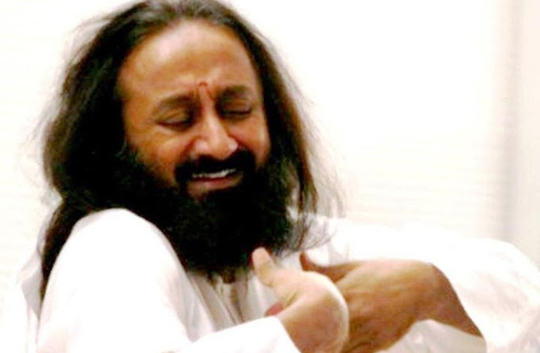
Sri Sri Ravi Shankar promotes Pakistan Zindabad' slogan

[email protected] (CD Network)
March 13, 2016

New Delhi, Mar 13: Amid ongoing row over the alleged anti-national sloganeering at Jawaharlal Nehru University (JNU), the Art of Living founder Sri Sri Ravi Shankar has openly promoted Pakistan Zindabad' slogan without any hesitation. Interestingly, no self-proclaimed nationalist' political parties and television channels have called him an anti-national'.

Sri

Speaking at the three-day World Culture Festival at the Yamuna floodplains on Saturday Ravi Shankar said that “Jai Hind and Pakistan Zindabad” should go together for peace and development in the region. The shocking remarks came soon after Pakistan's Mufti Muhammad Saeed Khan finished his speech.

“Jai Hind and Pakistan Zindabad should go together. It will be should be a win-win situation for both sides. We should focus on winning and making the other also win," the Art of Living founder added.

Union Home Minister Rajnath Singh, External Affairs Minister Sushma Swaraj and Delhi's Deputy Chief Minister Manish Sisodia were among the prominent political figures who attended the event on Saturday.

"This is the biggest cultural event happened anywhere in the world ever... Gurudev Sri Sri Ravi Shankar has made us all proud as he has conveyed the message of Indian heritage and traditions to all over the world," Rajnath Singh said.

Sushma Swaraj said: "India is lucky as Sri Sri was born here."

"The dais of Sri Sri Ravi Shankar is a perfect stage of secularism. Spiritual leaders from all the faiths are here. Sri Sri can have such a spiritual conclave anywhere in the world," she said.

Chief Ministers of Madhya Pradesh, Chhattisgarh and Maharashtra Shivraj Singh Chouhan, Raman Singh, and Devendra Fadnavis respectively also shared the dais with the spiritual guru.

On the second day, musical troupes and dance groups from several countries including Ghana, Indonesia, Sri Lanka, South Africa, and the Netherlands performed before a huge gathering at the huge seven-acre stage.

Indian folk and classical dances also enthralled the audience. The entertainment was coupled with religious teachings from spiritual leaders.

Comments

AK
 - 
Monday, 14 Mar 2016

A Clear Picture of Govt's COWARDNESS...
Kanaihya - Fake slogan arrested
Shankar - Slogan given openly and the POLICE, Bassi, the coward lawmakers, the VHP BD cheddis are all becoming BLIND & DEAF to this.
I request this cheddi gangs... TILL how long will YOU try to deceive PEOPLE and our SOCIETY... days are gone where YOUR games are hidden. God will EXPOSE every deception that U are playing with the SOCIETY>.. Come on guys stop falling TRAP to cheddi leaders and act for the betterment of the SOCIETY and KICK the cheddi leaders who tries to provoke U guys... Dont YOU have that sense to recogniZe GOOD from BAD...
Animals understand what is GOOD and what is BAD. God made us more intelligent than animals... Use your intellectual which god has given us and stop supporting the arrogant and LIARS

Fair talker
 - 
Sunday, 13 Mar 2016

What he said is 100% correct. He is the very open minded person.

What he said is not enough. He should have told. All the world zindabad including India, Pakistan, China. Every Indian should practice this idea. If the dog bites, should we bite the dog.

We also want the same attitude by Pakistan.

We want every Indian Sadhoo, Sadhvi, priest, Moulvi preach the same.

UMMAR
 - 
Sunday, 13 Mar 2016

WERE IS BJP WERE IS BD NHP RSS NEED PTOTEST AGAINST THE SRI SRI SRII,,,

IF AMIRKHAN SAYS IF KANAYYA SAYS THEY WIL HURT DEEPLY .. IF SRI SRI SAYS NOTHING HURTS ,,,

BJP IS BIG FRAUD PARTY THAT TRUE,,,

Rikaz
 - 
Sunday, 13 Mar 2016

What is strange in it....recently Fekuji went and met Nawab sharief in Pakistan....if they dont have problem why should we have problems...we innocent people fighting each other for nothing....those who are in big posts are enjoying their life like anything....

ali
 - 
Sunday, 13 Mar 2016

Now Coward BJP taking U turn through popet shankar. After the revolution in JNU BJP is scared from students votes.

What else public can expect from the jumla government.

Add new comment

  • Coastaldigest.com reserves the right to delete or block any comments.
  • Coastaldigset.com is not responsible for its readers’ comments.
  • Comments that are abusive, incendiary or irrelevant are strictly prohibited.
  • Please use a genuine email ID and provide your name to avoid reject.
Agencies
February 6,2020

Even more than three years after demonetisation and all-out efforts to make most transactions through electronic, cash is still king, as it thrives in a digital India, said fintech start-up Paytm founder Vijay Sekhar Sharma.

"While cashless economy is not possible in India, less cash economy will be in the future. Less cash is the only solution, not the elimination of cash," Sharma told IANS in an interview after unveiling an all-in-one payment gateway on Tuesday.

Asserting that it would take 5-10 years for India to make the transition to digital payments from the traditional mode of cash, Sharma, 41, said the e-payment industry benefitted more from the November 8, 2016 note ban and withdrawal of old Rs 1,000 and Rs 500 denominations.

"I think it (demonetisation) helped the industry despite lack of specific help. But the world has changed since then. It is about the scale of distribution of merchants that is what is propelling digital payments," said Sharma.

Most of the cash not only came back into circulation, but also remains as the mode of payment for the majority due to its convenience for the people used to such transactions.

Expounding Paytm's zero service charge, Sharma said the strategy is sustainable as it leads to acquiring more customers and merchants, enabling newer business opportunities.

Paytm also does not levy a service charge to small merchants for its payments services, unlike organised players like Uber.

"Though there is a monetisation model, the merchants who are small shopkeepers, become our financial services customers as they open a bank account, which is profitable."

Paytm secured a Payments Bank license from the Reserve Bank of India to offer a savings bank account, Rupay debit card and money transfer services.

"We are banking on payment services acquiring customers and merchants who avail banking, lending, insurance, wealth and software services like billing software and business ledger software services eventually," Sharma noted.

The mobile first bank services include zero balance and zero digital transaction charge accounts.

"Basically, payments, cloud, commerce and financial services are a cohort we follow. So, payments is our customer as well as merchant acquisition. If it breaks even, we are happy because other line items make more money, he affirmed.

Noting that in a market like India, one cannot price services at a premium unlike in a developed country like the US, the billionaire businessman said a consumer in a developing country would not be able to afford such a hefty charge.

Forbes ranked Sharma as India's youngest billionaire in 2017, with a net worth of $2.1 billion.

While several countries operate on the model of higher service charges, Sharma said newer business models have to be discovered in India, as customer lifecycle value is accounted for more stages than in other nations.

Asked about an upscale retailer like Zara not giving a wallet payment option during its recent end of season sale in Bengaluru, Sharma said Paytm was addressing such hiccups with its all-in-one payment solutions.

"It's an opportunity, because if the retailer has our all-in-one point of sale machine, where in they enter the amount, it shows both the Quick Response code (QR) and card payment options," he observed.

Sharma compared older swiping payment machine to feature phones and modern ones to feature-rich smartphones.

"If you notice, they look like feature phones and the modern day card machine is more a smartphone like. You can add the smatphone components, which can add the features," reiterated Sharma.

Though Paytm's all-in-one QR point of sale machine integrates the billing system, its chief executive said it was not ideal to have an independent QR feature.

Paytm has 16 million strong merchant user base, which Sharma aims to raise to 26 million base in the next one year.

Sharma has launched in this tech city an all-in-one payment gateway and Paytm Business Payments solution, which enable digital payments through multiple methods for small and medium enterprises (SMEs) and an Android point of sale machine.

With the new gateway solution, collecting digital payments through multiple methods can be achieved seamlessly while Paytm Business Payments solution enables automated vendor payments, including employee salaries and customer refunds among others.

The One97 Communications-owned Paytm aims to help SMEs streamline and digitise their business activities using its new solutions, which enhance the overall efficiency of both accepting and making payments.

Paytm has a data bank of over 200 million saved cards and bank accounts, a feature which enables partner apps to shorten transaction times and propel faster conversions while using the all-in-one payment gateway.

Complementing the two solutions, Sharma also launched an all-in-one Android point of sale machine, which can accept payments through all forms such as cards, wallets, UPI apps and even cash.

The device has a QR code that supports all contact and contactless payments, coming with integrated billing software customized solutions for different sectors such as catering, ticketing, parking and others.

The handheld Android device is equipped with an in-built printer, scanner and can also generate bills.

Valued at $16 billion, Paytm is not alone in the fiercely competitive Indian fintech space where a dozen players like PhonePe, MobiKwik, Kotak 811 and deep pocketed international giants Google Pay and Amazon Pay are in the fray.


Comments

Add new comment

  • Coastaldigest.com reserves the right to delete or block any comments.
  • Coastaldigset.com is not responsible for its readers’ comments.
  • Comments that are abusive, incendiary or irrelevant are strictly prohibited.
  • Please use a genuine email ID and provide your name to avoid reject.
Ram Puniyani
January 22,2020

Shivaji is a great icon in Maharashtra. Different sections of society have given him very high status, though for diverse reasons. Folklores about him abound in the state. His statues, popular songs on him are very prevalent. These folk songs (Powadas) praise his multifarious actions. So it was no surprise that when Jayabhagwan Goyal, released his book, ‘Aaj ka Shivaji: Narendra Modi’, at religious-cultural meet organized by Delhi BJP, there was a strong resentment in Maharashtra. Various leaders from Maharashtra were furious. The Shiv Sena leader Sanjay Raut challenged the Shivaji’s descendent, Sambhaji Raje who is in BJP and is member of Rajya Sabha, to resign on the issue. Sambhaji Raje in turn stated that "We respect Narendra Modi, who was elected as the prime minister of the country for the second time. But neither (Narendra) Modi nor anybody else in the world can be compared with Chhatrapati Shivaji Maharaj,"

Not to be left behind Jitendra Awhad of NCP felt Modi-BJP are insulting the pride of Maharashtra. It is not the first time that controversy is erupting around the Maharashtra warrior of medieval period. Earlier we had seen Sambhaji Brigrade demanding the ban on James Laine book, Shivaji: ‘A Hindu King in an Islamic Kingdom’, for its objectionable content. Bhandarkar Institute in Pune, which had helped James Laine in his research, was also vandalized. At another level there was a talk that Babasaheb Purandare, a Brahmin, who has written some popular material on Shivaji will be made as the Chairman of the committee for statue of Shivaji. Maratha Mahasangh and Shiv Dharm officials objected to a Brahmin heading the committee for a statue for the Maratha warrior. The caste angel in Shivaji’s case is coming to the fore from quite some time.

While there is no dearth of controversies around Shivaji, it is also true that each political tendency has created Shivaji’s image from their political point of view. Who was the real Shivaji, is the question. One can see two clear streams of projection in this matter. On one hand there is an attempt to present Shivaji as the anti Muslim King, a king who was respecting Cows and Brahmins (Go Brahman pratipalak). This view was brought forward from the times of Lokmanya Tilak and picked up by Hindu nationalists, who have been looking for icons in history to suit their political agenda. Nathram Godse, while criticizing Gandhi says that Gandhi’s nationalism was dwarf in front of the one of Shivaji or Rana Pratap.

In tune with this the Hindu nationalists are promoting both these as icons of Hindu nationalism and giving anti-Muslim slant to the whole discourse. This discourse also hides in this the Brahmanical agenda of Hindu nationalism as Cows and Brahmins are presented as the central object of veneration by Shivaji. This image of Shivaji fits well into the current agenda of Hindu nationalists, being spearheaded by RSS Combine.

It is because of this that for seeking votes in Mumbai Narendra Modi on the eve of 2014 elections stated that Shivaji attacked Surat to plunder the treasury of Aurangzeb. This also presents Shivaji-Aurangzeb, Shivaji-Afzal Khan interactions as battle between Hindus and Muslims. The truth is that Surat was plundered for its wealth as it was a rich port city and Bal Samant’s book on the topic gives in depth description of the same. It is noteworthy that Shivaji began his real career of conquest in 1656 when he conquered Javli from the Maratha Chief Chandra Rao More. He took over the treasures of this kingdom. That it was not a Hindu Muslim battle becomes clear when we know that in confrontation with Aurangzeb it was Mirza Raja Jaisingh who was negotiating and engaging with Shivaji on behalf of Aurangzeb. And Shivaji had Muslim officers like Kazi Haider as confidential secretary and many Muslim Generals in his army.

Darya Sarang was chief of armor division, Daulat Khan was in-charge of his naval division; Ibrahim Khan was another general of significance in his army.  This mixed up administration just shows that the kings were not having Hindu or Muslim administration depending on their religion. In the confrontation between Shivaji and Afzal Khan, Rustam-e-Jaman was Shivaji’s side and Afzal Khan had Krisnaji Bhaskar Kulkarni on his side.

As far as Shivaji’s popularity is concerned it was due to his being a King with welfare of his subjects in his mind. He lightened the burden of taxation on the average peasants, and reduced the domination of landlords over the serfs. This picture of Shivaji is well documents in the booklets by Com. Govind Pansare (Who was Shivaji) and Jayant Gadkari (Shivaji: Ek Lok Kalyankari Raja- Shivaji: King doing People’s Welfare). He did not belong to the warrior caste so Brahmins had refused to coronate him, for which purpose Gaga Bhatt a Brahmin from Kashi was brought in with heavy fees. Teesta Setalvad’s hand book on History for teachers underlined this fact.

Today while BJP-Brahmanical forces want to present Shivaji as worshipper of Brahmins and cows, the non upper caste have seen through the game. As such it was Jotirao Phule who brought forward the caste angel of Shivaji as he wrote Powada (Poem) in his honor and today dalit Bahujan are not toeing Hindu Nationalist projection on the issue.

The likes of Jayabhagwan Goyal of BJP as such are trying to give two messages through such attempts. One hand they want to paint Shivaji in anti Muslim and Brahmanical color, they also want to give the subtle message of similarity of this presentation of Shivaji with what Modi is doing. Non BJP forces have seen this game and want to present the other picture of Shivaji, which was highlighted by the likes of Jotirao Phule and which today many of those standing for rights of dalit-Bahujan are trying to articulate. The criticism of the said, book, since withdrawn is on these twin aspects. One about the picture of Shivaji who was concerned about welfare of the farmers, and two his respect for people of all religions.

Comments

Add new comment

  • Coastaldigest.com reserves the right to delete or block any comments.
  • Coastaldigset.com is not responsible for its readers’ comments.
  • Comments that are abusive, incendiary or irrelevant are strictly prohibited.
  • Please use a genuine email ID and provide your name to avoid reject.
coastaldigest.com news network
June 8,2020

Bengaluru, Jun 8: Karnataka recorded 308 new COVID-19 cases in the past 24 hours, with the majority of patients being domestic returnees, raising the state's tally to 5,760 an official said, here on Monday. "Over 308 new cases were reported from Sunday 5 pm to Monday 5 pm," said the health official.

Like everyday Maharashtra returnees accounted for 96 per cent (267 cases) of the 277 new cases. Majority infections in Karnataka nowadays are returnees, mostly from the state's northern neighbour.

A few returnees also came from Tamil Nadu, Telangana and Andhra Pradesh. There was one international returnee, a 23-year-old man from Dakshina Kannada, who came from the UAE. Only 24 new infections were contacts of earlier cases.

On Monday, cases spiked in Kalaburagi, Yadgir, Bidar, Udupi, Bengaluru Urban, Ballari and Gadag.

Among the new cases, Kalaburagi contributed (99), followed by Yadgir (66), Bidar (48), Udupi (45), Bengaluru Urban (18), Ballari (8), Gadag (6), Shivamogga and Dharwad (4 each), Hassan and Dakshina Kannada (3 each), Bagalkote (2) and Koppal and Ramnagar (1 each). Four patients are suffering from Influenza-Like Illness (ILI).

Meanwhile, record 387 patients got discharged in the past 24 hours. On Monday, three persons - A 67-year-old man, a 48-year-old woman and another 65-year-old woman, all from Bengaluru Urban, succumbed to coronavirus.

Of all the cases, 3,175 are active, 2,519 discharged, 64 dead and 14 in the ICU.

In the past 24 hours, Karnataka tested 8,779 people. Of this, 8,231 reports returned negative. A number of tests were lower than other days. In total, 3.93 lac samples have been tested so far, of which 3.8 lac have returned negative.

Currently, Udupi is leading the state's COVID-19 burden with 628 active cases, followed by Kalaburagi (539), Yadgir (488), Raichur (276) and Bengaluru Urban (176) among others.

Bengaluru Urban has accounted for 18 deaths, followed by Kalaburagi (7), Bidar, Vijayapura, Davangere and Dakshina Kannada (6 each) and Chikkaballapur (3 each), among others.

Comments

Add new comment

  • Coastaldigest.com reserves the right to delete or block any comments.
  • Coastaldigset.com is not responsible for its readers’ comments.
  • Comments that are abusive, incendiary or irrelevant are strictly prohibited.
  • Please use a genuine email ID and provide your name to avoid reject.