Srinivas Prasad praises Modi politics, says BJP is not anti-Dalit

[email protected] (CD Network)
January 3, 2017

Bengaluru, Jan 3: Party hopper V Srinivas Prasad, who recently quit as Congress MLA and formally joined BJP on Monday, claimed that he intends to retire in a dignified manner from politics.

srinivas 3

"This is my last leg in politics, I know that. I am not hungry for power or fame. I only want an honourable exit from politics," Prasad told reporters after joining BJP here.

Prasad, once a confidant of chief minister Siddaramaiah, resigned from his assembly seat and the Congress, after he was dropped during the cabinet reshuffle in June 2016.

Stating that the impending bypoll to the Nanjangud assembly constituency, which he represented, will be his last election, Prasad said he was hurt by the attitude of Congress and Siddaramaiah.

"Nobody anticipated this moment. Neither I nor you (BJP) could have foreseen this situation. But here we are, and my only assurance of joining the BJP is that I should not be treated the way Congress treated me," he said.

Showering praises on the saffron party, Prasad said that BJP could not have won the mandate of the people to run the nation if it was “anti-Dalit”.

“The BJP?not only emerged as the single largest party but also secured majority on its own in the Lok?Sabha elections in 2014. This could not have been achieved without the support of Dalits,” he said. Prasad said he joined the BJP?as he appreciated and agreed with the “politics of social concern and commitment” practised by Prime Minister Narendra Modi.

“Programmes such as Swachh Bharat and Mann Ki Baat appealed to me and I appreciated Modi. This went against me in the Congress,” he added.

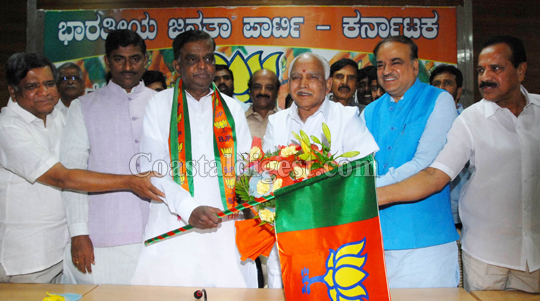
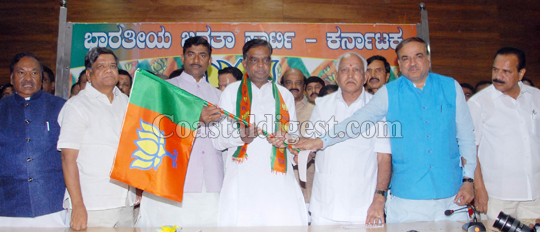
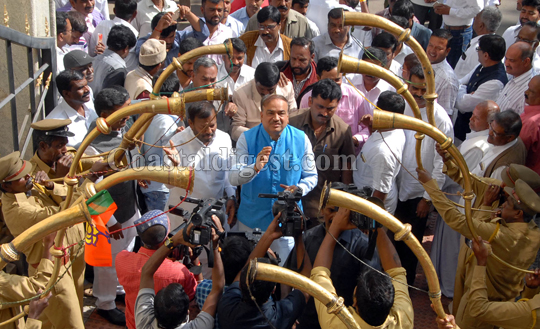
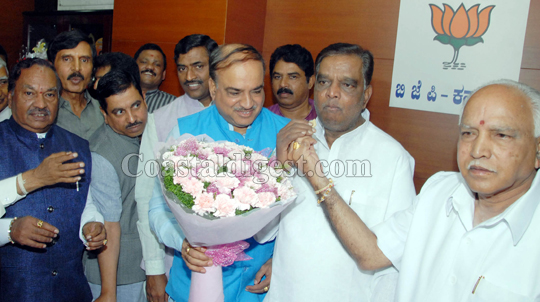
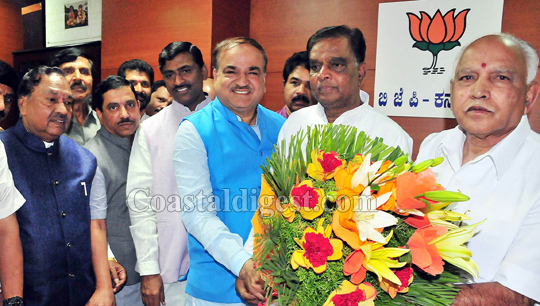
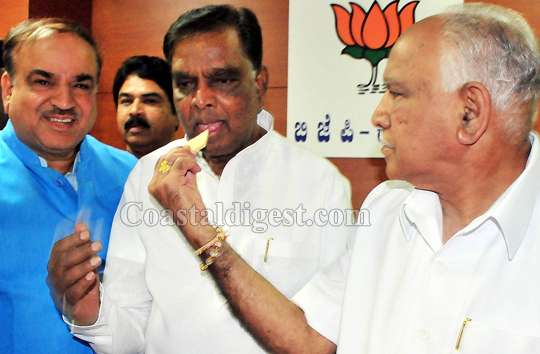
Prasad officially joined the BJP?by receiving the party flag from state unit president B?S?Yeddyurappa in?Bengaluru. Prasad also paid the requisite fee of Rs 5 to enrol as a primary member of the BJP. The event portrayed a show of unity among the state BJP leaders with most of the prominent faces including K S?Eshwarappa being present.

srinivas 1

srinivas 2

srinivas 4

srinivas 5

srinivas 6

Comments

Althaf
 - 
Tuesday, 3 Jan 2017

Besharam Janatha Party..

Thinkers
 - 
Tuesday, 3 Jan 2017

Bjp wins or not in next election, I got my cash.... Kalli walli people are fools to believe us politicians ... Ha Ha ha

shaji
 - 
Tuesday, 3 Jan 2017

This man is like a Girgit who changes its color based on environment and situation. Till yesterday this man was blaming bjp and today he is praising the party. Tomorrow he will jump to another party and blame bjp. We cant and should not trust politicians as they have no faith and trust. Money and seat are their belief.

Add new comment

  • Coastaldigest.com reserves the right to delete or block any comments.
  • Coastaldigset.com is not responsible for its readers’ comments.
  • Comments that are abusive, incendiary or irrelevant are strictly prohibited.
  • Please use a genuine email ID and provide your name to avoid reject.
Ram Puniyani
January 14,2020

In the beginning of January 2020 two very disturbing events were reported from Pakistan. One was the attack on Nankana Sahib, the holy shrine where Sant Guru Nanak was born. While one report said that the place has been desecrated, the other stated that it was a fight between two Muslim groups. Prime Minister of Pakistan Imran Khan condemned the incident and the main accused Imran Chisti was arrested. The matter related to abduction and conversion of a Sikh girl Jagjit Kaur, daughter of Pathi (One who reads Holy Guru Granth Sahib in Gurudwara) of the Gurudwara. In another incident one Sikh youth Ravinder Singh, who was out on shopping for his marriage, was shot dead in Peshawar.

While these condemnable attacks took place on the Sikh minority in Pakistan, BJP was quick enough to jump to state that it is events like this which justify the Citizenship Amendment Act (CAA). Incidentally CAA is the Act which is discriminatory and relates to citizenship with Religion, which is not as per the norms of Indian constitution. There are constant debates and propaganda that population of Hindus has come down drastically in Pakistan and Bangla Desh. Amit Shah, the Home minister stated that in Pakistan the population of Hindus has come down from 23% at the time of partition to 3.7% at present. And in Bangla Desh it has come down from 22% to present 8%.

While not denying the fact that the religious minorities are getting a rough deal in both these countries, the figures which are presented are totally off the mark. These figures don’t take into consideration the painful migrations, which took place at the time of partition and formation of Bangla Desh later. Pakistan census figures tell a different tale. Their first census was held in 1951. As per this census the overall percentage of Non Muslim in Pakistan (East and West together) was 14.2%, of this in West Pakistan (Now Pakistan) it was 3.44 and in Eat Pakistan it was 23.2. In the census held in Pakistan 1998 it became 3.72%. As far as Bangla Desh is concerned the share of Non Muslims has gone down from 23.2 (1951) to 9.6% in 2011.

The largest minority of Pakistan is Ahmadis, (https://minorityrights.org/country/pakistan/) who are close to 4 Million and are not recognised as Muslims in Pakistan. In Bangla Desh the major migrations of Hindus from Bangla Desh took place in the backdrop of Pakistan army’s atrocities in the then East Pakistan.

As far as UN data on refugees in India it went up by 17% between 2016-2019 and largest numbers were from Tibet and Sri Lanka.  (https://www.un.org/en/development/desa/population/migration/publication…)

The state of minorities is in a way the index of strength of democracy. Most South Asian Countries have not been able to sustain democratic values properly. In Pakistan, the Republic began with Jinnah’s classic speech where secularism was to be central credo of Pakistan. This 11th August speech was in a way what the state policy should be, as per which people of all faiths are free to practice their religion. Soon enough the logic of ‘Two Nation theory” and formation of Pakistan, a separate state for Muslim took over. Army stepped in and dictatorship was to reign there intermittently. Democratic elements were suppressed and the worst came when Zia Ul Haq Islamized the state in collusion with Maulanas. The army was already a strong presence in Pakistan. The popular formulation for Pakistan was that it is ruled by three A’s, Army, America and Allah (Mullah).

Bangla Desh had a different trajectory. Its very formation was a nail in the coffin of ‘two nation theory’; that religion can be the basis of a state. Bangla Desh did begin as a secular republic but communal forces and secular forces kept struggling for their dominance and in 1988 it also became Islamic republic. At another level Myanmar, in the grip of military dictatorship, with democratic elements trying to retain their presence is also seeing a hard battle. Democracy or not, the army and Sanghas (Buddhist Sang has) are strong, in Myanmar as well. The most visible result is persecution of Rohingya Muslims.

Similar phenomenon is dominating in Sri Lanka also where Budhhist Sanghas and army have strong say in the political affairs, irrespective of which Government is ruling. Muslim and Christian minorities are a big victim there, while Tamils (Hindus, Christians etc.) suffered the biggest damage as ethnic and religious minorities. India had the best prospect of democracy, pluralism and secularism flourishing here. The secular constitution, the outcome of India’s freedom struggle, the leadership of Gandhi and Nehru did ensure the rooting of democracy and secularism in a strong way.

India so far had best democratic credentials amongst all the south Asian countries. Despite that though the population of minorities rose mainly due to poverty and illiteracy, their overall marginalisation was order of the day, it went on worsening with the rise of communal forces, with communal forces resorting to identity issues, and indulging in propaganda against minorities.

While other South Asian countries should had followed India to focus more on infrastructure and political culture of liberalism, today India is following the footsteps of Pakistan. The retrograde march of India is most visible in the issues which have dominated the political space during last few years. Issues like Ram Temple, Ghar Wapasi, Love Jihad, Beef-Cow are now finding their peak in CAA.

India’s reversal towards a polity with religion’s identity dominating the political scene was nicely presented by the late Pakistani poetess Fahmida Riaz in her poem, Tum bhi Hum Jaise Nikle (You also turned out to be like us). While trying to resist communal forces has been an arduous task, it is becoming more difficult by the day. This phenomenon has been variously called, Fundamentalism, Communalism or religious nationalism among others. Surely it has nothing to do with the religion as practiced by the great Saint and Sufi traditions of India; it resorts mainly to political mobilization by using religion as a tool.


Comments

Ashi
 - 
Tuesday, 14 Jan 2020

If Malaysia implement similar NRC/CAA, India and China are the loser.

Add new comment

  • Coastaldigest.com reserves the right to delete or block any comments.
  • Coastaldigset.com is not responsible for its readers’ comments.
  • Comments that are abusive, incendiary or irrelevant are strictly prohibited.
  • Please use a genuine email ID and provide your name to avoid reject.
News Network
January 6,2020

Bengaluru, Jan 6: The city police commissioner Bhaskar Rao has ordered a special inquiry by the additional commissioner in connection with sexual harassment on a girl hailing from Kasaragod and the allegation that there were attempts to convert her to another religion.

Udupi-Chikmagalur MP Shobha Karandlaje on Sunday met Rao along with the girl and gave a complaint that two youths from Kasargod had raped her and forced her to convert to their religion.

A complaint has been filed in the Kasargod police station, but no action has been taken against them. Since both the accused work in Electronics City police station jurisdiction, she urged the police to arrest them.

Rao said he was yet to gather information about the case and he had directed the additional commissioner to conduct a preliminary investigation and submit a report.

After filing a complaint, Shobha told reporters that she has been sexually harassed ever since she was a minor. 

The MP said that the girl, who was brought from Kasaragod to Electronics City, where the accused youths run a business, was allegedly raped. “I have asked the Police Commissioner to direct the Electronics City police to register an FIR and arrest the youths,” she said.

“I have spoken to the survivor and she said that the youths were also forcing her to convert to Islam and threatened her with dire consequences if she did not,” the MP alleged.

Shobha went on to claim that there was a gang that could be operating to forcibly convert Hindu women to Islam. She also met Chief Minister B S Yediyurappa along with the girl’s family members and gave a petition.

Comments

Add new comment

  • Coastaldigest.com reserves the right to delete or block any comments.
  • Coastaldigset.com is not responsible for its readers’ comments.
  • Comments that are abusive, incendiary or irrelevant are strictly prohibited.
  • Please use a genuine email ID and provide your name to avoid reject.
News Network
July 6,2020

Bengaluru, Jul 6: Criminal cases will be registered against private hospitals that refuse treatment to COVID-19 patients, Medical Education Minister Dr K Sudhakar said on Sunday.

Addressing a press conference here at Vidhana Soudha, he said: "No hospital should refuse to admit patients and if any hospital is found denying treatment criminal cases will be registered against them."

He spoke to media persons after returning from his surprise visit to Jayanagar General Hospital and Rajiv Gandhi Chest Hospital responded to the questions regarding private hospitals refusing to treat covid patients.

"The government has come up with 6 different systems for treatment of COVID-19 patients. COVID care centres, government medical colleges, private medical college, government hospitals, corporate hospitals and home isolation with proper facilities and according to government guidelines," the minister added.

Dr Sudhakar gave the statistics of 4 metropolitan cities in the country including Delhi, Mumbai, Chennai and Bengaluru.

"Bengaluru's and the mortality rate is the lowest at 1.46%. The aim is to increase testing by optimal utilisation of capacity especially in private labs. Once we increase testing, it is natural that the positive cases will also increase," he said.

"So citizens need not panic due to this but should take all precautionary measures. He advised to get tested in the nearest fever clinics as soon as any symptoms like cough, fever etc are found. Guidelines regarding the home isolation will be released soon," the minister said.

He announced that 400 ambulances will be deployed in Bengaluru and 2 each for every ward.

He said that the government recommended patients at private hospitals will be provided with insurance under Suvarna Arogya Suraksha Trust.

"If private hospitals refuse to admit the patients, call 1912 helpline to get assistance. If admitted in Private hospital voluntarily the treatment cost will be borne by patients as per the rates fixed by the government," Sudhakar said.

He said that the cost of testing at private labs has been capped at Rs 2,200 as per test.

Comments

Add new comment

  • Coastaldigest.com reserves the right to delete or block any comments.
  • Coastaldigset.com is not responsible for its readers’ comments.
  • Comments that are abusive, incendiary or irrelevant are strictly prohibited.
  • Please use a genuine email ID and provide your name to avoid reject.