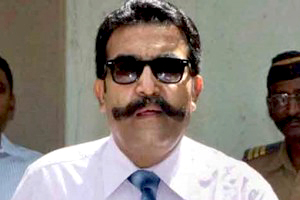
Staring at a woman for over 14 seconds can land you in jail: Kerala official

August 16, 2016

Kochi, Aug 16: A top Kerala official's comments that staring "annoyingly" at a woman for 14 seconds can land a man in jail as per certain sections of law has gone viral on social media with a state minister terming them "irritating".

kerofficer"There are sections in law to jail a man for annoyingly staring at a woman for 14 seconds. Please use it (the provisions in the law), if it is the case," State Excise Commissioner Rishiraj Singh said.

He made the comments at an event organised by a charitable trust here two days ago.

Urging women to fight the hooligans disturbing them, Singh had also asked them to carry knives and chili spray in their bags to protect themselves from such elements.

"Are you carrying a knife in your bag? Are you carrying chilly spray? Time is over for taking such precautions" he had said.

While Singh's words drew varied reactions on social media, Kerala Sports Minister E P Jayarajan termed them as "irritating".

"The remarks are irritating. If a bureaucrat makes remarks which are not in law, certainly the minister concerned will examine it and necessary steps will be taken," he told reporters.

Singh's comments drew humorous reactions on social media, with jokes such as -- how a man who went to see a woman at her home following a marriage proposal ended up in jail for staring at her for more than 14 seconds.

Some also expressed doubts over the points made by Singh.

They asked, "What will happen if a man blinks while staring at her continuously for 14 seconds?... what about a man who stares at a woman wearing a sunglass?".

Rishiraj Singh had courted controversy in July last year for not saluting the then Kerala Home Minister Ramesh Chennithala at a passing out parade in Thrissur.

Supreme Court lawyer KV Dhananjaya who spoke to media persons brought some perspective to the statement made by Singh. "This is an unbelievably mindless statement to make. There is no such provision in any law of this country and there cannot be such a mindless provision of law in any other country of the world. The offence of outraging the modesty of a woman is a very serious issue and it is a matter of concern that such a high ranking public servant is publicly saying an evidently false and mindless thing about it."

Comments

Morality
 - 
Wednesday, 17 Aug 2016

Manku Thimma udupi,

Please try with your house hold members with an outsiders and SEE HOW It feels and wats your reaction??????????????????????.

Satyameva jayate
 - 
Tuesday, 16 Aug 2016

If a person stares at a girl more than 10 seconds....she feels irritated and move away....what does this mean.....will anyone love to see someone staring at his wife or daughter continuously for sometime....will you not react.....this guy is somewhere right....trying to protect women...at least someone trying to do something....if modi said it....

MN DSouza
 - 
Tuesday, 16 Aug 2016

The one who gave this statement is wearing sun glasses. I think he wants to stare for more than 14 seconds and not get arrested.

Manku Thimma
 - 
Tuesday, 16 Aug 2016

Ok boss. Next time I will carry a timer with me and stare only 13 seconds.. Hope its not an offence ???

Add new comment

  • Coastaldigest.com reserves the right to delete or block any comments.
  • Coastaldigset.com is not responsible for its readers’ comments.
  • Comments that are abusive, incendiary or irrelevant are strictly prohibited.
  • Please use a genuine email ID and provide your name to avoid reject.
News Network
June 25,2020

Bengaluru, Jun 24: Dr K Sudhakar on Wednesday held a video conference with senior officials to review the preparedness for conducting of SSLC examinations safely which is beginning from Thursday.

"8,48,203 students will appear for the SSLC examination starting tomorrow in 2,879 centres across the state. All the guidelines issues by state government must be followed strictly" Sudhakar said in the meeting.

"It is the collective responsibility of officials of all departments to ensure that every student is safe, from the time he or she leaves home for the exam centre and returns home after the exams. The vehicles used to ferry students, where public transport is not available, must be sanitised properly. The surroundings near exam centres, exam halls, toilets must be sanitised properly. Social distancing must be maintained in the exam hall and mask must be provided to all students," he said.

The minister also said that since the students have been asked to arrive at exam centre at 7:30 in the morning, a small biscuit packet must be provided to each student so that they don't feel hungry during the exam and till they return home after the exam.

"Thermal scanning of every student should be done before allowing inside the exam hall. In case there is fever those students must be made to write exam in separate room. Separate exam halls must be arranged for students in quarantine areas and if it's not feasible they must be allowed to write exam in September. District administrations must disseminate information about precautionary measures taken to build confidence among parents," the minister said.

Sudhakar instructed the officials to work in coordination with the Education Department and other departments.

Stating that there are 458 containment zones in Bengaluru, the minister asked the officials to be extra cautious in these areas and make arrangements to ensure health department staff can take students to the nearest health center if anybody is found ill during the exam.

Education Minister Suresh Kumar, Additional Chief Secretary Javed Akhtar, Education Secretary, Secretary of Medical Education Department, BBMP officials, Health Experts and others were present.

Comments

Add new comment

  • Coastaldigest.com reserves the right to delete or block any comments.
  • Coastaldigset.com is not responsible for its readers’ comments.
  • Comments that are abusive, incendiary or irrelevant are strictly prohibited.
  • Please use a genuine email ID and provide your name to avoid reject.
Agencies
February 20,2020

India ranked 77th on a sustainability index that takes into account per capita carbon emissions and ability of children in a nation to live healthy lives and secures 131st spot on a flourishing ranking that measures the best chance at survival and well-being for children, according to a UN-backed report.

The report was released on Wednesday by a commission of over 40 child and adolescent health experts from around the world. It was commissioned by the World Health Organization (WHO), UN Children's Fund (UNICEF) and The Lancet medical journal.

In the report assessing the capacity of 180 countries to ensure that their youngsters can survive and thrive, India ranks 77th on the Sustainability Index and 131 on the Flourishing Index, it said.

Flourishing is the geometric mean of Surviving and Thriving. For Surviving, the authors selected maternal survival, survival in children younger than 5 years old, suicide, access to maternal and child health services, basic hygiene and sanitation, and lack of extreme poverty.

For Thriving, the domains were educational achievement, growth and nutrition, reproductive freedom, and protection from violence.

Under the Sustainability Index, the authors noted that promoting today's national conditions for children to survive and thrive must not come at the cost of eroding future global conditions for children's ability to flourish.

The Sustainability Index ranks countries on excess carbon emissions compared with the 2030 target. This provides a convenient and available proxy for a country's contribution to sustainability in future.

The report noted that under realistic assumptions about possible trajectories towards sustainable greenhouse gas emissions, models predict that global carbon emissions need to be reduced from 39·7 giga­ tonnes to 22·8 gigatonnes per year by 2030 to maintain even a 66 per cent chance of keeping global warming below 1·5°C.

It said that the world's survival depended on children being able to flourish, but no country is doing enough to give them a sustainable future.

"No country in the world is currently providing the conditions we need to support every child to grow up and have a healthy future," said Anthony Costello, Professor of Global Health and Sustainability at University College London, one of the lead authors of the report.

"Especially, they're under immediate threat from climate change and from commercial marketing, which has grown hugely in the last decade," said Costello – former WHO Director of Mother, Child and Adolescent health.

Norway leads the table for survival, health, education and nutrition rates - followed by South Korea and the Netherlands. Central African Republic, Chad and Somalia come at the bottom.

However, when taking into account per capita CO2 emissions, these top countries trail behind, with Norway 156th, the Republic of Korea 166th and the Netherlands 160th.

Each of the three emits 210 per cent more CO2 per capita than their 2030 target, the data shows, while the US, Australia, and Saudi Arabia are among the 10 worst emitters. The lowest emitters are Burundi, Chad and Somalia.

According to the report, the only countries on track to beat CO2 emission per capita targets by 2030, while also performing fairly – within the top 70 – on child flourishing measures are: Albania, Armenia, Grenada, Jordan, Moldova, Sri Lanka, Tunisia, Uruguay and Vietnam.

"More than 2 billion people live in countries where development is hampered by humanitarian crises, conflicts, and natural disasters, problems increasingly linked with climate change," said Minister Awa Coll-Seck from Senegal, Co-Chair of the commission.

The report also highlights the distinct threat posed to children from harmful marketing.

Evidence suggests that children in some countries see as many as 30,000 advertisements on television alone in a single year, while youth exposure to vaping (e-cigarettes) advertisements increased by more than 250 per cent in the US over two years, reaching more than 24 million young people.

Studies in Australia, Canada, Mexico, New Zealand and the US – among many others – have shown that self-regulation has not hampered commercial ability to advertise to children.

Children's exposure to commercial marketing of junk food and sugary beverages is associated with purchase of unhealthy foods and overweight and obesity, linking predatory marketing to the alarming rise in childhood obesity, it said.

The number of obese children and adolescents increased from 11 million in 1975 to 124 million in 2016 – an 11-fold increase, with dire individual and societal costs, the report said.

To protect children, the authors call for a new global movement driven by and for children.

Specific recommendations include stopping CO2 emissions with the utmost urgency, to ensure children have a future on this planet; placing children and adolescents at the centre of global efforts to achieve sustainable development, the report said.

New policies and investment in all sectors to work towards child health and rights; incorporating children's voices into policy decisions and tightening national regulation of harmful commercial marketing, supported by a new Optional Protocol to the UN Convention on the Rights of the Child, it said.


Comments

Add new comment

  • Coastaldigest.com reserves the right to delete or block any comments.
  • Coastaldigset.com is not responsible for its readers’ comments.
  • Comments that are abusive, incendiary or irrelevant are strictly prohibited.
  • Please use a genuine email ID and provide your name to avoid reject.
Ram Puniyani
February 29,2020

Like most of the political phenomenon, even the practice of Nationalism is not a static one. It changes with the changing political equations of the political forces and assumes the expressions which are very diverse. As such the phenomenon of Nationalism has a long journey and various state policies in particular have used it for purposes which relate more to the power of the state ‘vis a vis’ its people, power of the state ‘vis a vis’ the neighboring countries among others.

In India there has been a certain change in the practices of the state which have transformed the meaning of Nationalism during last few years. Particularly with BJP, the Hindu Nationalist outfit gaining simple majority, it has unfolded the policies where one can discern the drastic change in the meaning and application of Nationalism in regard to its citizens, particularly those belonging to minority community, with regard to those who are liberal, and with those who stand with the concept of Human rights.

Our former Prime Minister of Dr. Manmohan Singh hit the nail on the head when he said that “Nationalism and the "Bharat Mata Ki Jai" slogan are being misused to construct a "militant and purely emotional" idea of India that excludes millions of residents and citizens. Former Prime Minister recently stated this in an apparent attack on the BJP.” The occasion was the release of a book, ‘Who is Bharat Mata’, edited by Purushottam Agarwal and Radhakrishna. This is a compilation of significant extracts from writings of Nehru, and important assessments of and contributions of Nehru by prominent personalities.

Dr. Singh went on to add "With an inimitable style…Nehru laid the foundation of the universities, academies and cultural institutions of Modern India. But for Nehru's leadership, independent India would not have become what it is today," This statement of Dr. Singh has great importance in contemporary times, as Nehru is being denigrated by Hindu nationalists for all the problems which India is facing today and attempts are on to undermine his role and glorifying Sardar Vallabh Bhai Patel. This is also significant as it gives us the glimpses of what Nationalism meant for Nehru.

As Singh’s statement captures the present nationalism being practiced by BJP and company, the Hindu nationalists, immediately shot back saying that Dr. Singh is supporting the anti India activities at JNU and Jamia and his party is supporting the anti India nationalists. They asked whether Singh likes the nationalism of the likes of Shashi Tharoor or Manishankar Ayer who are provoking the Shaheen Bagh protest rather than making the protestors quiet. Whether he likes the anti national protests which go on at JNU or Jamia? As per them there is no Nationalism in Congress. One more example being cited is the private visit of Shatrughan Sinha who talked to Pakistani President during his visit there recently!

Most of the arguments being used to oppose Dr. Singh are very superficial. What is being referred to; is not opposition to Indian nationalism and its central values which were the core of anti colonial struggles. While ‘Bharat Mata Ki Jai’ may not be acceptable to a section of population, even the book he was releasing has the title ‘Who is Bharat Mata’. What is being stated by Singh is the twist which slogan ‘Bharat Mata ki Jai’ has been used by Hindu nationalists to frighten the religious minorities.

Indian nation came into being on the values, which later were the foundation of Indian Constitution. Indian Constitution carefully picked up the terminology which was away from the concepts of Hindu or Muslim nationalism. That’s how the country came to be called as ‘India that is Bharat’. The freedom of expression which was the hallmark of freedom movement and it was given a pride of place in our Constitution. It respected the diversity and formulated rules where the nation was not based on particular culture, as Hindu nationalists will like us to believe, but cultural diversity was centrally recognized in the Constitution. In addition promoting good relations with neighbors and other countries of the World was also part of our principles.

JNU, Jamia and AMU are being demonized as most institutions so far regard the freedom of expression as a core part of Indian democracy. These institutions have been thriving on discussions and debates which have base in liberalism. Deliberately some slogans have been constructed to defame these institutions. While Constitution mandates good relations with neighbors, creation of ‘Anti Pakistan hysteria’ is the prime motive of many a channels and sections of other media, which are servile to the ideology of ruling Government. They also violate most of the norms of ethical journalism, where the criticism of the ruling party is an important factor to keep the ruling dispensation in toes.

A stifling atmosphere has been created during last six years. In this the Prime Minster can take a detour, land in Pakistan to have a cup of tea with Pakistan PM, but a Congress leader talking to Pakistani President is a sign of being anti National. Students taking out a march while reading the preamble of Indian Constitution are labeled as anti-national; and are stopped while those openly wielding guns near Jamia or Shaheen Bagh roam freely.

Nationalism should promote amity and love of the people; it should pave the way for growth and development. Currently the nationalism which is dominant and stalking the streets has weakened the very fraternity, which is one of the pillars of our democracy. Nehru did explain that Bharat Mata is not just our mountains, rivers and land but primarily the people who inhabit the land. Which nationalism to follow was settled during the freedom movement when Muslim nationalism and Hindu nationalism were rejected by the majority of people of India in favor of the Nationalism of Gandhi, Nehru, Patel and Maulana Azad, where minorities are equal citizens, deserving affirmative action. In today’s scenario the Hindu nationalists cannot accept any criticism of their policies.

Comments

Add new comment

  • Coastaldigest.com reserves the right to delete or block any comments.
  • Coastaldigset.com is not responsible for its readers’ comments.
  • Comments that are abusive, incendiary or irrelevant are strictly prohibited.
  • Please use a genuine email ID and provide your name to avoid reject.