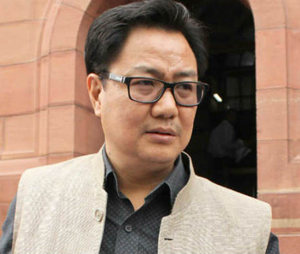
Stop questioning police: Rijiju on killing of SIMI men

November 1, 2016

New Delhi, Nov 1: Amidst a raging controversy over killing of eight SIMI activists who had fled from a jail, Union Minister Kiren Rijiju today said raising doubts and questioning the police should stop as no conclusion should be drawn on the basis of videos only.rijiju1

Rijiju said facts will come out soon and decried the "habit" of raising doubts and questioning the authorities and police in such incidents. "It is not good to raise questions on security forces dealing with terrorists just on the basis of videos.

"We are facing challenges in border with ceasefire violation. Our forces are responding," he told reporters here.

The Minister of State for Home Affairs was queried on the circumstances in which the eight SIMI members were killed yesterday near Bhopal by police. The eight SIMI activists were killed in an alleged encounter with police on the outskirts of Bhopal hours after they escaped from the high-security Central jail there killing a security guard.

As a controversy raged over the police action after the daring pre-dawn jail-break, TV channels showed footage purportedly from the encounter site in which a policeman is seen pumping bullets into a man from close range after some unidentified person takes out what appears to be a knife said to be in a plastic cover and places it back.

Comments

Peace
 - 
Tuesday, 1 Nov 2016

Chori karnewale ko Chor math bolo... what an joke sir ji... Shame on you...

Mohammed SS
 - 
Tuesday, 1 Nov 2016

The same way stop barking about the killing in the border by Pakistan

Add new comment

  • Coastaldigest.com reserves the right to delete or block any comments.
  • Coastaldigset.com is not responsible for its readers’ comments.
  • Comments that are abusive, incendiary or irrelevant are strictly prohibited.
  • Please use a genuine email ID and provide your name to avoid reject.
News Network
February 28,2020

Patna, Feb 28: Social and cultural activists from far and wide converged here on Thursday to lend their support to a massive rally that marked the conclusion of Kanhaiya Kumar's 'Jan Gan Man Yatra' across Bihar to galvanise public opinion against CAA-NPR-NRC.

Medha Patkar of the Narmada Bachao Andolan fame, Mahatma Gandhi's grandson Tushar Gandhi and former IAS officer Kannan Gopinathan, who gave up his career at a young age in protest against abrogation of Article 370, shared the stage with the former JNU students' leader.

Shabnam Hashmi -- founder of socio-cultural organisation ANHAD and sister of slain Marxist playwright and director Safdar Hashmi -- also joined them.

Congress MLA Shakil Ahmed Khan, a former president of JNU students' union himself who accompanied Kanhaiya during his tour that commenced at Champaran on January 30, Mahatma Gandhi's death anniversary, and leaders of state units of CPI and CPI(M) also addressed the rally held at Gandhi Maidan.

Kanhaiya began his speech with a one-minute silence held in the memory of those who lost their lives in Delhi violence.

Defending his frequent use of the term "azadi" (freedom) which supporters of the Sangh Parivar hold to be tantamount to supporting secession, Kanhaiya said, "We must talk about the virtues of azadi here since today happens to be the day when legendary revolutionary Chandrashekhar Azad had given up his life fighting the British."

Charging the ruling BJP with pitting Hindus against Muslims, he said, "Let us resolve to defeat their agenda by emulating the fabled friendship of Ram Prasad Bismil and Ashfaqullah Khan."

The young CPI leader, who made an unsuccessful debut from his native Begusarai Lok Sabha constituency last year, seemed unimpressed with the resolution passed by the Bihar Assembly earlier this week against NRC and inclusion of contentious clauses in NPR forms.

"Both the government and the opposition are busy congratulating themselves. I extend my congratulations as well. But to all those who are present here, I would say it is a half-victory. We must not allow our movement to fizzle out and draw inspiration from Gandhi's model of civil disobedience when the NPR exercise gets underway," he said.

"Villagers should ask their respective panchayat heads to ensure that no NPR official is allowed to come knocking in their areas of jurisdiction when NPR is scheduled to be undertaken in May," the CPI leader said.

"We have to brace for a long and tough fight. We are living under a regime which sends conscientious professionals like Dr Kafeel Ahmed behind the bars and declares anybody questioning its actions as an anti-national," said Kanhaiya, who has himself been slapped with a sedition case.

Earlier, in his address, Tushar Gandhi likened CAA, NPR and NRC to the "three bullets that killed the Mahatma" and asserted that these measures would "harm the poor, belonging to all religious communities and not just the Muslims".

"If the government does not care about the poor, we must tell those in power -- 'chale jaao' (go away) just as we had done to the British colonisers... it is going to be a long fight. Independence was achieved five years after the call for Quit India Movement," he said.

"We need to keep repeating the importance of non-violence over and over again while those with other value systems simply have to utter inciting statements," he said, in an oblique reference to the controversial poll campaign of Union minister and BJP leader Anurag Thakur during the recently-held Delhi Assembly elections, which the party lost.

Kannan Gopinathan said, "The claim that CAA is all about granting citizenship and not taking it away is bunkum. Any law which seeks to favour one section of the society on the basis of religion can be tweaked to harm another social segment... people say this government is Fascist. I am not sure of that but it is certainly stupid."

"This government brought in demonetisation and wrecked the economy but failed to achieve its promise of eradicating black money. It abrogated Article 370 and now it is clueless as to what to do with the situation in Kashmir," he said.

"Union minister Amit Shah had declared in Parliament that NRC will be implemented. Faced with public resistance, Prime Minister Narendra Modi had to say he does not know what NRC is. Keep up the stir for a little longer, he will start saying he does not know Amit Shah," said Kannan, evoking peals of laughter.

In the course of his speech, Kanhaiya also made the crowds sing after him the National Anthem but skipped a few words towards the end. Participants at the rally were viciously trolled on social media for the slip-up.

Comments

Add new comment

  • Coastaldigest.com reserves the right to delete or block any comments.
  • Coastaldigset.com is not responsible for its readers’ comments.
  • Comments that are abusive, incendiary or irrelevant are strictly prohibited.
  • Please use a genuine email ID and provide your name to avoid reject.
News Network
June 10,2020

New Delhi, Jun 10: Petrol price on Wednesday was hiked by 40 paise per litre and diesel by 45 paise, the fourth straight daily increase in rates after oil PSUs ended an 82-day hiatus in rate revision. Petrol price in Delhi was hiked to Rs 73.40 per litre from Rs 73, while diesel rates were increased to Rs 71.62 a litre from Rs 71.17, according to a price notification of state oil marketing companies.

Rates have been increased across the country and vary from state to state depending on the incidence of local sales tax or VAT.

This is the fourth daily increase in rates in a row since oil companies on Sunday restarted revising prices in line with costs, after ending an 82-day hiatus.

In four hikes, petrol price has gone up by Rs 2.14 per litre and diesel by Rs 2.23.

Latest petrol, diesel prices in top cities:

New Delhi: Petrol ₹73.40. Diesel ₹71.62

Gurgaon: Petrol ₹72.86. Diesel ₹64.90

Mumbai: Petrol ₹80.40. Diesel ₹70.35

Chennai: Petrol ₹77.43. Diesel ₹70.13

Hyderabad: Petrol ₹76.20. Diesel ₹70b

Bengaluru: Petrol ₹75.77. Diesel ₹68.09

Comments

Add new comment

  • Coastaldigest.com reserves the right to delete or block any comments.
  • Coastaldigset.com is not responsible for its readers’ comments.
  • Comments that are abusive, incendiary or irrelevant are strictly prohibited.
  • Please use a genuine email ID and provide your name to avoid reject.
News Network
January 1,2020

Jan 1: The ban on the practice of instant triple talaq, making it a penal offence and the increase in the strength of Supreme Court judges were two of the major achievements of the law ministry in 2019.

In July, Parliament gave its nod to The Muslim Women (Protection of Rights on Marriage) Bill, 2019. The new law makes talaq-e-biddat or any other similar form of talaq having the effect of instantaneous and irrevocable divorce pronounced by a Muslim husband void and illegal.

It makes it illegal to pronounce talaq three times in spoken, written or through SMS or WhatsApp or any other electronic chat in one sitting.

According to the new law, any Muslim who pronounces the illegal form of talaq upon his wife shall be punished with imprisonment for a term which may extend to three years, and shall also be liable to fine.

During the year, four new judges were appointed to the Supreme Court in September, taking its strength to 34, the highest-ever.

However, vacancies in high courts and lower courts are on the rise and convincing state governments and the 25 high courts to come on board to create an all-India judicial service to recruit judges for the subordinate courts tops the agenda of the Law Ministry in 2020.

Besides creating a consensus on setting up the All-India Judicial Services, the ministry will also have to focus on filling up vacancies in the high court. On an average, the vacancies stood at 400 throughout this year.

With more than 5,000 positions of judicial officers in district and subordinate courts lying vacant, the Law Ministry has pitched for setting up all-India judicial services.

The sanctioned strength of the judicial officers in district and subordinate courts was 22,644. The number of judicial officers in position and vacant posts is 17,509 and 5,135, respectively.

The government has proposed that while states and high courts can recruit judicial officers, the Union Public Service Commission (UPSC) can hold pan-India entrance tests.

The ministry has made it clear that such services would not encroach on the powers of the states.

As of now, the selection and appointment of judges in subordinate courts is the responsibility of the high courts and state governments concerned.

The Narendra Modi government has given a fresh push to the long-pending proposal to set up the new service to have a separate cadre for the lower judiciary in the country.

But there is a divergence of opinion among state governments and respective high courts on the constitution of the All India Judicial Service (AIJS).

One of the problems cited is that since several states have used powers under Code of Criminal Procedure (CrPC) and Code of Civil Procedure (CPC) to declare that the local language would be used in lower courts even for writing orders, a person say selected from Tamil Nadu may find it difficult to hold proceedings in states like Uttar Pradesh and Bihar.

The other point of opposition is that an all India service may hamper the career progression of state judicial services officers.

Another key issue the ministry has to handle in 2020 is vacancies in the 25 high courts.

Throughout 2019, on an average, the high courts faced a shortage of 400 judges.

According to Law Ministry data, as on September 1, the high courts had 414 vacant positions as compared to the sanctioned strength of 1,079 judges. The figure was 409 in August and 403 in July, as per the data.

A three-member Supreme Court collegium recommends the names of candidates for appointment as high court judges. In case of appointments to the Supreme Court, the collegium consists of five top judges of the top court.

High court collegiums shortlist candidates for their respective high courts and send the names to the law ministry.

The ministry, along with background check reports by the Intelligence Bureau, forwards it to the Supreme Court collegium for a final call.

The government has maintained that appointment of judges in the high courts is a "continuous collaborative process" between the Executive and the Judiciary, as it requires consultation and approval from various Constitutional authorities.

Vacancies keep arising on account of retirement, resignation or elevation of judges and increase in judges' strength. In June last year, the vacancy position stood at 399, while it was 396 in May.

In April, 399 posts of judges were vacant, while the figure was 394 in March. The vacancy position in February stood at 400 and in January, it was 392, according to the data collated by the Department of Justice.

Over 43 lakh cases are pending in the 25 high courts.

Another priority would be the finalisation of the memorandum of the procedure to guide the appointment and transfer of the Supreme Court and high court judges. The issue had now been pending for over two years now with the SC collegium and the government failing to reach a consensus.

Successive governments have also been working on making India a hub of international arbitration. It has taken several steps to change laws dealing with commercial disputes.


Comments

Add new comment

  • Coastaldigest.com reserves the right to delete or block any comments.
  • Coastaldigset.com is not responsible for its readers’ comments.
  • Comments that are abusive, incendiary or irrelevant are strictly prohibited.
  • Please use a genuine email ID and provide your name to avoid reject.