Strife started in states after NDA came to power: Rahul Gandhi

Agencies
July 29, 2017

Jagdalpur, Jul 29: Congress vice president Rahul Gandhi today hit out at the NDA government, alleging that strife started in several states, including Jammu and Kashmir, after it came to power in May 2014.Rahul

He claimed that the prevailing unrest in parts of the country under its rule was benefiting the RSS, China and Pakistan.

"After the NDA came to power in Delhi, conflicts started in several states. There was peace in Jammu and Kashmir. Terrorism there had nearly come to an end during the UPA rule," he alleged.

"We held talks with people from various sections... our idea was to reach out to people, provide jobs to the youth. We conducted Panchayati Raj elections," he said.

Gandhi was interacting with tribal students during a programme, 'Amcho Hak' (our rights), organised by the National Students Union of India here in Chhattisgarh.

"When we came to power in 2004, we gradually controlled terrorism in J&K and it nearly came to an end. But now unrest is everywhere in the country--Srinagar, Sikkim and Bastar," the Amethi MP alleged.

"Peace has vanished from Uttar Pradesh, Tamil Nadu. Who's getting benefit from the conflict in Kashmir? It's the RSS, Pakistan and China," the Congress leader alleged.

Questioning who was fuelling civilian unrest in Kashmir, he said "you all have seen how the people of Jammu and Kashmir were living peacefully" when the Congress-led UPA was in power at the Centre.

"Situation worsened after the BJP came to power there in coalition with the PDP. Similarly, in Chhattisgarh, the RSS and industrialists are getting benefits of conflict in Bastar," he claimed.

He said Chhattisgarh was a rich state with water, forests and minerals and alleged that "they want to snatch your resources and they can't do that till there is strife".

"That's why they are spreading discord, they want to make you fight among yourselves. Adivasis will never benefit from industrialisation," Gandhi claimed.

The Congress MP alleged that the RSS wanted Dalits, adivasis and OBCs to remain weak and oppressed so that they could rule over them.

"Wherever they go they trigger fight (aag lagate hai). In Haryana, they started a fight between Jats and non-Jats... between Hindus and Muslims in Kashmir, Bengali and non-Bengali in Assam...wherever they go they make people fight," he alleged.

Contrary to this, the Congress believes in peace, he said, adding his party wants to protect the rights of tribals.

"We want you (tribals) to get benefit of your water, forests and minerals not anyone else. We want to protect your rights. Why is prime minister Modi trying to snatch your lands? So that he can give your lands, mines to industrialists," he claimed.

He said in all this, the tribals were suffering and it was causing them losses.

Comments

HOFZ
 - 
Saturday, 29 Jul 2017

Mangalore mp kateel busy with searching match box to fire alvas foundation

Add new comment

  • Coastaldigest.com reserves the right to delete or block any comments.
  • Coastaldigset.com is not responsible for its readers’ comments.
  • Comments that are abusive, incendiary or irrelevant are strictly prohibited.
  • Please use a genuine email ID and provide your name to avoid reject.
Agencies
June 7,2020

New Delhi, Jun 7: A day after India and China military commanders held "cordial and positive" talks at Chushul-Moldo point along the Line of Actual Control in Eastern Ladakh, Ministry of External Affairs said the two countries have agreed to "peacefully" resolve the situation in the border areas by continuing the military and diplomatic engagements.

The Indian delegation led by 14 Corps Commander Lt Gen Harinder Singh on Saturday met his Chinese equivalent Maj Gen Liu Lin, who is the commander of South Xinjiang Military Region of the Chinese People's Liberation Army, to address the ongoing tussle in Eastern Ladakh.

In a statement on Sunday, the MEA said that the meeting between the Corps Commander based in Leh and the Chinese Commander took place in a "cordial and positive atmosphere".

"Both sides agreed to peacefully resolve the situation in the border areas in accordance with various bilateral agreements and keeping in view the agreement between the leaders that peace and tranquillity in the India-China border regions is essential for the overall development of bilateral relations," the statement read.

They also noted that this year marked the 70th anniversary of the establishment of diplomatic relations between the two countries and agreed that an early resolution would contribute to the further development of the relationship.

"Accordingly, the two sides will continue the military and diplomatic engagements to resolve the situation and to ensure peace and tranquillity in the border areas," it further read.

China has moved its troops along the Line of Actual Control (LAC) in the Eastern Ladakh areas including the Finger area, Pangong Tso Lake, and Galwan Nala area.

The meeting between military commanders was to discuss and resolve the stand-off in Eastern Ladakh.

Following the meeting, the Army Headquarters' Directorate General of Military Operations also briefed the Ministry of External Affairs and other concerned government officials about the discussions.

On Friday, officials of India and China interacted through video-conferencing with the two sides agreeing that they should handle "their differences through peaceful discussion" while respecting each other's sensitivities and concerns and not allowing them to become disputes in accordance with the guidance provided by the leadership.

In the last few days, there has not been any major movement of the PLA troops at the multiple sites where it has stationed itself along the LAC opposite Indian forces.

The Chinese Army's intent to carry out deeper incursions was checked by the Indian security forces by quick deployment.

The Chinese have also brought in heavy vehicles with artillery guns and infantry combat vehicles in their rear positions close to the Indian territory.

Comments

Add new comment

  • Coastaldigest.com reserves the right to delete or block any comments.
  • Coastaldigset.com is not responsible for its readers’ comments.
  • Comments that are abusive, incendiary or irrelevant are strictly prohibited.
  • Please use a genuine email ID and provide your name to avoid reject.
coastaldigest.com web desk
June 16,2020

New Delhi, Jun 16: Despite Prime Minister Narendra Modi led government’s attempt to downplay the border dispute with China, matters have heated up unprecedentedly along the Line of Actual Control (LAC)- the effective Sino-India border in Eastern Ladakh. 

The country has lost three precious lives – an army officer and two soldiers. The last time blood was spilled on the LAC, before the latest episode, was 45 years ago when the Chinese ambushed an Assam Rifles patrol in Tulung La.

India had lost four soldiers on October 20, 1975 in Tulung La, the last time bullets were fired on the India-China border though both the countries witnessed bitter stand-offs later at Sumdorong Chu valley in 1987, Depsang in 2013, Chumar in 2014 and Doklam in 2017.

Between 1962 and 1975, the biggest clash between India and China took place in Nathu La pass in 1967 when reports suggest that around 80 Indian soldiers were killed and many more Chinese personnel.

While three soldiers, including a Commanding Officer, were killed in the latest episode in Galwan Valley, the government describes it as a "violent clash" and does not mention opening fire.

New Delhi described the locality where the 1975 incident took place as "well within" its territory only to be rebuffed by Beijing as "sheer reversal of black and white and confusion of right and wrong".

The Ministry of External Affairs had then said that the Chinese had crossed the LAC and ambushed the soldiers while Beijing claimed the Indians entered their territory and did not return despite warnings.

The Indian government maintained that the ambush on the Assam Rifles' patrol in 1975 took place "500 metres south of Tulung" on the border between India and Tibet and "therefore in Indian territory". It said Chinese soldiers "penetrating" Indian territory implied a "change in China's position" on the border question but the Chinese denied this and blamed India for the incident.

The US diplomatic cables quoted an Indian military intelligence officer saying that the Chinese had erected stone walls on the Indian side of Tulung La and from these positions fired several hundred rounds at the Indian patrol.

"Four of the Indians had gone into a leading position while two (the ones who escaped) remained behind. The senior military intelligence officer emphasised that the soldiers on the Indian patrol were from the area and had patrolled that same region many times before," the cable said.

One of the US cables showed that former US Secretary of State and National Security Adviser Henry Kissinger sought details of the October 1975 clash "without approaching the host governments on actual location of October 20 incident". He also wanted to know what ground rules were followed regarding the proximity of LAC by border patrols.

A cable sent from the US mission in India on November 4, 1975 appeared to have doubts about the Chinese account saying it was "highly defensive".

"Given the unsettled situation on the sub-continent, particularly in Bangladesh, both Chinese and Indian authorities have authorised stepped up patrols along the disputed border. The clash may well have ensued when two such patrols unexpectedly encountered each other," it said.

Another cable from China on the same day quoted another October 1974 cable, which spoke about Chinese officials being concerned for long that "some hotheaded person on the PRC (People's Republic of China) might provoke an incident that could lead to renewed Sino-Indian hostilities. It went on to say that this clash suggested that "such concerns and apprehensions are not unwarranted".

According to the United States diplomatic cables, Chinese Foreign Ministry on November 3, 1975 disputed the statement of the MEA spokesperson, who said the incident took place inside Indian territory.

The Chinese had said "sheer reversal of black and white and confusion of right and wrong". In its version of the 1975 incident, they said Indian troops crossed the LAC at 1:30 PM at Tulung Pass on the Eastern Sector and "intruded" into their territory when personnel at the Civilian Checkpost at Chuna in Tibet warned them to withdraw.

Ignoring this, they claimed, Indian soldiers made "continual provocation and even opened fire at the Chinese civilian checkpost personnel, posing a grave threat to the life of the latter. The Chinese civilian checkpost personnel were obliged to fire back in self defence."

The Chinese Foreign Ministry spokesperson had also said they told the Indian side that they could collect the bodies "anytime" and on October 28, collected the bodies, weapons and ammunition and "signed a receipt".

The US cables from the then USSR suggested that the official media carried reports from Delhi on the October 1975 incident and they cited only Indian accounts of the incident "ridiculing alleged Chinese claims that the Indians crossed the line and opened fire first".

Comments

Add new comment

  • Coastaldigest.com reserves the right to delete or block any comments.
  • Coastaldigset.com is not responsible for its readers’ comments.
  • Comments that are abusive, incendiary or irrelevant are strictly prohibited.
  • Please use a genuine email ID and provide your name to avoid reject.
Agencies
August 4,2020

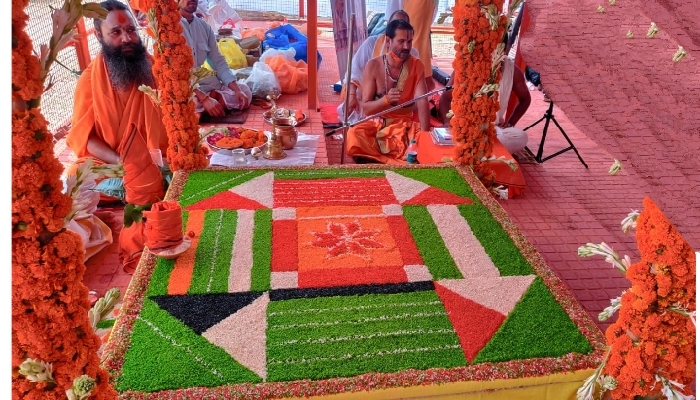
Ayodhya, Aug 4: Ramarchan puja begins at Ram Janmabhoomi site ahead of the foundation laying ceremony of Ram Temple in Ayodhya.
Ramarchan Puja is a prayer to invite all major gods and goddesses ahead of Lord Ram's arrival.

Mahesh Bhagchandka, one of the trustees of Ashok Singhal foundation as Yajman in the puja said, "This is being conducted at the temporary seat of Ramlalla. The pooja will be conducted in four phases."

Speaking about the third and fourth phases, he said: "In the third phase, Dashrath, father of Lord Ram with his wives will be worshipped and then all three brothers of Lord Ram - Laxman, Bharat and Shatrughan with their wives. Lord Hanuman ji will too be worshipped. Whereas in the fourth phase, Lord Ram will be worshipped."
Meanwhile, security has been heightened in Ayodhya ahead of the foundation laying ceremony.

Temples across the city is decorated with lights, diyas and flowers ahead of the grand event. Patna's Mahavir Mandir Trust is preparing over 1.25 lakh 'Raghupati Laddoos' for the occasion. Thes laddoos will be distributed as 'prasad' to devotees.

Uttar Pradesh Chief Minister Yogi Adityanath on Monday offered prayers at the Hanuman Garhi temple during his visit to Ayodhya to take stock of the preparations for the 'bhoomi pujan'.
He along with officials also visited 'Ram ki Paudi' to inspect the arrangements ahead of the foundation stone laying ceremony.

Prime Minister Narendra Modi is scheduled to lay the foundation stone of the Ram Temple in Ayodhya on August 5. 

Comments

Add new comment

  • Coastaldigest.com reserves the right to delete or block any comments.
  • Coastaldigset.com is not responsible for its readers’ comments.
  • Comments that are abusive, incendiary or irrelevant are strictly prohibited.
  • Please use a genuine email ID and provide your name to avoid reject.