Sushma promises to evacuate 10,000 Indians stranded in Saudi

August 1, 2016

New Delhi, Aug 01: About 10,000 Indians stranded in Saudi Arabia will be evacuated and no one will go hungry as ration has been distributed to them, External Affairs Minister Sushma Swaraj said in Parliament today.swaraj

Her deputy V K Singh is leaving for Saudi Arabia to oversee the evacuation process, she said in a statement in both Houses of Parliament.

As members in the Lok Sabha and the Rajya Sabha expressed concern over the fate of these Indians, Swaraj made the statement informing them that the Indian embassy was running five camps to feed them and she had received hourly inputs till early today.
"Not one worker of ours will go hungry. This is my assurance to the country through Parliament... We will bring all of them back to India," Swaraj said.

The government, she said, was in touch with the foreign and labour offices in Saudi Arabia to ensure their early evacuation.

Swaraj noted that the law there does not permit an emergency exit visa without no objection certificate from the employers who, she said, have shut their factories and left the country, leaving these employees stranded.

The government has requested the Saudi government to give them exit visas as employers had left the country and also urged it to first clear the dues of workers who have not been paid for months, whenever they settle the accounts with the companies concerned.

Singh is leaving for Saudi Arabia to oversee the operation, she said.

She recieved the last report at 2.45 AM, she said and informed the Lok Sabha that ration for 10 days had been distributed in all the five camps. "I am personally monitoring the situation."

As some opposition members in Lok Sabha raised some questions, Speaker Sumitra Mahajan disallowed them, saying "She (Swaraj) has done everything. She has done really good work. Nobody has worked this much."

Swaraj's response also drew praise from the Chair and members in the Rajya Sabha.
Swaraj made the statement in the Lower House amid the din created by Andhra Pradesh MPs, who were demanding special category status for the state.

Senior BJP member L K Advani, who was sitting next to Swaraj, was seen requesting Andhra members with folded hands to allow her to speak.

Comments

abdullah mohammed
 - 
Monday, 1 Aug 2016

Mr Manohar bhai , they will airlift after RSS are tamed, what an foolish response, by the way all these 6 months where were these consulates and Indian govt doing and caring these unpaid Indians ???

Add new comment

  • Coastaldigest.com reserves the right to delete or block any comments.
  • Coastaldigset.com is not responsible for its readers’ comments.
  • Comments that are abusive, incendiary or irrelevant are strictly prohibited.
  • Please use a genuine email ID and provide your name to avoid reject.
Ram Puniyani
January 14,2020

In the beginning of January 2020 two very disturbing events were reported from Pakistan. One was the attack on Nankana Sahib, the holy shrine where Sant Guru Nanak was born. While one report said that the place has been desecrated, the other stated that it was a fight between two Muslim groups. Prime Minister of Pakistan Imran Khan condemned the incident and the main accused Imran Chisti was arrested. The matter related to abduction and conversion of a Sikh girl Jagjit Kaur, daughter of Pathi (One who reads Holy Guru Granth Sahib in Gurudwara) of the Gurudwara. In another incident one Sikh youth Ravinder Singh, who was out on shopping for his marriage, was shot dead in Peshawar.

While these condemnable attacks took place on the Sikh minority in Pakistan, BJP was quick enough to jump to state that it is events like this which justify the Citizenship Amendment Act (CAA). Incidentally CAA is the Act which is discriminatory and relates to citizenship with Religion, which is not as per the norms of Indian constitution. There are constant debates and propaganda that population of Hindus has come down drastically in Pakistan and Bangla Desh. Amit Shah, the Home minister stated that in Pakistan the population of Hindus has come down from 23% at the time of partition to 3.7% at present. And in Bangla Desh it has come down from 22% to present 8%.

While not denying the fact that the religious minorities are getting a rough deal in both these countries, the figures which are presented are totally off the mark. These figures don’t take into consideration the painful migrations, which took place at the time of partition and formation of Bangla Desh later. Pakistan census figures tell a different tale. Their first census was held in 1951. As per this census the overall percentage of Non Muslim in Pakistan (East and West together) was 14.2%, of this in West Pakistan (Now Pakistan) it was 3.44 and in Eat Pakistan it was 23.2. In the census held in Pakistan 1998 it became 3.72%. As far as Bangla Desh is concerned the share of Non Muslims has gone down from 23.2 (1951) to 9.6% in 2011.

The largest minority of Pakistan is Ahmadis, (https://minorityrights.org/country/pakistan/) who are close to 4 Million and are not recognised as Muslims in Pakistan. In Bangla Desh the major migrations of Hindus from Bangla Desh took place in the backdrop of Pakistan army’s atrocities in the then East Pakistan.

As far as UN data on refugees in India it went up by 17% between 2016-2019 and largest numbers were from Tibet and Sri Lanka.  (https://www.un.org/en/development/desa/population/migration/publication…)

The state of minorities is in a way the index of strength of democracy. Most South Asian Countries have not been able to sustain democratic values properly. In Pakistan, the Republic began with Jinnah’s classic speech where secularism was to be central credo of Pakistan. This 11th August speech was in a way what the state policy should be, as per which people of all faiths are free to practice their religion. Soon enough the logic of ‘Two Nation theory” and formation of Pakistan, a separate state for Muslim took over. Army stepped in and dictatorship was to reign there intermittently. Democratic elements were suppressed and the worst came when Zia Ul Haq Islamized the state in collusion with Maulanas. The army was already a strong presence in Pakistan. The popular formulation for Pakistan was that it is ruled by three A’s, Army, America and Allah (Mullah).

Bangla Desh had a different trajectory. Its very formation was a nail in the coffin of ‘two nation theory’; that religion can be the basis of a state. Bangla Desh did begin as a secular republic but communal forces and secular forces kept struggling for their dominance and in 1988 it also became Islamic republic. At another level Myanmar, in the grip of military dictatorship, with democratic elements trying to retain their presence is also seeing a hard battle. Democracy or not, the army and Sanghas (Buddhist Sang has) are strong, in Myanmar as well. The most visible result is persecution of Rohingya Muslims.

Similar phenomenon is dominating in Sri Lanka also where Budhhist Sanghas and army have strong say in the political affairs, irrespective of which Government is ruling. Muslim and Christian minorities are a big victim there, while Tamils (Hindus, Christians etc.) suffered the biggest damage as ethnic and religious minorities. India had the best prospect of democracy, pluralism and secularism flourishing here. The secular constitution, the outcome of India’s freedom struggle, the leadership of Gandhi and Nehru did ensure the rooting of democracy and secularism in a strong way.

India so far had best democratic credentials amongst all the south Asian countries. Despite that though the population of minorities rose mainly due to poverty and illiteracy, their overall marginalisation was order of the day, it went on worsening with the rise of communal forces, with communal forces resorting to identity issues, and indulging in propaganda against minorities.

While other South Asian countries should had followed India to focus more on infrastructure and political culture of liberalism, today India is following the footsteps of Pakistan. The retrograde march of India is most visible in the issues which have dominated the political space during last few years. Issues like Ram Temple, Ghar Wapasi, Love Jihad, Beef-Cow are now finding their peak in CAA.

India’s reversal towards a polity with religion’s identity dominating the political scene was nicely presented by the late Pakistani poetess Fahmida Riaz in her poem, Tum bhi Hum Jaise Nikle (You also turned out to be like us). While trying to resist communal forces has been an arduous task, it is becoming more difficult by the day. This phenomenon has been variously called, Fundamentalism, Communalism or religious nationalism among others. Surely it has nothing to do with the religion as practiced by the great Saint and Sufi traditions of India; it resorts mainly to political mobilization by using religion as a tool.


Comments

Ashi
 - 
Tuesday, 14 Jan 2020

If Malaysia implement similar NRC/CAA, India and China are the loser.

Add new comment

  • Coastaldigest.com reserves the right to delete or block any comments.
  • Coastaldigset.com is not responsible for its readers’ comments.
  • Comments that are abusive, incendiary or irrelevant are strictly prohibited.
  • Please use a genuine email ID and provide your name to avoid reject.
News Network
February 14,2020

Mysuru, Feb 14: Citing the coronavirus scare prevalent in the city, hotel owners have urged the civic corporation to shut down roadside food vends, calling them a risk to public health.

A team of the city Hotel Owners Association, led by president C Narayanagowda and honorary secretary Ravindra Bhat, met mayor Tasneem Bano and MCC commissioner Gurudatta Hegde on Tuesday and urged them to implement the high court’s ban on street food vending.

In a statement issued on Thursday, the association said it had raised the poor hygiene at such joints amid the coronavirus threat and increasing incidence of chikungunya and malaria in the city. There is no check on the ingredients or water used and the cleanliness of the kitchens and cooking staff, they pointed out. Many of the joints operate near drains and public urinals and don’t have running water for washing or cleaning utensils, they said. Besides, the vends dump unsegregated garbage and compromise pedestrian safety by blocking pavements, they alleged.

“As this involves the livelihood of the vendors, I will take a decision after discussions with the commissioner and elected representatives,” the mayor said while pointing out that MCC had issued identity cards to the vendors after collecting details about them and their stalls. She said the health and education standing committees would also be consulted.

Commissioner Hegde said MCC was planning to move the vendors to designated hawking zones to ensure their livelihood was not affected. He explained that any drive to remove the vends was fraught with law and order problems. “False cases have been filed against MCC officers whenever they conducted drives against footpath food vendors in non-hawking zones. We will consult with the city police commissioner before taking any steps,” he said.

Comments

Add new comment

  • Coastaldigest.com reserves the right to delete or block any comments.
  • Coastaldigset.com is not responsible for its readers’ comments.
  • Comments that are abusive, incendiary or irrelevant are strictly prohibited.
  • Please use a genuine email ID and provide your name to avoid reject.
News Network
July 28,2020

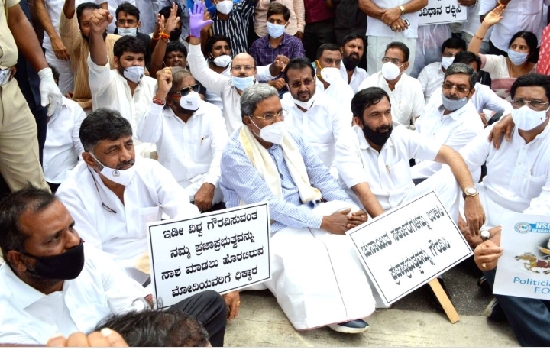
Bengaluru, Jul 28: Several state Congress leaders, including its President D K Shivakumar, among others, were detained by police as they tried to march towards Raj Bhavan here against the alleged attempts by BJP to topple the party's government in Rajasthan.

Shivakumar, along with Leader of the Opposition Siddaramaiah, state Congress Working President Eshwar Khandre, Salim Ahmed among others were stopped by the police midway as they marched from KPCC office towards Raj Bhavan.

Congress leaders then staged a dharna at the place where they were stopped. Addressing the gathering, Shivakumar accused the BJP of trying to "murder" democracy by destabilizing and removing elected governments.

"We wanted to protest against it and submit a memorandum to the President through the Governor," but the Karnataka government by using police was not letting them proceed towards Raj Bhavan, he said. "Despite our being a peaceful protest, the police stopped us," he said.

Siddaramaiah, echoing similar views, said peaceful protests against injustice was the right of every citizen. Alleging that the BJP was attempting to destabilise and remove the elected government in Rajasthan as it did in Karnataka and Madhya Pradesh, he said the Governor's office there (Rajasthan) was being 'misused'.

The Governor was working like an agent of the central government, he charged. He said, despite repeated appeals by the Rajasthan cabinet, the Governor there had not convened the assembly session, for the floor test to take place and for Congress to prove its majority. Police subsequently detained Shivakumar and some other Congress leaders and took them to a nearby police station.

They were later released. Meanwhile, as the Congress' protest amid Covid19 pandemic did not follow social distancing norms, Medical Education Minister K Sudhakar hit out at that party's leaders. In a tweet Sudhakar said, for Congress leaders getting publicity was more important than social concerns.

Comments

Add new comment

  • Coastaldigest.com reserves the right to delete or block any comments.
  • Coastaldigset.com is not responsible for its readers’ comments.
  • Comments that are abusive, incendiary or irrelevant are strictly prohibited.
  • Please use a genuine email ID and provide your name to avoid reject.