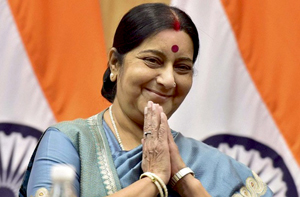
Sushma Swaraj announces new Post Office Passport Seva Kendras

Agencies
June 17, 2017

New Delhi, Jun 17: No Indian will have to travel more than 50 km to get their passport, as the government is planning to set up a comprehensive network of Passport Seva Kendras (PSK) across the nation, with major post offices to also provide the service, External Affairs Minister Sushma Swaraj said on Saturday.sushma 2

The Minister, announcing the opening of 149 new Post Office Passport Seva Kendras (POPSKs), said these will be set up in the second phase. In the first phase 86 POPSKs were to be set up -- 52 of which are now functional.

Apart from centres in the post offices, the government had earlier also announced 16 full-fledged PSKs taking the total number of new centres to the "auspicious" 251, she said.

"When I started at the Ministry, we had only 77 PSKs to cater to the whole nation. I realised that distance was the biggest hurdle for people to get their passports," she said.

Even after pushing through 16 more PSKs apart from 86 of them in post offices, Sushma Swaraj said she felt it was not enough.

"We planned to set a target and decided that no individual should have to travel more than 50 km for a passport."

"With that criterion for selection, today I announce 149 new POPSKs," she said.

Sushma Swaraj also launched a web portal for the ministry's flagship "Know India Programme" aimed at connecting the Indian youth living abroad with Indian culture and heritage.

Under the programme, the Indian diaspora would visit the country for a 25-day tour fully funded by the government.

Comments

Abv
 - 
Sunday, 18 Jun 2017

Shushmaji is doing grate work right candidate for PM for next two years

Add new comment

  • Coastaldigest.com reserves the right to delete or block any comments.
  • Coastaldigset.com is not responsible for its readers’ comments.
  • Comments that are abusive, incendiary or irrelevant are strictly prohibited.
  • Please use a genuine email ID and provide your name to avoid reject.
News Network
July 21,2020

Bengaluru,  Jul 21: The salaries of doctors under the National Health Mission (NHM) has been hiked to Rs 45,000 in Karnataka, according to Medical Education Minister Dr K Sudhakar.

Addressing the media on Monday, Dr Sudhakar said that the state government will bear the cost of the hike in salaries of the doctors and added that ASHA workers too will get a hike in their pay soon.

Regarding the COVID-19 management in the state, he further said that testing will be increased in the containment zones.

During a meeting chaired by Chief Minister BS Yediyurappa, the Education Minister said that it had been decided that booth level committees will conduct door to door survey for early detection of influenza-like illness (ILI) and severe acute respiratory infections (SARI), and vulnerable persons.

He also implored private hospitals to admit and treat COVID-19 patients and asked them to not be hesitant in admitting pregnant women.

Karnataka on Monday reported 3,648 COVID-19 cases taking the tally to 67,420, informed the state health department.

According to a bulletin issued by the department, the state recorded 72 more deaths due to COVID-19 with the toll at 1,403 while six patients who tested positive for the infection have died due to non-COVID causes, as of Monday. There are 42,216 active cases in the state.

Comments

Prakash Salins
 - 
Tuesday, 21 Jul 2020

What about the nurses???

Add new comment

  • Coastaldigest.com reserves the right to delete or block any comments.
  • Coastaldigset.com is not responsible for its readers’ comments.
  • Comments that are abusive, incendiary or irrelevant are strictly prohibited.
  • Please use a genuine email ID and provide your name to avoid reject.
News Network
March 5,2020

Mar 5: The government on Thursday asserted that there is no shortage of raw ingredients or medicines in the country as it has taken various initiatives to tackle the challenge posed by the coronavirus outbreak.

All initiatives are also being taken to ensure that there is no impact of the disease in India, Minister of Chemicals and Fertilizers D V Sadananda Gowda said.

"There is no shortage of any APIs in the country. We have sufficient APIs (active pharmaceutical ingredients) and medicines in the country," he said.

Gowda was addressing the 5th international exhibition and conference on the pharmaceutical and medical industry organised by the Department of Pharmaceuticals, Gujarat government and industry chamber Ficci here.

For another three months there is no shortage for undertaking production in the pharma sector, he added.

"Our government has taken all initiatives to ensure that as far as our country is concerned the coronavirus should be stopped, and there is no hazard as far as this issue is concerned," Gowda reiterated.

Coronavirus is a challenge and "we should make all efforts that need to be taken..., " he added.

On Tuesday, India, the world's largest maker of generic drugs, restricted the export of common medicines such as paracetamol and 25 other pharmaceutical ingredients and drugs made from them, as it looks to prevent shortages amid concerns of the coronavirus outbreak turning into a pandemic.

Besides over-the-counter painkiller and fever reducer paracetamol, drugs restricted for exports included common antibiotics metronidazole, and those used to treat bacterial and other infections as well as Vitamin B1 and B12 ingredients.

A notification by the Directorate General of Foreign Trade (DGFT) had said the export of 26 active pharmaceutical ingredients (APIs) and formulations would require licence.

Comments

Add new comment

  • Coastaldigest.com reserves the right to delete or block any comments.
  • Coastaldigset.com is not responsible for its readers’ comments.
  • Comments that are abusive, incendiary or irrelevant are strictly prohibited.
  • Please use a genuine email ID and provide your name to avoid reject.
Ram Puniyani
June 29,2020

In Minneapolis, US an African American, George Floyd lost his life as the white policeman, Derek Chauvin, caught hold of him and put his knee on his neck. This is a technique developed by Israel police. For nine long minutes the knee of the while policeman was on the neck of George, who kept shouting, I can’t breathe.

Following this gruesome murder America erupted with protests, ‘Black lives matter’. The protestors were not just African Americans but also a large section of whites. Within US one police Chief apologized for the act of this. In a touching gesture of apology the police force came on its knees. This had reverberations in different parts of the World.

The act was the outcome of the remnants of the racial hatred against blacks by the whites. It is the hatred and the perceptions which are the roots of such acts of violence. What was also touching that the state of democracy in US is so deep that even the police apologized, the nation, whites and blacks, stood up as a sensitive collective against this violence.

US is not the only country where the brutal acts of violence torment the marginalized sections of society. In India there is a list of dalits, minorities and adivasis who are regularly subjected to such acts. But the reaction is very different. We have witnessed the case of Tabrez Ansari, who was tied to the pole by the mob and beaten ruthlessly. When he was taken to police station, police took enough time to take him to hospital and Tabrez died.

Mohsin Sheikh, a Pune techie was murdered by Hindu Rashtra Sena mob, the day Modi came to power in 2014. Afrazul was killed by Shambhulal Regar, videotaped the act released on social media. Regar believed that Muslims are indulging in love Jihad, so deserve such a fate. Mohammad Akhlaq is one among many names who were mob lynched on the issue of beef cow. The list can fill pages after pages.

Recently a young dalit boy was shot dead for the crime of entering a temple. In Una four dalits were stripped above waste and beaten mercilessly. Commenting on this act the Union Minister Ramvilas Paswan commented that it is a minor incident. Again the list of atrocities against dalits is long enough. The question is what Paswan is saying is the typical response to such gruesome murders and tortures. In US loss of one black life, created the democratic and humane response. In India there is a general silence in response to these atrocities. Some times after a good lapse of time, the Prime Minister will utter, ‘Mother Bharati has lost a son’. Most of the time victim is blamed. Some social groups raise their voice in some fora but by and large the deafening silence from the country is the norm.

India is regarded as the largest democracy. Democracy is the rule of law, and the ground on which the injustices are opposed. In America though the present President is insensitive person, but its institutions and processes of democratic articulations are strong. The institutions have deepened their roots and though prejudices may be guiding the actions of some of the officers like the killer of George, there are also police officers who can tell their President to shut up if he has nothing meaningful to say on the issue. The prejudices against Blacks may be prevalent and deep in character, still there are large average sections of society, who on the principles of ‘Black lives matter’. There are large sections of vocal population who can protest the violation of basic norms of democracy and humanism.

In India by contrast there are multiple reasons as to why the lives of Tabrez Ansari, Mohammad Akhlaq, Una dalit victims and their likes don’t matter. Though we claim that we are a democracy, insensitivity to injustices is on the rise. The strong propaganda against the people from margins has become so vicious during last few decades that any violence against them has become sort of a new normal. The large populace, though disturbed by such brutalities, is also fed the strong dose of biases against the victims. The communal forces have a great command over effective section of media and large section of social media, which generates Hate against these disadvantaged groups, thereby the response is muted, if at all.

As such also the process of deepening of our democracy has been weak. Democracy is a dynamic process; it’s not a fixed entity. Decades ago workers and dalits could protest for their rights. Now even if peasants make strong protests, dominant media presents it as blocking of traffic! How the roots of democracy are eroded and are visible in the form where the criticism of the ruling dispensation is labelled as anti National..

Our institutions have been eroded over a period of time, and these institutions coming to the rescue of the marginalized sections have been now become unthinkable. The outreach of communal, divisive ideology, the ideology which looks down on minorities, dalits and Adivasis has risen by leaps and bounds.

The democracy in India is gradually being turned in to a hollow shell, the rule of law being converted in to rule of an ideology, which does not have faith in Indian Constitution, which looks down upon pluralism and diversity of this country, which is more concerned for the privileges of the upper caste, rich and affluent. The crux of the matter is the weak nature of democracy, which was on way to become strong, but from decades of 1980s, as emotive issues took over, the strength of democracy started dwindling, and that’s when the murders of the types of George Floyd, become passé. One does complement the deeper roots of American democracy and its ability to protect the democratic institutions, which is not the case in India, where protests of the type, which were witnessed after George Floyd’s murder may be unthinkable, at least in the present times. 

Comments

Add new comment

  • Coastaldigest.com reserves the right to delete or block any comments.
  • Coastaldigset.com is not responsible for its readers’ comments.
  • Comments that are abusive, incendiary or irrelevant are strictly prohibited.
  • Please use a genuine email ID and provide your name to avoid reject.