Swacch Mangaluru Abhiyan: Over 700 volunteers clean 9 venues

[email protected] (Media Release)
October 18, 2016

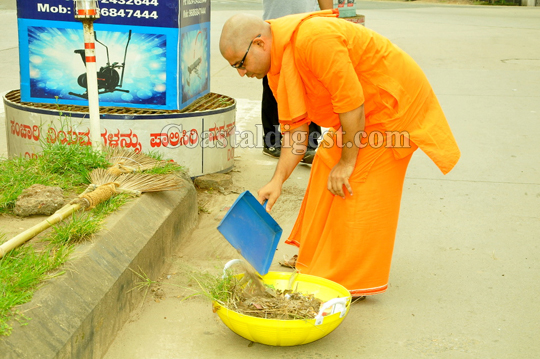
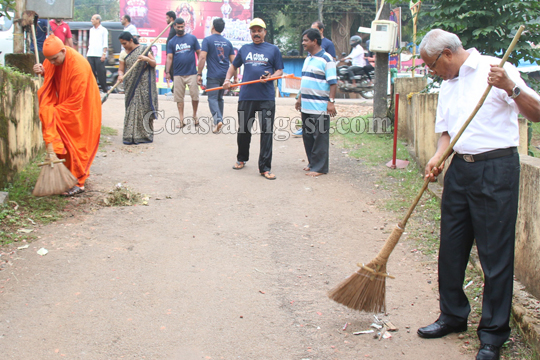
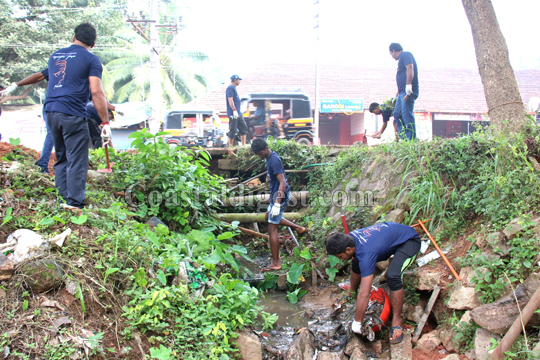
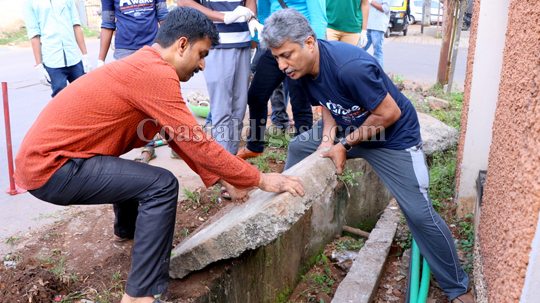
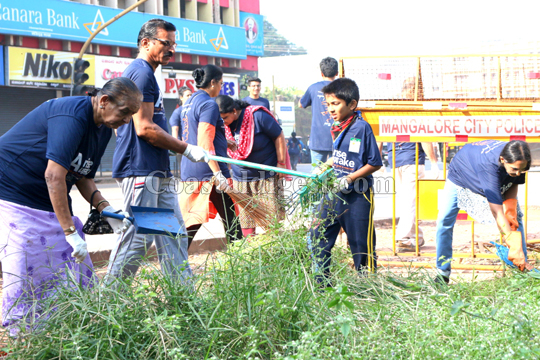
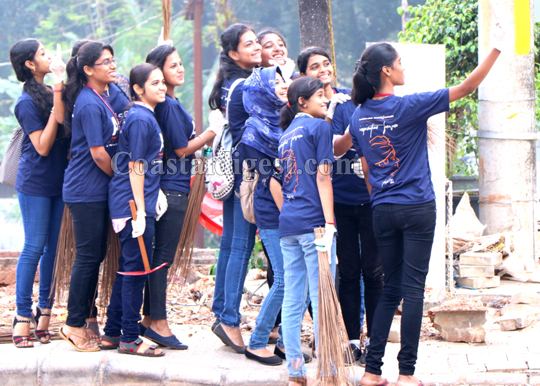
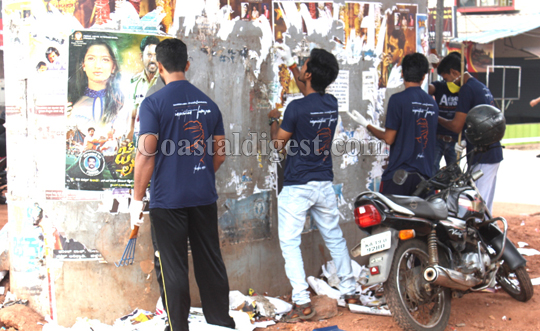
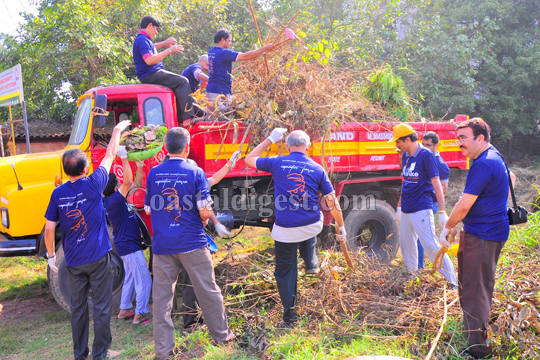
Mangaluru, Oct 18: The second week of 9 cleanliness drives of the 400 abhiyans being organized by Ramakrishna Mission, Mangaluru took off last Sunday at 9 different venues in the city. About 700 volunteers took active part in these drives.
swacch 12

Kodialbail – Members of Prerana Team under the leadership of Sri Sadananda Upadhyaya took up the cleanliness drive near PVS Circle. Swami Purnakamanandaji & Swami Jitakamanandaji of Ramakrishna Math, Mangalore jointly flagged off the 11th drive. Different teams like Ragataranga, Lions Club Metro Gold and members of Leo club joined them in the drive.

Bejai – Members of Mangalore Senior Citizen club, “Mangalore Seniors” carried out the cleanliness drive in and around KSRTC Bus stand. Swami Purnakamanandaji of Ramakrishna Math & Sri Nagesh, Secretary, Senior Citizens Forum jointly flagged off the 12th drive. Swamiji opined that the zeal of the senior citizens will nspire the youngsters of today.

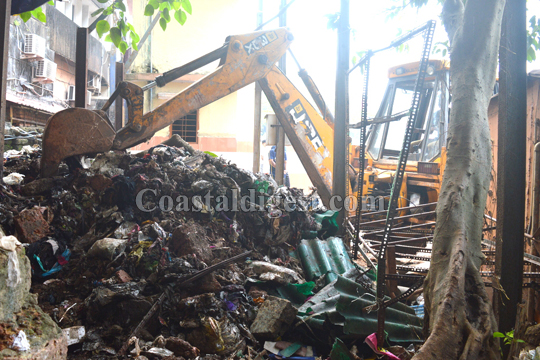
Kottara Chowki – The members of group “Kumara Gym Friends” under leadership of Sri Kiran Kumar cleaned the over bridge & surroundings of Kottara Chowki. Capt. Ganesh Karnik & Br Shivakumar of Ramakrishna Math flagged off the 13th drive. JCB & tipper was used to clear the construction debris.

Nanthur – The members of “Havyaka Mahasabha” cleaned the Nanthur-Padua region. Swami Jitakamanandaji inaugurated the 14th drive. Cleanliness was carried on for 2 hours. Dr. Rajendraprasad, Sri G K Seraje, Sri Venugopal, Sri Ramachandra Bhat & others participated in the drive.

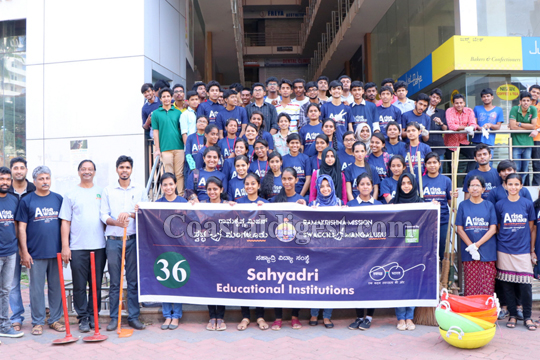
Kankanadi – The students of Sahyadri Engineering College carried on the 15th drive in Kankanady area under the guidance of Sri Sheshappa Amin. Swami Dharmavratanandaji & Sri Umashankar, Dean of Sahyadri Engg. College flagged off the drive.

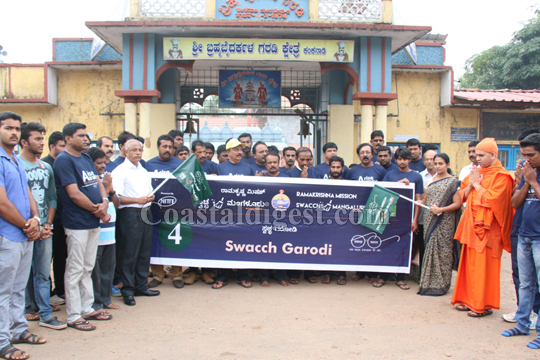
Garodi – “Swacch Garodi for Swacch Mangalore” group formed to create awareness among the public took up the cleanliness drives in Garodi area. Sri J R Lobo & Smt. Asha D'Silva, Corporator, MCC flagged off the 16th drive near Garodi. Swami Ekagamyanandaji of Ramakrishan Math was present. Members of Team Garodi, Googly Cricketers, Nagori, Garodi Multi Gym, Billava Seva Samiti actively participated in the drive.

Padil – Swami Ekagamyanandaji & Sri Vasudev Kottari jointly flagged off the 17th cleanliness drive in front of Mahadevi Bhajana mandir. About 75 volunteers under the leadership of Sri KOdange Balakrishan Nayak carried out cleanliness work for about 3 hours.

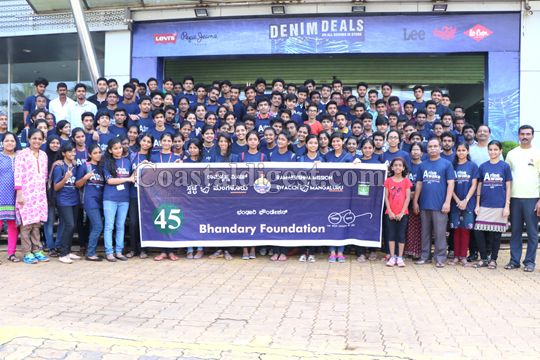
Bendoorwell – Bhandary Foundation has helped the Swacch Mangalore Abhiyan immensely. Students of Sahyadri Engineering College under the leadership of Sri Umanath Kotekar cleaned the road leading from Bendoor well circle to St. Agnes College. Swami Dharmavratanandaji & Sri Umashankar, Dean of Sahyadri Engg. College flagged off the 18th Drive. Smt. Shreelatha UA convened the drive.

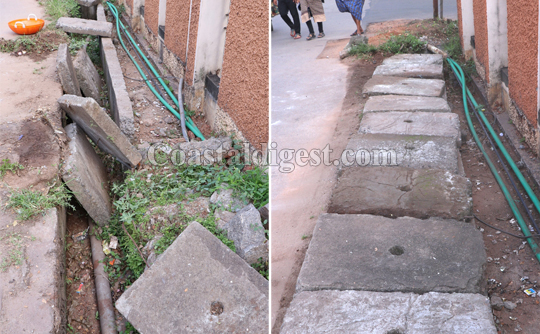
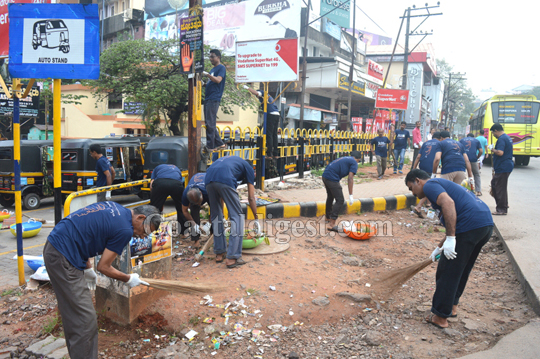
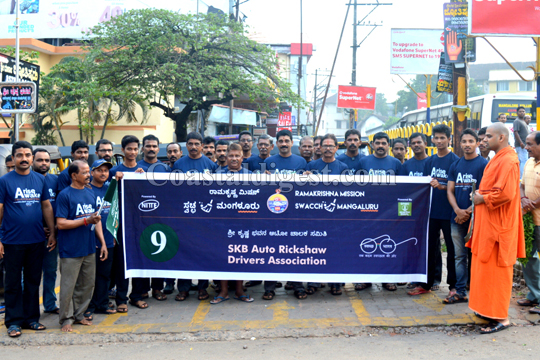
Hampankatta – Auto drivers of Sri Krishna Bhavan Auto shelter dedicated their time and efforts in cleaning the Hampankatta Area under the able guidance of Sri Dilraj Alva, Convener of the Abhiyan. JCB & Tippers were used to clear the heaps of garbage lying in the corners for years. Interlock tiles were re-laid in the footpath to help the pedestrians. Swami Chidambarananda flagged off the drive.

Nitte Education Trust & MRPL are patronizing this 3rd phase of Swacch Mangaluru Abhiyan. We have attached few snaps of all the 9 drives. Kindly cooperate with us by publishing this as news item in your esteemed daily/channels.
swacch 1

swacch 2

swacch 3

swacch 4

swacch 5

swacch 6

swacch 7

swacch 8

swacch 9

swacch 10

swacch 11

swacch 13

swacch 14

swacch 15

Comments

ali
 - 
Wednesday, 19 Oct 2016

RSS should come forward and join hands with municipality people to take garbage from the district. After all you have got the same uniform of municipality department.

Fairman
 - 
Tuesday, 18 Oct 2016

Thank you for cleaning.

Mainly It is required to clean of our heart and brain. Otherwise it will be like wearing clean dress without taking bath.

Therefore required to free the society from all types of public evils like discord (disharmony), rites, bribes, corruption, hunger, crimes.
we need to have healthy relation amongst all our communities.

May God help.

Add new comment

  • Coastaldigest.com reserves the right to delete or block any comments.
  • Coastaldigset.com is not responsible for its readers’ comments.
  • Comments that are abusive, incendiary or irrelevant are strictly prohibited.
  • Please use a genuine email ID and provide your name to avoid reject.
Ram Puniyani
June 29,2020

In Minneapolis, US an African American, George Floyd lost his life as the white policeman, Derek Chauvin, caught hold of him and put his knee on his neck. This is a technique developed by Israel police. For nine long minutes the knee of the while policeman was on the neck of George, who kept shouting, I can’t breathe.

Following this gruesome murder America erupted with protests, ‘Black lives matter’. The protestors were not just African Americans but also a large section of whites. Within US one police Chief apologized for the act of this. In a touching gesture of apology the police force came on its knees. This had reverberations in different parts of the World.

The act was the outcome of the remnants of the racial hatred against blacks by the whites. It is the hatred and the perceptions which are the roots of such acts of violence. What was also touching that the state of democracy in US is so deep that even the police apologized, the nation, whites and blacks, stood up as a sensitive collective against this violence.

US is not the only country where the brutal acts of violence torment the marginalized sections of society. In India there is a list of dalits, minorities and adivasis who are regularly subjected to such acts. But the reaction is very different. We have witnessed the case of Tabrez Ansari, who was tied to the pole by the mob and beaten ruthlessly. When he was taken to police station, police took enough time to take him to hospital and Tabrez died.

Mohsin Sheikh, a Pune techie was murdered by Hindu Rashtra Sena mob, the day Modi came to power in 2014. Afrazul was killed by Shambhulal Regar, videotaped the act released on social media. Regar believed that Muslims are indulging in love Jihad, so deserve such a fate. Mohammad Akhlaq is one among many names who were mob lynched on the issue of beef cow. The list can fill pages after pages.

Recently a young dalit boy was shot dead for the crime of entering a temple. In Una four dalits were stripped above waste and beaten mercilessly. Commenting on this act the Union Minister Ramvilas Paswan commented that it is a minor incident. Again the list of atrocities against dalits is long enough. The question is what Paswan is saying is the typical response to such gruesome murders and tortures. In US loss of one black life, created the democratic and humane response. In India there is a general silence in response to these atrocities. Some times after a good lapse of time, the Prime Minister will utter, ‘Mother Bharati has lost a son’. Most of the time victim is blamed. Some social groups raise their voice in some fora but by and large the deafening silence from the country is the norm.

India is regarded as the largest democracy. Democracy is the rule of law, and the ground on which the injustices are opposed. In America though the present President is insensitive person, but its institutions and processes of democratic articulations are strong. The institutions have deepened their roots and though prejudices may be guiding the actions of some of the officers like the killer of George, there are also police officers who can tell their President to shut up if he has nothing meaningful to say on the issue. The prejudices against Blacks may be prevalent and deep in character, still there are large average sections of society, who on the principles of ‘Black lives matter’. There are large sections of vocal population who can protest the violation of basic norms of democracy and humanism.

In India by contrast there are multiple reasons as to why the lives of Tabrez Ansari, Mohammad Akhlaq, Una dalit victims and their likes don’t matter. Though we claim that we are a democracy, insensitivity to injustices is on the rise. The strong propaganda against the people from margins has become so vicious during last few decades that any violence against them has become sort of a new normal. The large populace, though disturbed by such brutalities, is also fed the strong dose of biases against the victims. The communal forces have a great command over effective section of media and large section of social media, which generates Hate against these disadvantaged groups, thereby the response is muted, if at all.

As such also the process of deepening of our democracy has been weak. Democracy is a dynamic process; it’s not a fixed entity. Decades ago workers and dalits could protest for their rights. Now even if peasants make strong protests, dominant media presents it as blocking of traffic! How the roots of democracy are eroded and are visible in the form where the criticism of the ruling dispensation is labelled as anti National..

Our institutions have been eroded over a period of time, and these institutions coming to the rescue of the marginalized sections have been now become unthinkable. The outreach of communal, divisive ideology, the ideology which looks down on minorities, dalits and Adivasis has risen by leaps and bounds.

The democracy in India is gradually being turned in to a hollow shell, the rule of law being converted in to rule of an ideology, which does not have faith in Indian Constitution, which looks down upon pluralism and diversity of this country, which is more concerned for the privileges of the upper caste, rich and affluent. The crux of the matter is the weak nature of democracy, which was on way to become strong, but from decades of 1980s, as emotive issues took over, the strength of democracy started dwindling, and that’s when the murders of the types of George Floyd, become passé. One does complement the deeper roots of American democracy and its ability to protect the democratic institutions, which is not the case in India, where protests of the type, which were witnessed after George Floyd’s murder may be unthinkable, at least in the present times. 

Comments

Add new comment

  • Coastaldigest.com reserves the right to delete or block any comments.
  • Coastaldigset.com is not responsible for its readers’ comments.
  • Comments that are abusive, incendiary or irrelevant are strictly prohibited.
  • Please use a genuine email ID and provide your name to avoid reject.
News Network
July 28,2020

Hounde, Jul 28: Coronavirus and its restrictions are pushing already hungry communities over the edge, killing an estimated 10,000 more young children a month as meager farms are cut off from markets and villages are isolated from food and medical aid, the United Nations warned Monday.

In the call to action shared with The Associated Press ahead of publication, four UN agencies warned that growing malnutrition would have long-term consequences, transforming individual tragedies into a generational catastrophe.

Hunger is already stalking Haboue Solange Boue, an infant from Burkina Faso who lost half her former body weight of 5.5 pounds (2.5 kilograms) in just a month. Coronavirus restrictions closed the markets, and her family sold fewer vegetables. Her mother was too malnourished to nurse.

“My child,” Danssanin Lanizou whispered, choking back tears as she unwrapped a blanket to reveal her baby's protruding ribs.

More than 550,000 additional children each month are being struck by what is called wasting, according to the UN — malnutrition that manifests in spindly limbs and distended bellies. Over a year, that's up 6.7 million from last year's total of 47 million. Wasting and stunting can permanently damage children physically and mentally.

“The food security effects of the COVID crisis are going to reflect many years from now,” said Dr. Francesco Branca, the WHO head of nutrition. “There is going to be a societal effect.”

From Latin America to South Asia to sub-Saharan Africa, more poor families than ever are staring down a future without enough food.

In April, World Food Program head David Beasley warned that the coronavirus economy would cause global famines “of biblical proportions” this year. There are different stages of what is known as food insecurity; famine is officially declared when, along with other measures, 30% of the population suffers from wasting.

The World Food Program estimated in February that one Venezuelan in three was already going hungry, as inflation rendered salaries nearly worthless and forced millions to flee abroad. Then the virus arrived.

“Every day we receive a malnourished child,” said Dr. Francisco Nieto, who works in a hospital in the border state of Tachira.

In May, Nieto recalled, after two months of quarantine, 18-month-old twins arrived with bodies bloated from malnutrition. The children's mother was jobless and living with her own mother. She told the doctor she fed them only a simple drink made with boiled bananas.

“Not even a cracker? Some chicken?” he asked.

“Nothing,” the children's grandmother responded. By the time the doctor saw them, it was too late: One boy died eight days later.

The leaders of four international agencies — the World Health Organization, UNICEF, the World Food Program and the Food and Agriculture Organization — have called for at least dollar 2.4 billion immediately to address global hunger.

But even more than lack of money, restrictions on movement have prevented families from seeking treatment, said Victor Aguayo, the head of UNICEF's nutrition program.

“By having schools closed, by having primary health care services disrupted, by having nutritional programs dysfunctional, we are also creating harm,” Aguayo said. He cited as an example the near-global suspension of Vitamin A supplements, which are a crucial way to bolster developing immune systems.

In Afghanistan, movement restrictions prevent families from bringing their malnourished children to hospitals for food and aid just when they need it most. The Indira Gandhi hospital in the capital, Kabul, has seen only three or four malnourished children, said specialist Nematullah Amiri. Last year, there were 10 times as many.

Because the children don't come in, there's no way to know for certain the scale of the problem, but a recent study by Johns Hopkins University indicated an additional 13,000 Afghans younger than 5 could die.

Afghanistan is now in a red zone of hunger, with severe childhood malnutrition spiking from 690,000 in January to 780,000 — a 13% increase, according to UNICEF.

In Yemen, restrictions on movement have blocked aid distribution, along with the stalling of salaries and price hikes. The Arab world's poorest country is suffering further from a fall in remittances and a drop in funding from humanitarian agencies.

Yemen is now on the brink of famine, according to the Famine Early Warning Systems Network, which uses surveys, satellite data and weather mapping to pinpoint places most in need.

Some of the worst hunger still occurs in sub-Saharan Africa. In Sudan, 9.6 million people live from one meal to the next — a 65% increase from the same time last year.

Lockdowns across Sudanese provinces, as around the world, have dried up work and incomes for millions. With inflation hitting 136%, prices for basic goods have more than tripled.

“It has never been easy but now we are starving, eating grass, weeds, just plants from the earth,” said Ibrahim Youssef, director of the Kalma camp for internally displaced people in war-ravaged south Darfur.

Adam Haroun, an official in the Krinding camp in west Darfur, recorded nine deaths linked with malnutrition, otherwise a rare occurrence, over the past two months — five newborns and four older adults, he said.

Before the pandemic and lockdown, the Abdullah family ate three meals a day, sometimes with bread, or they'd add butter to porridge. Now they are down to just one meal of “millet porridge” — water mixed with grain. Zakaria Yehia Abdullah, a farmer now at Krinding, said the hunger is showing “in my children's faces.”

“I don't have the basics I need to survive,” said the 67-year-old, who who hasn't worked the fields since April. “That means the 10 people counting on me can't survive either.”

Comments

Add new comment

  • Coastaldigest.com reserves the right to delete or block any comments.
  • Coastaldigset.com is not responsible for its readers’ comments.
  • Comments that are abusive, incendiary or irrelevant are strictly prohibited.
  • Please use a genuine email ID and provide your name to avoid reject.
News Network
July 11,2020

Bengaluru, Jul 11: The Bharatiya Janata Party led government of Karnataka is planning to ban cow slaughter as well as the sale and consumption of beef in the state by bringing Prevention of Cow Slaughter and Preservation Bill, 2012.

"Many states have passed the Anti-Cow Slaughter Bill. We are preparing to implement it in Karnataka as well. The state government will soon implement a ban on cow slaughter, sale and consumption of beef on the lines of many other states," said Prabhu Chauhan, the state's Animal Husbandry Minister.

The Anti-Cow Slaughter Act is already in place in several states like Gujarat, Delhi, Haryana, Maharashtra, Madhya Pradesh among others.

Last month, the Yogi Adityanath-led Uttar Pradesh government passed a draft ordinance to prevent cow slaughter, providing maximum rigorous imprisonment of 10 years and a fine up to Rs 5 lakh.
The Uttar Pradesh Cabinet Cow Slaughter Prevention (Amendment) Ordinance, 2020 aims at making the existing Uttar Pradesh Prevention of Cow Slaughter Act, 1955 more effective towards cow safety.

In Karnataka, the BJP-led government had promised to ban cow slaughter in its manifesto for 2018 state assembly election.

"The government will form a team of experts to look into once the current pandemic situation eases," Chauhan stated, adding that if necessary, the team of experts will visit states like Uttar Pradesh, Gujarat.

The then BS Yediyurappa-led BJP government had passed the Karnataka Prevention of Cow Slaughter and Protection Bill in 2010 but it failed to get presidential approval. Three years later, the Bill was withdrawn by the Siddaramaiah-led Congress government.

"I will discuss this matter with Chief Minister and if this pandemic situation eases, by next session, if not by upcoming assembly session, we will try to bring Karnataka Prevention of Slaughter and Preservation of Cattle Bill," Chauhan added.

Comments

Go-pitha maha
 - 
Sunday, 12 Jul 2020

now india is ruled by most unfit people in the world...

one yogi become CM after dumping his family, another became PM after dumping his family and mother, now they teach that COW is mother and need protection...

the main point is here is the business, they know very well muslims make profit in meat business and now they want to steal from them...gomata, protection all these are bullshit...only gobar bakth will belive...

Add new comment

  • Coastaldigest.com reserves the right to delete or block any comments.
  • Coastaldigset.com is not responsible for its readers’ comments.
  • Comments that are abusive, incendiary or irrelevant are strictly prohibited.
  • Please use a genuine email ID and provide your name to avoid reject.