Swacch Mangaluru Abhiyan: Over 700 volunteers clean 9 venues

[email protected] (Media Release)
October 18, 2016

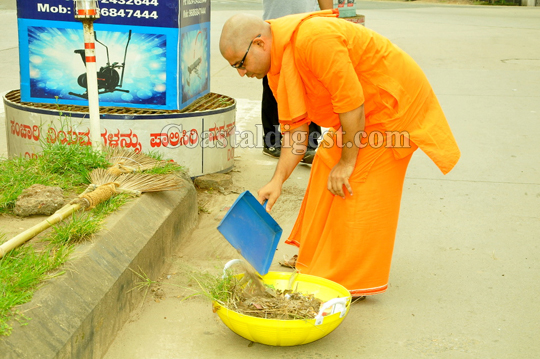
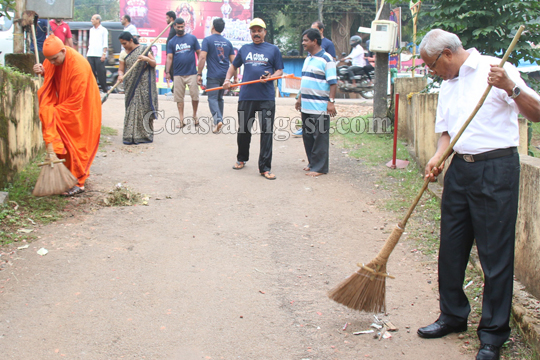
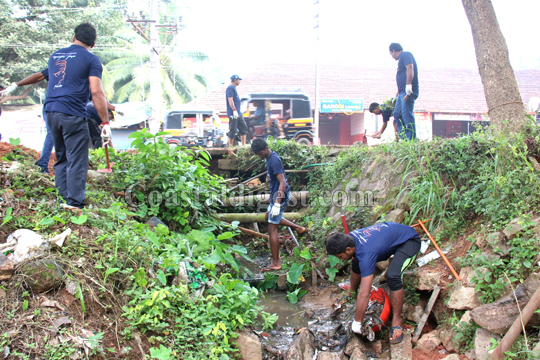
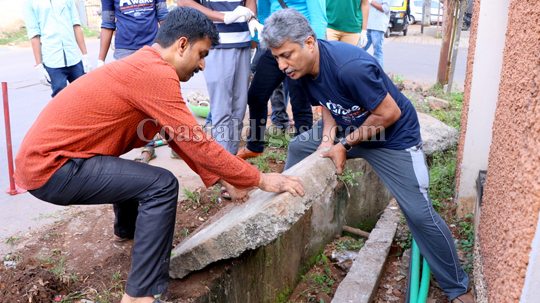
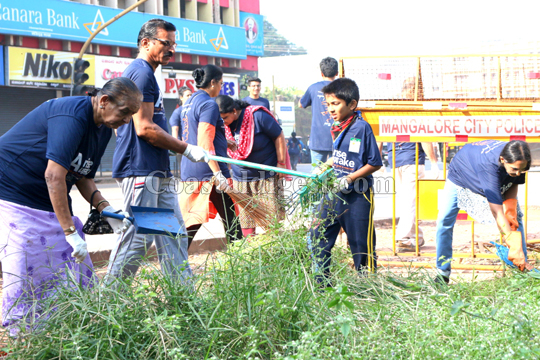
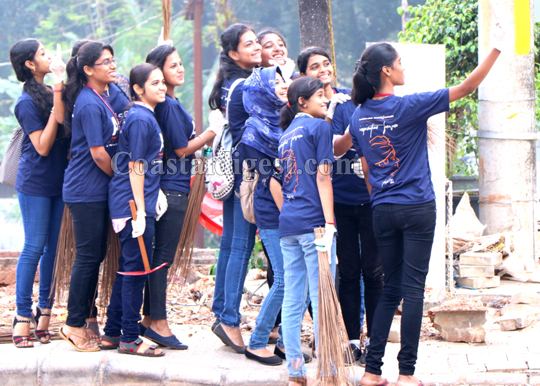
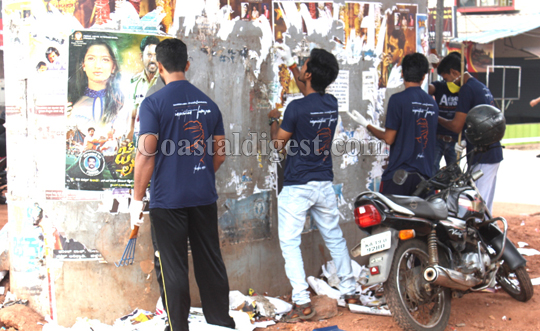
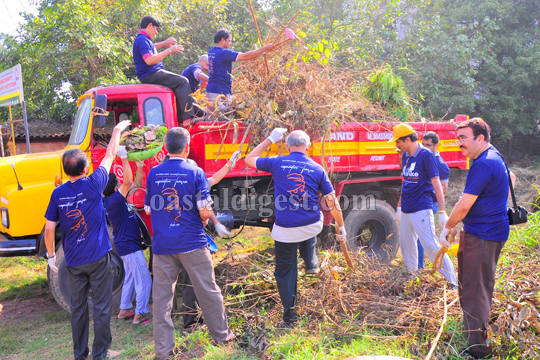
Mangaluru, Oct 18: The second week of 9 cleanliness drives of the 400 abhiyans being organized by Ramakrishna Mission, Mangaluru took off last Sunday at 9 different venues in the city. About 700 volunteers took active part in these drives.
swacch 12

Kodialbail – Members of Prerana Team under the leadership of Sri Sadananda Upadhyaya took up the cleanliness drive near PVS Circle. Swami Purnakamanandaji & Swami Jitakamanandaji of Ramakrishna Math, Mangalore jointly flagged off the 11th drive. Different teams like Ragataranga, Lions Club Metro Gold and members of Leo club joined them in the drive.

Bejai – Members of Mangalore Senior Citizen club, “Mangalore Seniors” carried out the cleanliness drive in and around KSRTC Bus stand. Swami Purnakamanandaji of Ramakrishna Math & Sri Nagesh, Secretary, Senior Citizens Forum jointly flagged off the 12th drive. Swamiji opined that the zeal of the senior citizens will nspire the youngsters of today.

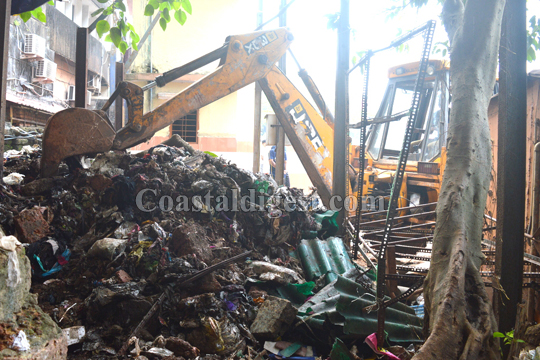
Kottara Chowki – The members of group “Kumara Gym Friends” under leadership of Sri Kiran Kumar cleaned the over bridge & surroundings of Kottara Chowki. Capt. Ganesh Karnik & Br Shivakumar of Ramakrishna Math flagged off the 13th drive. JCB & tipper was used to clear the construction debris.

Nanthur – The members of “Havyaka Mahasabha” cleaned the Nanthur-Padua region. Swami Jitakamanandaji inaugurated the 14th drive. Cleanliness was carried on for 2 hours. Dr. Rajendraprasad, Sri G K Seraje, Sri Venugopal, Sri Ramachandra Bhat & others participated in the drive.

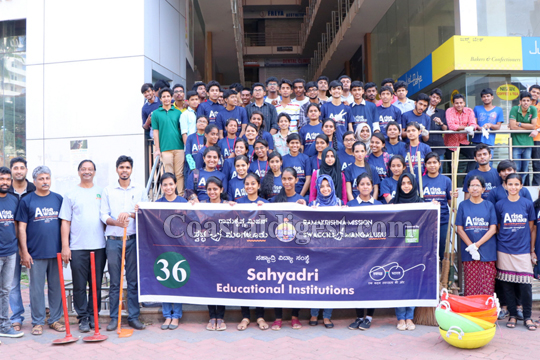
Kankanadi – The students of Sahyadri Engineering College carried on the 15th drive in Kankanady area under the guidance of Sri Sheshappa Amin. Swami Dharmavratanandaji & Sri Umashankar, Dean of Sahyadri Engg. College flagged off the drive.

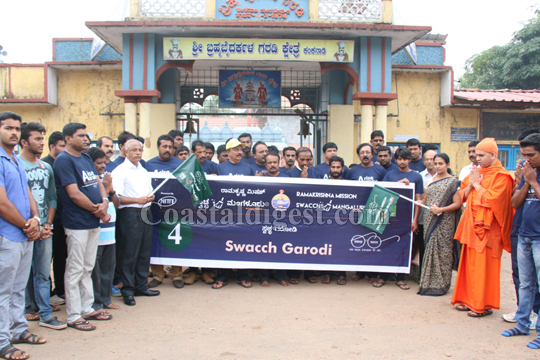
Garodi – “Swacch Garodi for Swacch Mangalore” group formed to create awareness among the public took up the cleanliness drives in Garodi area. Sri J R Lobo & Smt. Asha D'Silva, Corporator, MCC flagged off the 16th drive near Garodi. Swami Ekagamyanandaji of Ramakrishan Math was present. Members of Team Garodi, Googly Cricketers, Nagori, Garodi Multi Gym, Billava Seva Samiti actively participated in the drive.

Padil – Swami Ekagamyanandaji & Sri Vasudev Kottari jointly flagged off the 17th cleanliness drive in front of Mahadevi Bhajana mandir. About 75 volunteers under the leadership of Sri KOdange Balakrishan Nayak carried out cleanliness work for about 3 hours.

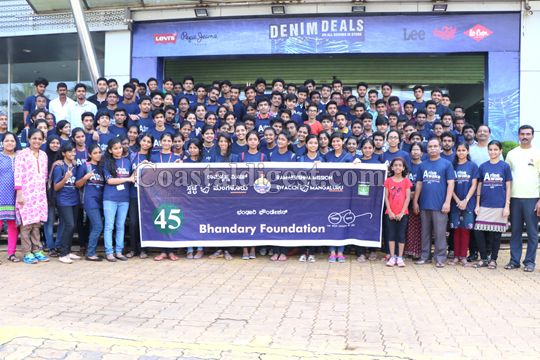
Bendoorwell – Bhandary Foundation has helped the Swacch Mangalore Abhiyan immensely. Students of Sahyadri Engineering College under the leadership of Sri Umanath Kotekar cleaned the road leading from Bendoor well circle to St. Agnes College. Swami Dharmavratanandaji & Sri Umashankar, Dean of Sahyadri Engg. College flagged off the 18th Drive. Smt. Shreelatha UA convened the drive.

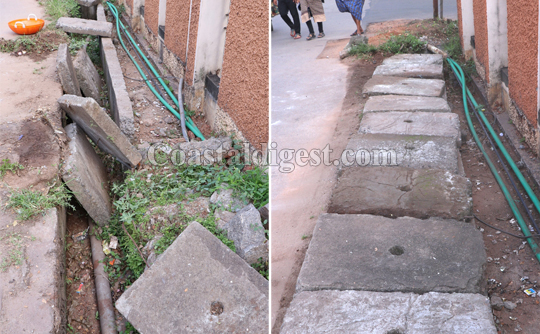
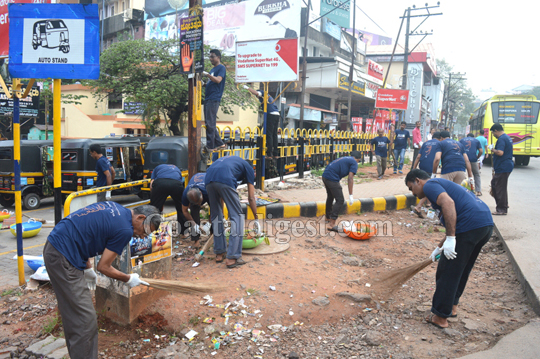
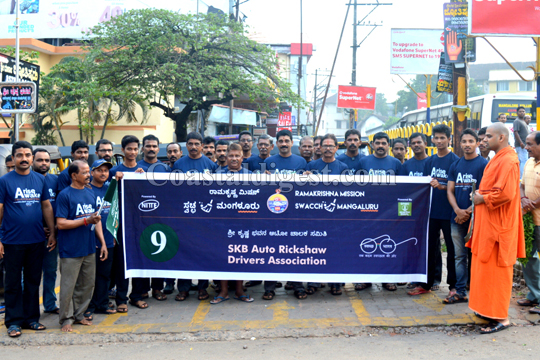
Hampankatta – Auto drivers of Sri Krishna Bhavan Auto shelter dedicated their time and efforts in cleaning the Hampankatta Area under the able guidance of Sri Dilraj Alva, Convener of the Abhiyan. JCB & Tippers were used to clear the heaps of garbage lying in the corners for years. Interlock tiles were re-laid in the footpath to help the pedestrians. Swami Chidambarananda flagged off the drive.

Nitte Education Trust & MRPL are patronizing this 3rd phase of Swacch Mangaluru Abhiyan. We have attached few snaps of all the 9 drives. Kindly cooperate with us by publishing this as news item in your esteemed daily/channels.
swacch 1

swacch 2

swacch 3

swacch 4

swacch 5

swacch 6

swacch 7

swacch 8

swacch 9

swacch 10

swacch 11

swacch 13

swacch 14

swacch 15

Comments

ali
 - 
Wednesday, 19 Oct 2016

RSS should come forward and join hands with municipality people to take garbage from the district. After all you have got the same uniform of municipality department.

Fairman
 - 
Tuesday, 18 Oct 2016

Thank you for cleaning.

Mainly It is required to clean of our heart and brain. Otherwise it will be like wearing clean dress without taking bath.

Therefore required to free the society from all types of public evils like discord (disharmony), rites, bribes, corruption, hunger, crimes.
we need to have healthy relation amongst all our communities.

May God help.

Add new comment

  • Coastaldigest.com reserves the right to delete or block any comments.
  • Coastaldigset.com is not responsible for its readers’ comments.
  • Comments that are abusive, incendiary or irrelevant are strictly prohibited.
  • Please use a genuine email ID and provide your name to avoid reject.
Ram Puniyani
January 14,2020

In the beginning of January 2020 two very disturbing events were reported from Pakistan. One was the attack on Nankana Sahib, the holy shrine where Sant Guru Nanak was born. While one report said that the place has been desecrated, the other stated that it was a fight between two Muslim groups. Prime Minister of Pakistan Imran Khan condemned the incident and the main accused Imran Chisti was arrested. The matter related to abduction and conversion of a Sikh girl Jagjit Kaur, daughter of Pathi (One who reads Holy Guru Granth Sahib in Gurudwara) of the Gurudwara. In another incident one Sikh youth Ravinder Singh, who was out on shopping for his marriage, was shot dead in Peshawar.

While these condemnable attacks took place on the Sikh minority in Pakistan, BJP was quick enough to jump to state that it is events like this which justify the Citizenship Amendment Act (CAA). Incidentally CAA is the Act which is discriminatory and relates to citizenship with Religion, which is not as per the norms of Indian constitution. There are constant debates and propaganda that population of Hindus has come down drastically in Pakistan and Bangla Desh. Amit Shah, the Home minister stated that in Pakistan the population of Hindus has come down from 23% at the time of partition to 3.7% at present. And in Bangla Desh it has come down from 22% to present 8%.

While not denying the fact that the religious minorities are getting a rough deal in both these countries, the figures which are presented are totally off the mark. These figures don’t take into consideration the painful migrations, which took place at the time of partition and formation of Bangla Desh later. Pakistan census figures tell a different tale. Their first census was held in 1951. As per this census the overall percentage of Non Muslim in Pakistan (East and West together) was 14.2%, of this in West Pakistan (Now Pakistan) it was 3.44 and in Eat Pakistan it was 23.2. In the census held in Pakistan 1998 it became 3.72%. As far as Bangla Desh is concerned the share of Non Muslims has gone down from 23.2 (1951) to 9.6% in 2011.

The largest minority of Pakistan is Ahmadis, (https://minorityrights.org/country/pakistan/) who are close to 4 Million and are not recognised as Muslims in Pakistan. In Bangla Desh the major migrations of Hindus from Bangla Desh took place in the backdrop of Pakistan army’s atrocities in the then East Pakistan.

As far as UN data on refugees in India it went up by 17% between 2016-2019 and largest numbers were from Tibet and Sri Lanka.  (https://www.un.org/en/development/desa/population/migration/publication…)

The state of minorities is in a way the index of strength of democracy. Most South Asian Countries have not been able to sustain democratic values properly. In Pakistan, the Republic began with Jinnah’s classic speech where secularism was to be central credo of Pakistan. This 11th August speech was in a way what the state policy should be, as per which people of all faiths are free to practice their religion. Soon enough the logic of ‘Two Nation theory” and formation of Pakistan, a separate state for Muslim took over. Army stepped in and dictatorship was to reign there intermittently. Democratic elements were suppressed and the worst came when Zia Ul Haq Islamized the state in collusion with Maulanas. The army was already a strong presence in Pakistan. The popular formulation for Pakistan was that it is ruled by three A’s, Army, America and Allah (Mullah).

Bangla Desh had a different trajectory. Its very formation was a nail in the coffin of ‘two nation theory’; that religion can be the basis of a state. Bangla Desh did begin as a secular republic but communal forces and secular forces kept struggling for their dominance and in 1988 it also became Islamic republic. At another level Myanmar, in the grip of military dictatorship, with democratic elements trying to retain their presence is also seeing a hard battle. Democracy or not, the army and Sanghas (Buddhist Sang has) are strong, in Myanmar as well. The most visible result is persecution of Rohingya Muslims.

Similar phenomenon is dominating in Sri Lanka also where Budhhist Sanghas and army have strong say in the political affairs, irrespective of which Government is ruling. Muslim and Christian minorities are a big victim there, while Tamils (Hindus, Christians etc.) suffered the biggest damage as ethnic and religious minorities. India had the best prospect of democracy, pluralism and secularism flourishing here. The secular constitution, the outcome of India’s freedom struggle, the leadership of Gandhi and Nehru did ensure the rooting of democracy and secularism in a strong way.

India so far had best democratic credentials amongst all the south Asian countries. Despite that though the population of minorities rose mainly due to poverty and illiteracy, their overall marginalisation was order of the day, it went on worsening with the rise of communal forces, with communal forces resorting to identity issues, and indulging in propaganda against minorities.

While other South Asian countries should had followed India to focus more on infrastructure and political culture of liberalism, today India is following the footsteps of Pakistan. The retrograde march of India is most visible in the issues which have dominated the political space during last few years. Issues like Ram Temple, Ghar Wapasi, Love Jihad, Beef-Cow are now finding their peak in CAA.

India’s reversal towards a polity with religion’s identity dominating the political scene was nicely presented by the late Pakistani poetess Fahmida Riaz in her poem, Tum bhi Hum Jaise Nikle (You also turned out to be like us). While trying to resist communal forces has been an arduous task, it is becoming more difficult by the day. This phenomenon has been variously called, Fundamentalism, Communalism or religious nationalism among others. Surely it has nothing to do with the religion as practiced by the great Saint and Sufi traditions of India; it resorts mainly to political mobilization by using religion as a tool.

Comments

Ashi
 - 
Tuesday, 14 Jan 2020

If Malaysia implement similar NRC/CAA, India and China are the loser.

Add new comment

  • Coastaldigest.com reserves the right to delete or block any comments.
  • Coastaldigset.com is not responsible for its readers’ comments.
  • Comments that are abusive, incendiary or irrelevant are strictly prohibited.
  • Please use a genuine email ID and provide your name to avoid reject.
News Network
April 3,2020

Mangaluru, Apr 3: The Dakshina Kannada district administration’s decision to ban use of private vehicles, excluding permitted categories, from Friday for effective implementation of lockdown, began showing results since morning itself.

Mangaluru City Traffic Police and Dakshina Kannada district police erected several pickets at vantage places on arterial roads to check those moving without a valid reason. Several two-wheelers were seized during the checking while a few car drivers were let off with a strict warning.

Assistant Commissioner of Police (Traffic), M Manjunatha Shetty, who was supervising a picket at Hampankatta, said that movement of private vehicles has drastically reduced in the city.

Comments

Add new comment

  • Coastaldigest.com reserves the right to delete or block any comments.
  • Coastaldigset.com is not responsible for its readers’ comments.
  • Comments that are abusive, incendiary or irrelevant are strictly prohibited.
  • Please use a genuine email ID and provide your name to avoid reject.
News Network
June 3,2020

Mangaluru, Jun 3: A banner that read "Veer Savarkar Flyover Pumpwell" surfaced on the sidewall of the Pumpwell flyover in Mangaluru on Tuesday night.

It is suspected that activists of Bajrang Dal put up the controversial banner. Though it was removed later, it sparked debates on social media and photos of it went viral.

The development comes amid the controversy over the naming of a flyover at Yelahanka in Bengaluru after Savarkar.

A Hindutva ideologue, Savarkar has tendered apology to British imperialists and pledged to support them following his arrest during India’s freedom movement.

Comments

Add new comment

  • Coastaldigest.com reserves the right to delete or block any comments.
  • Coastaldigset.com is not responsible for its readers’ comments.
  • Comments that are abusive, incendiary or irrelevant are strictly prohibited.
  • Please use a genuine email ID and provide your name to avoid reject.