Swachh Mangaluru: Central market, jail road, Chilimbi areas cleaned

[email protected] (CD Network)
February 8, 2016

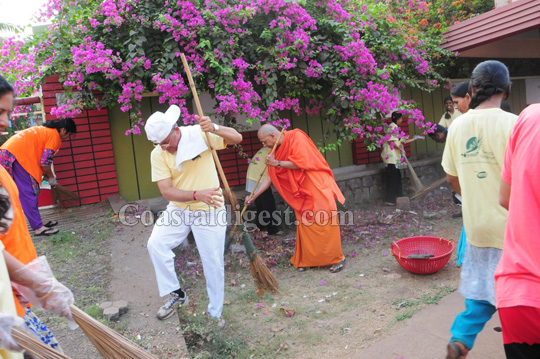
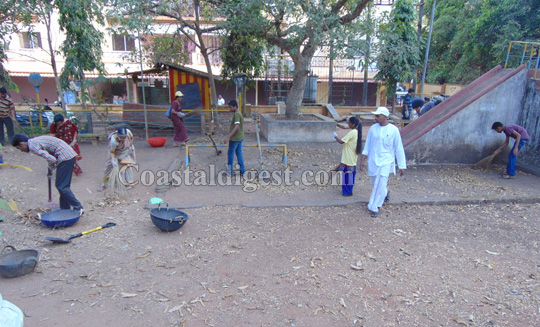
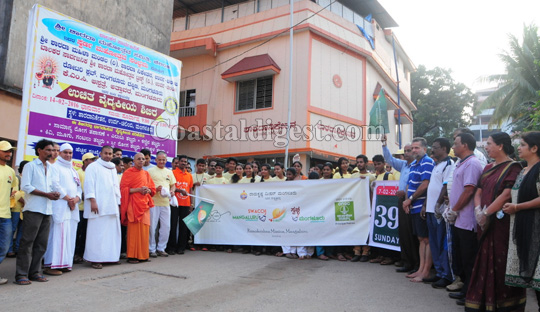
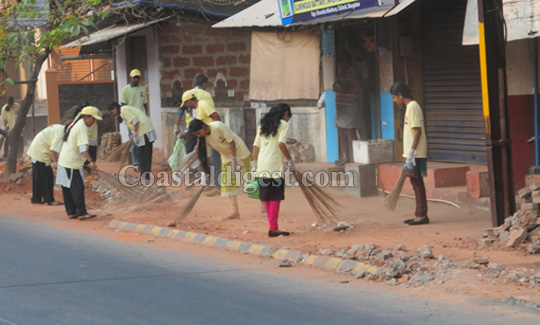
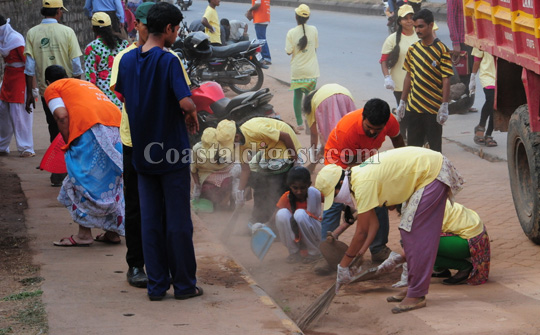
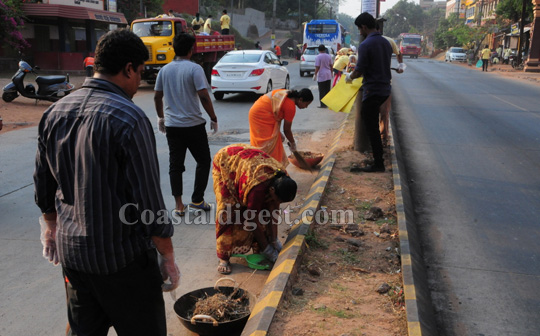
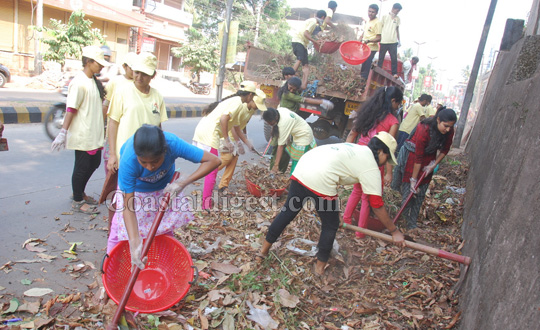
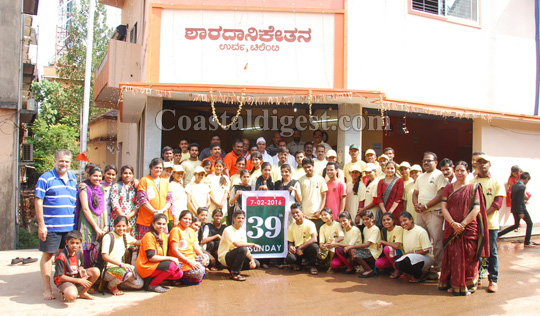
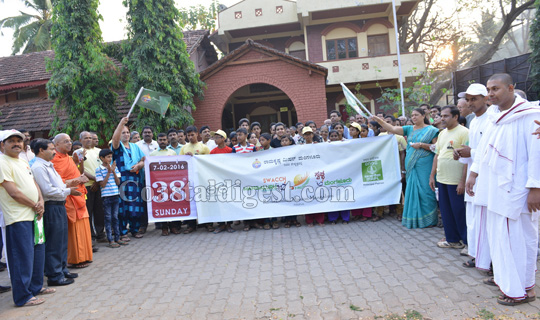
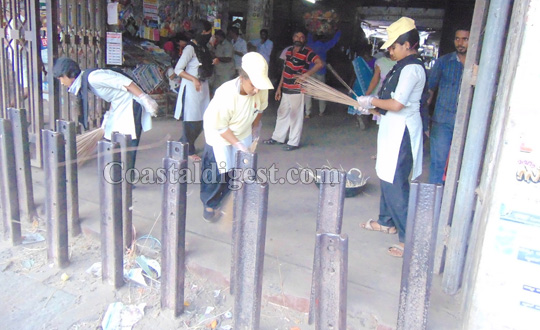
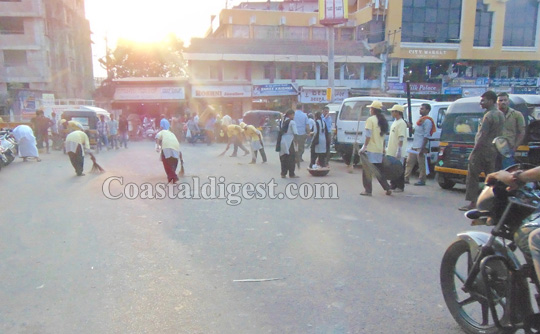
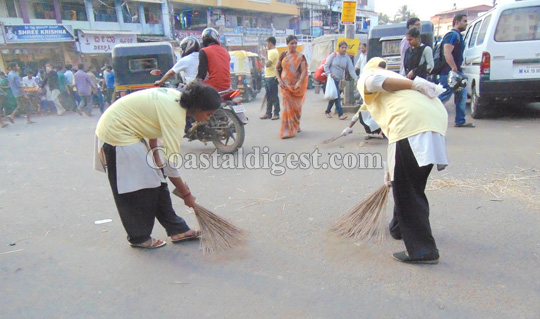
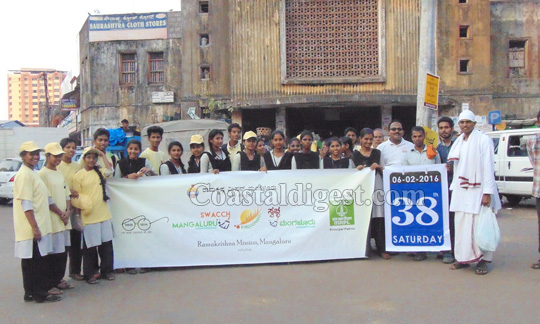
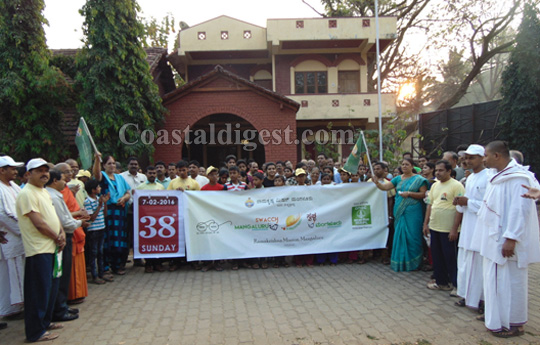
Mangaluru, Feb 7: With the 40-week long Swachh Mangaluru Abhiyan on its home stretch, Ramakrishna Math, chief organisers of the campaign in association with MRPL, principal patron of the event carried out a special weekend of cleanliness. While volunteers cleaned up the Central market area on Saturday, they targeted the Karangalpady Jail road area and Chilimbi area respectively for the 38th and 39th Swachh Mangaluru Abhiyan respectively on Sunday.

ramakrishna 4

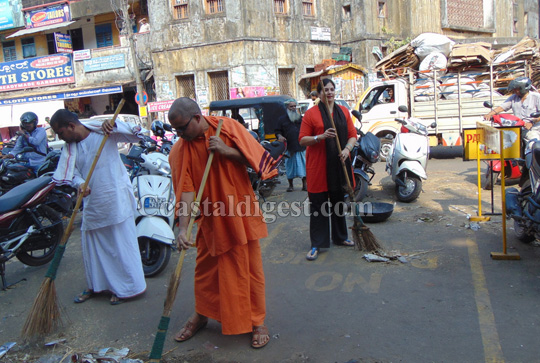
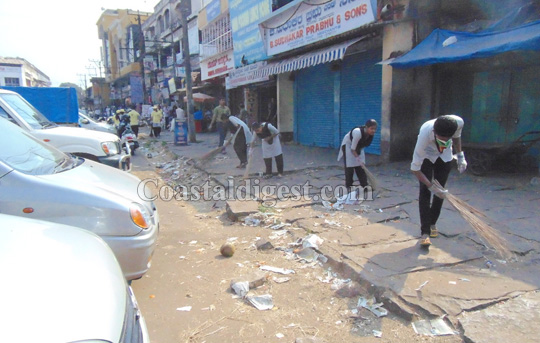
Swami Dharmavratanandaji of Ramakrishna Math, Mangaluru and Deepa Pai, managing director of Hangyo Ice creams Ltd, Rajashekhar Hebbar, principal, GFGC, Car street were present at the special drive at Central market. Volunteers not only cleaned Central market area with brooms but also heaps of dirt and garbage that had filled the nooks and corners of the market were thoroughly cleaned. They also distributed awareness handbills to all shops and customers in the market.

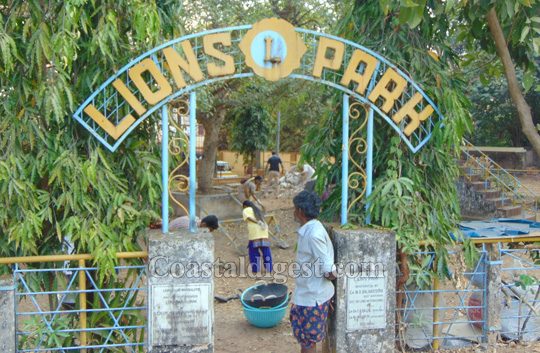
The 38th abhiyan was carried out in Karangalpady Jail Road area on Sunday. Jacintha Vijay Alfred, Mayor and Lily Pinto flagged off the drive in the presence of Swami Jitakamanandaji, president, Ramakrishna Math. The Mayor cleaned the premises of DIET with broom. Volunteers were divided into three groups and each one cleaned Jail Road, C G Kamath Road and Lions Park under the guidance of Dr Satish Rao, Ramkumar Bekal and Satish Bhat.

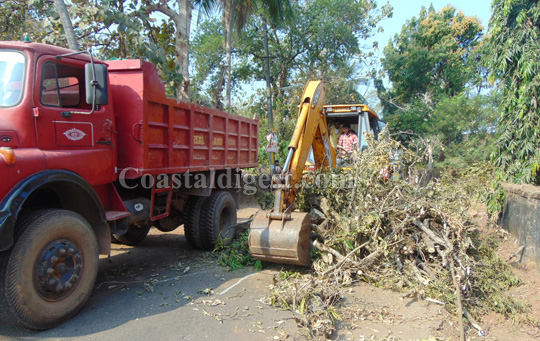
Branches of trees pruned by authorities and that lay unattended along the roads were cleared using earth excavator machines helping the pedestrians. Worn out direction boards were repainted and awareness handbills were distributed among different households. The 39th Swachh Mangaluru Abhiyan was carried in Chilimbi area. Ganesh Karnik, MLC briefed volunteers about the abhiyan. Volunteers cleaned different areas in and around Chilmbi for almost 3 hours later.

ramakrishna 1

ramakrishna 2

ramakrishna 3

ramakrishna 5

ramakrishna 6

ramakrishna 7

ramakrishna 8

ramakrishna 9

ramakrishna 10

ramakrishna 11

ramakrishna 12

ramakrishna 13

ramakrishna 14

ramakrishna 15

ramakrishna 16

ramakrishna 17

ramakrishna 18

Comments

fathima
 - 
Monday, 8 Feb 2016

Great and Godly work.Keep up the same spirit.I request schools and colleges to have atleast half an hour cleanliness classes for students.
Lets not be lifeless towrds our surroundings.
In Japan, they involve students from 5th grade and above in farming in the school premises.Potatoes,tomatoes are grown by students in the farm.Same vegetables are taken to school canteen for lunch .We need to implement farming classes in schools so that child gets encouraged in the agriculture field and help the farmers with new farming technologies etc.

Add new comment

  • Coastaldigest.com reserves the right to delete or block any comments.
  • Coastaldigset.com is not responsible for its readers’ comments.
  • Comments that are abusive, incendiary or irrelevant are strictly prohibited.
  • Please use a genuine email ID and provide your name to avoid reject.
News Network
February 23,2020

The euphoria over the claim that around 3,000 tonnes of gold reserves, worth Rs 12 trillion, have been discovered in Uttar Pradesh’s Sonbhadra district could not last even 24 hours, with the Geological Survey of India (GSI) clarifying on Saturday there had been no such discovery.

The GSI, headquartered in Kolkata, rebutted the claims of the Uttar Pradesh Directorate of Geology and Mining (UPDGM), and said “miscommunication” must have led to the wrong reporting of facts.

M Sridhar, director general of the GSI, said nobody in the agency gave any such data. He said 52,806 tonnes of gold ore was found in Sonbhadra district during the exploration work in 1998-2000. From this reserve, only 160 kg of gold can be extracted.

“There must have been some miscommunication of facts because of which the gold ore deposits have been overestimated. We have written a letter to Uttar Pradesh (UPDGM), stating the facts. The GSI has not estimated such kind of vast resource of gold deposits in Sonbhadra,” Sridhar said.

ALSO READ: 2,900-tonne gold mine found in Sonbhadra, 4 times that of India's reserves

The UPDGM had said on Friday that gold deposits were found in Son Pahadi and Hardi areas of the district. Sridhar said while gold ore was found in the area during the GSI’s exploration work in 1998-2000, it had told the state government about the discovery in November last year.

Under the new regulation, which came into effect from 2015, the GSI has to inform the state government when ore deposits are discovered. Earlier, no such action was mandatory. In its report, the GSI estimated that only 3.03 gm of gold can be extracted from a tonne of ore. It also clarified that even the extraction amount was tentative and could not be established for certain.

Moreover, Sridhar said the deposits were spread across only 0.5 sq km in forest land, which made the mining of ore economically unviable. “When there are several mines nearby, we can club it into a block and then it makes sense to mine the ore. But in this case, the deposits are too small to make it viable for any company to mine it,” he said. The GSI usually prioritises its exploration work based on the needs of the Centre. While strategic minerals like tin, cobalt, lithium, beryllium, germanium, gallium, indium, tantalum, niobium, selenium, and bismuth are atop the list in GSI exploration, gold is another commodity on its priority list.

According to the World Gold Council, India has reserves of 630 tonnes of gold.

Comments

Add new comment

  • Coastaldigest.com reserves the right to delete or block any comments.
  • Coastaldigset.com is not responsible for its readers’ comments.
  • Comments that are abusive, incendiary or irrelevant are strictly prohibited.
  • Please use a genuine email ID and provide your name to avoid reject.
coastaldigest.com news network
July 26,2020

Mangaluru, Jul 26: Rubbishing reports about cancellation of institutional quarantine for international passengers in Mangaluru, local health authorities have clarified that 14 day isolation including first seven day institutional quarantine must for international passengers. 

For past couple of days rumours were doing rounds on social media that the government has done away with quarantine for international passengers. A few Mangaluru-based news portals also had published it as news without quoting any reliable sources. 

Meanwhile, district health officer in his clarification message said that neither Karnataka government nor Dakshina Kannada district administrant has revised the quarantine norms for international passengers. 

“Those who arrive from overseas must remain in isolation for 14 days. Out of this, seven days have to be spent in institutional quarantine (in hotel or lodge). During this period, the throat swab sample of the person will be sent for covid-19 testing. If the report is negative, then they will be sent to home quarantine for another seven days."

He said that concession in terms of number of days has only been given for people with other health conditions, children and the elderly. "For children below 10 years, pregnant women, elderly above the age of 60 years and other with other ailments, the throat swab will be collected on the second day of institutional quarantine. If the report turns negative, they will be sent to home quarantine for 14 days."

Comments

Add new comment

  • Coastaldigest.com reserves the right to delete or block any comments.
  • Coastaldigset.com is not responsible for its readers’ comments.
  • Comments that are abusive, incendiary or irrelevant are strictly prohibited.
  • Please use a genuine email ID and provide your name to avoid reject.
Media Release
February 14,2020

Veteran journalist P. Sainath has said that the nation is in a crisis. And this crisis is not limited to just the rural area. It has become a national crisis at various areas such as agriculture, education, economy, job creation etc.

He was delivering the endowment lecture on the topic ‘Indian democracy at the post-liberalization and post-truth era’ at Media Manthan 2020 organized by the PG department of journalism and mass communication at St Aloysius College (Autonomous). 

Mr Sainath said that the many policies adopted in the 90s led to India becoming unusually unequal. Referring to the speech Ambedkar had made at the Constituent Assembly while handing over the draft of the Constitution, Mr Sainath said, “Ambedkar had warned about the weakness of Indian democracy that liberty without equality allows the supremacy of a few over the multitude. Liberty, equality and fraternity must be kept together as we cannot have one without the other.” 

Mr Sainath stated that the agrarian crisis was no longer about the loss of productivity, employment or about farmer suicide; it was a societal, civilizational crisis. Commenting on the lopsided policies such as cow-slaughter ban, he explained how cow slaughter ban had adversely affected many industries due to their interdependency. While Muslims who slaughtered cows were rendered helpless, the cattle traders who were mostly OBCs lost their earnings as the cattle prices crashed. An important industry like Kolhapur sandals industry in Maharashtra went bankrupt as a result of the cow slaughter ban in Maharashtra. He said the policymakers had no idea how the rural industries were interconnected. Demonetisation too devastated the rural economy as 98 percent of rural transactions happen through cash. 

Mr Sainath also spoke about the crisis of inequality which affects the Dalits and the Adivasis far more than anyone else as 90 percent of the rural households take home less than Rs 10,000/- per month. “Women are yet another group whose labour is never counted in the gross domestic product. Women and girls globally do unpaid work which amounts to about 12.5 billion working hours per year. Monetarily speaking, this is worth 10.8 trillion dollars,” Mr Sainath added. 

Speaking about the crisis of jobs Mr Sainath said that major companies were laying off employees just to create more profits for the investors and the adoption of artificial intelligence in the industry would further destroy millions of jobs.

Rector of St Aloysius College Institutions Fr Dionysius Vaz SJ, Principal Dr (Fr) Praveen Martis SJ, HOD of Journalism and Mass Communication department Dr (Fr) Melwyn Pinto SJ were present.

‘Veerappan and Vijay Mallya’s business models are interesting!’

Addressing the gathering during his endowment lecture on Friday, Mr Sainath made an interesting comment on the so called ‘revenue model’. “Whenever I visit IIMs and IITs for lectures on my PARI project, the students there ask me what my revenue model for my project is. I tell them that I do not have a revenue model. In fact, journalism does not begin with a revenue model. Gandhiji, Ambedkar, Bhagat Singh were all great journalists. But they did not have a revenue model,” Mr Sainath said.

On a lighter note, he said that the best revenue model that he liked was that of forest brigand Veerappan and liquor baron Vijay Mallya. “Veerappan ruled the forest for forty years and from the top ministers to the villagers he could dictate terms and liver royally. Similarly, Mallya’s revenue model was to steal the banks and run away abroad and live like a king,” Mr Sainath added.

Journalism is not and can never be a business. It is a calling, he opined. While newspaper can be a business, television can be a business, journalism per se cannot be reduced to a business. “Unfortunately today, journalists are recruited on a contract basis and they have no bargaining power; and there are no unions to fight for their cause. Hence, they are at the mercy of the corporate media houses for their survival and are made to write stories that cannot be called journalism,” Mr Sainath said.

Answering a question as to the pressures he faced as a journalist, he said that external pressures from the government or others could be very well handled. It is the internal pressures from once own media house that journalists find it difficult to manage.


 

Comments

Add new comment

  • Coastaldigest.com reserves the right to delete or block any comments.
  • Coastaldigset.com is not responsible for its readers’ comments.
  • Comments that are abusive, incendiary or irrelevant are strictly prohibited.
  • Please use a genuine email ID and provide your name to avoid reject.