


Swamy links Sonia with chopper deal, Cong forces adjournments

April 27, 2016

New Delhi, Apr 27: Angry exchanges between opposition Congress and ruling BJP members over Subramaniam Swamy seeking to drag Sonia Gandhi's name in the controversial AgustaWestland helicopter contract bribery case led to two adjournments of the Rajya Sabha in the pre-noon session.
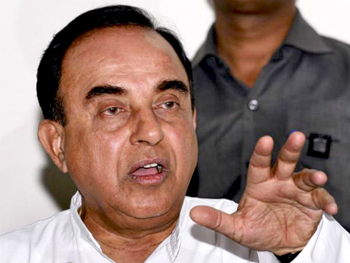
SwamyHowever, Gandhi's name was later expunged by Deputy Chairman P J Kurien.

Swamy had raised the issue through a zero hour notice, his first intervention since he took oath in the House yesterday, and referred to the allegations made by Christian Micheal, the middleman in the scandal, through a letter in the High Court of Italy.

The naming of Gandhi led the Congress members to angrily storm into the Well, with a handful even moving closer to the treasury benches menacingly. Members of the treasury benches too got up on their seats to counter the opposition.

Fearing an ugly showdown, a couple of marshalls too stepped into the Well to act as a wall between the opposition and the ruling side.

Before things got out of hand, Deputy Chairman P J Kurien adjourned the House for 10 minutes.

When the House reassembled, Kurien expunged Swamy's reference to Gandhi saying he should not name a member who cannot come and defend himself or herself.

"I am not admonishing you as this is your first speech in the House" after being nominated to the Upper House. "But the name is expunged," Kurien said.

This did not satisfy the Congress members who were in the Well again shouting slogans against Swamy.

Kurien said though it was Swamy's first day today after being nominated to the Rajya Sabha, "you have been member of this House before and you should know that the name of a member of the other House cannot be taken here".

As Congress members continued to raise slogans from the Well, the Deputy Chairman again adjourned the House till noon.

During the 10 minute break, Swamy was surrounded by BJP members, seemingly complimenting him for provoking an angry reaction from Congress.

Defence Minister Manohar Parrikar walked up to him and was seen exchanging notes with Swamy. HRD Minister Smriti Irani too walked up and complimented him.

Few Congress leaders including Anand Sharma and Leader of the House and Finance Minister Arun Jaitley walked into the Chairman's chamber during the break.

Just before the House reassembled, Minister of State for Parliamentary Affairs Mukhtar Abbas Naqvi took Swamy aside, apparently to give him some advice.

After the second adjournment, Jaitley took Swamy with him for a chat on the issue.

Earlier Jaitley, while responding to Leader of Opposition Ghulam Nabi Azad's question, said the reports about a meeting between Prime Minister Narendra Modi and his Italian counterpart were "false and untrue in entirety."

"No such meeting at all has been held," he said debunking a media report of Modi offering to free Italian marines in exchange of information on Gandhi family.

He said the principal issue was that there were allegation of bribe being paid to secure the defence deal. "The bribe giver has been convicted and now bribe taker has to be identified," he said adding written admission by the alleged middle man has to be examined.

"Investigation is underway," he said.

Earlier, Azad quoted media reports to ask the government if the Prime Minister had during a meeting with his Italian counterpart in September last year offered to free two Italian marines in exchange of information on Gandhi family in the controversial chopper deal.

"Pronouncement of judgment (on the chopper deal) has come and now NDA government is now allowing Italian marines to return home. So the deal is struck," he said.

Azad said the Congress-led UPA government had in 2013 cancelled the deal when wrong-doings were reported and had directed the CBI and ED to investigate corruption charges.

Also, the then Government had encashed bank guarantee and got back advance money paid. Besides, three helicopters received as part of the deal were not returned, he said.

The VVIP chopper deal relates to a 2010 decision of the UPA government to buy 12 helicopters from Italian manufacturer, Finmeccanica. But reports later said the Italian company had paid a bribe of up to Rs 3,565 crore to swing the deal.

Though the Italian company was blacklisted by UPA, it was part of Modi government's 'Make in India' drive, the Congress leader alleged.

Comments

Fair talker
 - 
Wednesday, 27 Apr 2016

Swamy( Asamy) is receiving Wahee from the shaitan.

Add new comment

  • Coastaldigest.com reserves the right to delete or block any comments.
  • Coastaldigset.com is not responsible for its readers’ comments.
  • Comments that are abusive, incendiary or irrelevant are strictly prohibited.
  • Please use a genuine email ID and provide your name to avoid reject.
Agencies
May 26,2020

The Shopping Centres Association of India (SCAI) on Monday said the sector has lost over Rs 90,000 crore in the last two months, owing to the lockdown, and market players need much more than the repo rate cut and the loan moratorium extended by the RBI.

In a statement, the industry body said that the Reserve Bank of India's (RBI) relief measures are not adequate to support the liquidity needs of the industry.

According to the SCAI, there is a common misconception that the shopping centres' industry is centred around metros and large cities with investments only from large developers, private equity players and foreign investors.

"However, the fact is that most malls are part of the SMEs or standalone developers. i.e. more than 550 are single owned by standalone developers out of the 650-odd organised shopping centres across the country and there are 1,000+ small centres in smaller cities," it said.

Amitabh Taneja, Chairman of SCAI said: "The organised retail industry is in distress and has not earned anything since the lockdown and their survival is at stake. While the extension of the loan moratorium talks about some relief on repayment but won't help the industry in liquidity."

He said that a long term beneficial plan from the government is much required to revive the sector.

"Being the most safe, accountable, and controlled environment, unfortunately, malls have not been permitted to open which will lead to job losses and might even shut shops for a lot of mall developers," Taneja said.

In its representations to the Centre and the Reserve Bank of India, the association has also pointed out that, in absence of financial package and stimulus from the RBI, over 500 shopping centres may go bankrupt, that may lead to the banking industry staring at NPAs of Rs 25,000 crore.

The industry body has put forward its recommendations and requests to the government. It had sought moratorium till March 2021 at the least in terms of repayment of bank loans, interest, EMI and so on, without levy of any penalties or penal interest.

It has also sought a one-time loan restructuring with lower rates of interest, permitted for shopping centres and a facilitative and forward-looking support provision of short-term financing options for a period of six to 12 months, at lower interest rates, to meet the increased working capital requirements.

Among other relaxations, it had also appealed for GST rebates to offset the losses on account of and for the period of closure of business.

It also said that interest rates should be brought down to "manageable levels" of 5-6% in view of the precarious financial situation.

Comments

Add new comment

  • Coastaldigest.com reserves the right to delete or block any comments.
  • Coastaldigset.com is not responsible for its readers’ comments.
  • Comments that are abusive, incendiary or irrelevant are strictly prohibited.
  • Please use a genuine email ID and provide your name to avoid reject.
News Network
May 6,2020

New Delhi, May 6: Taking a cue from states, the Centre announced one of the steepest hikes in duties on petrol and diesel in the recent past, by raising it by Rs 10 and Rs 13 per litre, respectively, in a notification issued late on Tuesday.

Retail prices, however, will see no change as the price hike will be absorbed by oil marketing companies against the fall in crude prices.

Road and infrastructure cess was hiked by Rs 8 for petrol and diesel and the special additional excise duty (SAED) was hiked by Rs 2 per litre and Rs 5 per litre, respectively. While the road cess will only go into the Centre’s coffers, the hike on account of SAED will be passed on to states via devolution at 42 per cent. Hence, the states will get only Rs 0.84 per litre in case of petrol and Rs 2.1 in case of diesel.

The decision comes after several states increased the value added tax (VAT) on petrol and diesel making use of the lower price regime. The Delhi government on Tuesday increased VAT on petrol and diesel to 30 per cent each, from 27 and 16.75, respectively. As a result, the price of petrol in Delhi increased by Rs 1.67 to Rs 71.26 a litre and diesel by Rs 7.10 to Rs 69.29 in Delhi on Tuesday.

Amid falling international crude oil prices, the Centre introduced an enabling provision in March to raise excise duty on petrol and diesel by Rs 8 per litre in the Finance Act. The government had on March 14 raised excise duty on petrol and diesel by? 3 per litre each, which was to help raise an additional ?39,000 crore in revenue annually.

This duty hike included Rs 2 a litre increase in SAED and Rs 1 in road and infrastructure cess. It raised SAED to Rs 10 for petrol and Rs 4 for diesel. The limit has now been increased to Rs 18 a litre in case of petrol and Rs 12 in case of diesel by way of amendment of the Eighth Schedule of the Finance Act.

Economists said the move would impact retail inflation by over half a percentage point at least. “With lower consumption, there was loss of revenue for Centre and states, who earn Rs 6 trillion annually or Rs 50,000 crore monthly from fuel. Amid lockdown in April, the collection must have come down to just Rs 5,000 crore, and this will hold for May.

This means that Centre and states have lost 20 per cent of annual revenue from fuel. Hence, they have hiked duties to recover losses,” said Madan Sabnavis, chief economist, CARE Ratings. He added that the hike will impact inflation by at least 0.6-0.7 percentage points.

According to industry experts, an estimate of the additional government revenue cannot be made as the consumption of petrol and diesel has dropped to 40 per cent of what it was before the lockdown. The duty hike comes following a drop in international crude oil prices in April, owing to lower consumption figures globally. At 11.50 pm on Tuesday, Brent was priced at $30.67 a barrel, while West Texas Intermediate (WTI) crude was seen at $24.36 a barrel. On Monday, the Indian basket of crude oil was priced at $23.38 a barrel, after touching a 15-year low last month.

Comments

Add new comment

  • Coastaldigest.com reserves the right to delete or block any comments.
  • Coastaldigset.com is not responsible for its readers’ comments.
  • Comments that are abusive, incendiary or irrelevant are strictly prohibited.
  • Please use a genuine email ID and provide your name to avoid reject.
News Network
January 6,2020

Jan 6: India’s Finance Ministry has delivered a challenge to its revenue collectors: meet tax targets despite $20 billion of corporate tax cuts.

Through a video conference on Dec. 16, officials were exhorted to meet the direct tax mop-up target of 13.4 trillion rupees ($187 billion), a government official told reporters. Collection in the eight months to November grew at 5% from a year earlier, against the desired 17%.

The missive shows Prime Minister Narendra Modi’s urgent need to buoy public finances in a slowing economy where April-November tax collections were half the amount budgeted. Authorities withheld some payments to states and have capped ministries’ expenditure as the fiscal deficit ballooned beyond the target.

The government’s efforts to maintain its deficit goal goes against advice from some quarters, including central bank Governor Shaktikanta Das, who urged more spending to spur economic growth.

It’s uncertain though how much room Modi’s administration has to boost expenditure, given that it may already be borrowing as much as 540 billion rupees through state-run companies, a figure that isn’t reflected on the federal balance sheet. Uncertainty about public finances pushed up sovereign yields in November and December, compelling Das to announce unconventional policies to keep costs in check.

“This is not a time to conceal the fiscal deficit by off-budget borrowing or deferring payments,” said Indira Rajaraman, an economist and a former member of the Reserve Bank of India’s board. “If they were to stick to the target, that would be catastrophic because there is so much pump-priming that is needed right now.”

GDP grew 4.5% in the quarter ended September, the slowest pace in more than six years as both consumption and investments cooled in Asia’s third-largest economy. Only government spending supported the expansion, piling pressure on Modi to keep stimulating.

S&P Global Ratings warned in December it may downgrade India’s sovereign ratings if economic growth doesn’t recover. Government support seems to be waning now, with ministries asked to cap spending in the final quarter of the financial year at 25% of the amount budgeted rather than 33% allowed earlier. This new rule will hamstring sectors including agriculture, aviation and coal, where not even half of annual targets have been disbursed.

As the federal government runs short of money, it’s been delaying payouts to state administrations.

Private hospitals have threatened to suspend cash-less services to government employees over non-payment of dues, while a builder informed the stock exchange about delayed rental payments from no less than the tax office itself.

India is considering a litigation-settlement plan that will allow companies to exit lingering tax disputes by paying a portion of the money demanded by the government, the Economic Times newspaper reported Saturday.

The move will help improve the ease of doing business besides unlocking a part of the almost 8 trillion rupees ($111 billion) caught up in these disputes. The step, which is being considered as part of the annual budget, could also bridge India’s fiscal gap.

Finance Minister Nirmala Sitharaman has refused to comment on the deficit goal before the official budget presentation due Feb. 1.

A deviation from target, if any, “will need to be balanced with a credible consolidation plan further-out,” said Radhika Rao, an economist at DBS Group Holdings Ltd. in Singapore.

Comments

Add new comment

  • Coastaldigest.com reserves the right to delete or block any comments.
  • Coastaldigset.com is not responsible for its readers’ comments.
  • Comments that are abusive, incendiary or irrelevant are strictly prohibited.
  • Please use a genuine email ID and provide your name to avoid reject.