


Swamy links Sonia with chopper deal, Cong forces adjournments

April 27, 2016

New Delhi, Apr 27: Angry exchanges between opposition Congress and ruling BJP members over Subramaniam Swamy seeking to drag Sonia Gandhi's name in the controversial AgustaWestland helicopter contract bribery case led to two adjournments of the Rajya Sabha in the pre-noon session.
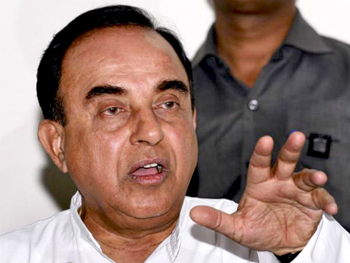
SwamyHowever, Gandhi's name was later expunged by Deputy Chairman P J Kurien.

Swamy had raised the issue through a zero hour notice, his first intervention since he took oath in the House yesterday, and referred to the allegations made by Christian Micheal, the middleman in the scandal, through a letter in the High Court of Italy.

The naming of Gandhi led the Congress members to angrily storm into the Well, with a handful even moving closer to the treasury benches menacingly. Members of the treasury benches too got up on their seats to counter the opposition.

Fearing an ugly showdown, a couple of marshalls too stepped into the Well to act as a wall between the opposition and the ruling side.

Before things got out of hand, Deputy Chairman P J Kurien adjourned the House for 10 minutes.

When the House reassembled, Kurien expunged Swamy's reference to Gandhi saying he should not name a member who cannot come and defend himself or herself.

"I am not admonishing you as this is your first speech in the House" after being nominated to the Upper House. "But the name is expunged," Kurien said.

This did not satisfy the Congress members who were in the Well again shouting slogans against Swamy.

Kurien said though it was Swamy's first day today after being nominated to the Rajya Sabha, "you have been member of this House before and you should know that the name of a member of the other House cannot be taken here".

As Congress members continued to raise slogans from the Well, the Deputy Chairman again adjourned the House till noon.

During the 10 minute break, Swamy was surrounded by BJP members, seemingly complimenting him for provoking an angry reaction from Congress.

Defence Minister Manohar Parrikar walked up to him and was seen exchanging notes with Swamy. HRD Minister Smriti Irani too walked up and complimented him.

Few Congress leaders including Anand Sharma and Leader of the House and Finance Minister Arun Jaitley walked into the Chairman's chamber during the break.

Just before the House reassembled, Minister of State for Parliamentary Affairs Mukhtar Abbas Naqvi took Swamy aside, apparently to give him some advice.

After the second adjournment, Jaitley took Swamy with him for a chat on the issue.

Earlier Jaitley, while responding to Leader of Opposition Ghulam Nabi Azad's question, said the reports about a meeting between Prime Minister Narendra Modi and his Italian counterpart were "false and untrue in entirety."

"No such meeting at all has been held," he said debunking a media report of Modi offering to free Italian marines in exchange of information on Gandhi family.

He said the principal issue was that there were allegation of bribe being paid to secure the defence deal. "The bribe giver has been convicted and now bribe taker has to be identified," he said adding written admission by the alleged middle man has to be examined.

"Investigation is underway," he said.

Earlier, Azad quoted media reports to ask the government if the Prime Minister had during a meeting with his Italian counterpart in September last year offered to free two Italian marines in exchange of information on Gandhi family in the controversial chopper deal.

"Pronouncement of judgment (on the chopper deal) has come and now NDA government is now allowing Italian marines to return home. So the deal is struck," he said.

Azad said the Congress-led UPA government had in 2013 cancelled the deal when wrong-doings were reported and had directed the CBI and ED to investigate corruption charges.

Also, the then Government had encashed bank guarantee and got back advance money paid. Besides, three helicopters received as part of the deal were not returned, he said.

The VVIP chopper deal relates to a 2010 decision of the UPA government to buy 12 helicopters from Italian manufacturer, Finmeccanica. But reports later said the Italian company had paid a bribe of up to Rs 3,565 crore to swing the deal.

Though the Italian company was blacklisted by UPA, it was part of Modi government's 'Make in India' drive, the Congress leader alleged.

Comments

Fair talker
 - 
Wednesday, 27 Apr 2016

Swamy( Asamy) is receiving Wahee from the shaitan.

Add new comment

  • Coastaldigest.com reserves the right to delete or block any comments.
  • Coastaldigset.com is not responsible for its readers’ comments.
  • Comments that are abusive, incendiary or irrelevant are strictly prohibited.
  • Please use a genuine email ID and provide your name to avoid reject.
News Network
January 13,2020

Jan 13: For the first time in years, the government of India’s Prime Minister Narendra Modi is playing defense. Protests have sprung up across the country against an amendment to India’s laws — which came into effect on Friday — that makes it easier for members of some religions to become citizens of India. The government claims this is simply an attempt to protect religious minorities in the Muslim-majority countries that border India; but protesters see it as the first step toward a formal repudiation of India’s constitutionally guaranteed secularism — and one that must be resisted.

Modi was re-elected prime minister last year with an enhanced majority; his hold over the country’s politics is absolute. The formal opposition is weak, discredited and disorganized. Yet, somehow, the anti-Citizenship Act protests have taken hold. No political party is behind them; they are generally arranged by student unions, neighborhood associations and the like.

Yet this aspect of their character is precisely what will worry Modi and his right-hand man, Home Minister Amit Shah. They know how to mock and delegitimize opposition parties with ruthless efficiency. Yet creating a narrative that paints large, flag-waving crowds as traitors is not quite that easy.

For that is how these protests look: large groups of young people, many carrying witty signs and the national flag. They meet and read the preamble to India’s Constitution, into which the promise of secularism was written in the 1970’s.

They carry photographs of the Constitution’s drafter, the Columbia University-trained economist and lawyer B. R. Ambedkar. These are not the mobs the government wanted. They hoped for angry Muslims rampaging through the streets of India’s cities, whom they could point to and say: “See? We must protect you from them.” But, in spite of sometimes brutal repression, the protests have largely been nonviolent.

One, in Shaheen Bagh in a Muslim-dominated sector of New Delhi, began simply as a set of local women in a square, armed with hot tea and blankets against the chill Delhi winter. It has now become the focal point of a very different sort of resistance than what the government expected. Nothing could cure the delusions of India’s Hindu middle class, trained to see India’s Muslims as dangerous threats, as effectively as a group of otherwise clearly apolitical women sipping sweet tea and sharing their fears and food with anyone who will listen.

Modi was re-elected less than a year ago; what could have changed in India since then? Not much, I suspect, in most places that voted for him and his party — particularly the vast rural hinterland of northern India. But urban India was also possibly never quite as content as electoral results suggested. India’s growth dipped below 5% in recent quarters; demand has crashed, and uncertainty about the future is widespread. Worse, the government’s response to the protests was clearly ill-judged. University campuses were attacked, in one case by the police and later by masked men almost certainly connected to the ruling party.

Protesters were harassed and detained with little cause. The courts seemed uninterested. And, slowly, anger began to grow on social media — not just on Twitter, but also on Instagram, previously the preserve of pretty bowls of salad. Instagram is the one social medium over which Modi’s party does not have a stranglehold; and it is where these protests, with their photogenic signs and flags, have found a natural home. As a result, people across urban India who would never previously have gone to a demonstration or a political rally have been slowly politicized.

India is, in fact, becoming more like a normal democracy. “Normal,” that is, for the 2020’s. Liberal democracies across the world are politically divided, often between more liberal urban centers and coasts, and angrier, “left-behind” hinterlands. Modi’s political secret was that he was that rare populist who could unite both the hopeful cities and the resentful countryside. Yet this once magic formula seems to have become ineffective. Five of India’s six largest cities are not ruled by Modi’s Bharatiya Janata Party in any case — the financial hub of Mumbai changed hands recently. The BJP has set its sights on winning state elections in Delhi in a few weeks. Which way the capital’s voters will go is uncertain. But that itself is revealing — last year, Modi swept all seven parliamentary seats in Delhi.

In the end, the Citizenship Amendment Act is now law, the BJP might manage to win Delhi, and the protests might die down as the days get unmanageably hot and state repression increases. But urban India has put Modi on notice. His days of being India’s unifier are over: From now on, like all the other populists, he will have to keep one eye on the streets of his country’s cities.

Comments

Add new comment

  • Coastaldigest.com reserves the right to delete or block any comments.
  • Coastaldigset.com is not responsible for its readers’ comments.
  • Comments that are abusive, incendiary or irrelevant are strictly prohibited.
  • Please use a genuine email ID and provide your name to avoid reject.
Agencies
August 5,2020

Ayodhya, Aug 5: Every street in Ayodhya was seen illuminated with earthen lamps ahead of the foundation stone laying ceremony of the Ram Temple on Wednesday.

People also lit diyas on the banks of Saryu river as part of the 'deepotsava' celebrations in the temple town which will see Prime Minister Narendra Modi and other dignitaries arrive today for the 'bhoomi pujan' ceremony of the Ram Temple.

The entire Ayodhya has been decked up and massive preparations have been made for this occasion with a festive air.

Earlier chief minister Yogi Adityanath had said that 11,000 diyas will be lit at Ram Ki Paidi on the banks of the Saryu river and that all houses and temples in Ayodhya will be celebrating with a 'deepotsava' (festival of lights) on the nights of August 4 and 5.

Adityanath burst firecrackers and lit earthen lamps at his official residence on in Lucknow as part of 'deepotsava'.

The construction work of Ram temple will begin after the foundation stone laying ceremony, in which dignitaries from various political and religious fields have been invited to participate.
Apart from Ayodhya other cities in like Kanpur were also illuminated to celebrate the grand event. Vishva Hindu Parishad (VHP) workers light earthen lamps in the city, as part of 'deepotsava'.

Chief Minister's residence in Uttarakhand will be decorated with 5100 diyas filled with Ghee on Wednesday evening to celebrate the occasion of the 'bhoomi pujan' of the Ram Temple in Ayodhya today by Prime Minister Narendra Modi.

Uttrakhand Chief Minister Trivendra Singh Rawat has said that Lord Ram Temple being built in Ayodhya is associated with "our belief". He also appealed to people in the state to light diyas at their homes on the occasion.

Earthen lamps were lit at Ujjain's Mahakaleshwar Temple in Madhya Pradesh and in Punjab too people lit lamps as part of 'deepotsava'.

Prime Minister Narendra Modi will perform 'pooja' at Hanumangarhi and Shree Ramlala Virajman before performing 'bhoomi pujan' of the Ram Temple in Ayodhya on Wednesday, informed Prime Minister's Office (PMO) on Tuesday.

He will unveil a plaque to mark the laying of the foundation stone and also release Commemorative Postage Stamp on 'Shree Ram Janmabhoomi Mandir'.

Comments

Add new comment

  • Coastaldigest.com reserves the right to delete or block any comments.
  • Coastaldigset.com is not responsible for its readers’ comments.
  • Comments that are abusive, incendiary or irrelevant are strictly prohibited.
  • Please use a genuine email ID and provide your name to avoid reject.
News Network
March 27,2020

New Delhi, Mar 27: The Delhi government has arranged to serve lunch and dinner to the needy in 325 schools in Delhi, chief minister Arvind Kejriwal said on Friday amid reports of people going hungry without access to food during the ongoing nationwide lockdown.

From Saturday, arrangements will be put in place to feed about four lakh people daily at different centres across Delhi, he said addressing the media. "We have made arrangements to provide lunch and dinner in 325 schools. Around 500 people will be provided with food in all these schools. So far we were providing food to 20,000 people daily, the number will now increase to around 2,00,000 from today."

He also said that "from tomorrow, we'll be providing food to 4,00,000 people daily. We're distributing the centres across Delhi."

Stating that the total number of confirmed positive COVID-19 cases in Delhi is now 39, Kejriwal said "We are ready to face any challenge.".

"There are a total of 39 coronavirus positive cases in Delhi as of today, of which 29 cases are of those who had come from outside and were kept in quarantine and 10 of these were cases of local transmission," said Kejriwal at a press conference.

The Chief Minister said that a team of 5 doctors has been set up to look into the preparedness needed to deal with an increase in the number of positive cases for coronavirus in future.

He said, "The team of doctors under the chairmanship of Dr Shiv Kumar Sarin, the head of Institute of Liver and Biliary Sciences, presented a detailed report on March 26 on the preparedness needed to deal with a situation if the number of positive cases for coronavirus increases."

"The report has categorized three situations - if the number of positive cases increases to 100 per day, 500 per day and 1000 per day," he said while adding that the doctors have clearly stated what preparedness should be taken for each situation including the number of ventilators, isolation beds, doctors and nurses required.

He also cited concerns raised by chief ministers of several states including Jharkhand's Hemant Soren and West Bengal's Mamata Banerjee.

Kejriwal said "we consider all those living in Delhi as Delhiites and everyone will be taken care of."
The number of cases tested positive for coronavirus rose to 724 on Friday, according to the Ministry of Health and Family Welfare. 

Comments

Add new comment

  • Coastaldigest.com reserves the right to delete or block any comments.
  • Coastaldigset.com is not responsible for its readers’ comments.
  • Comments that are abusive, incendiary or irrelevant are strictly prohibited.
  • Please use a genuine email ID and provide your name to avoid reject.