


Swamy links Sonia with chopper deal, Cong forces adjournments

April 27, 2016

New Delhi, Apr 27: Angry exchanges between opposition Congress and ruling BJP members over Subramaniam Swamy seeking to drag Sonia Gandhi's name in the controversial AgustaWestland helicopter contract bribery case led to two adjournments of the Rajya Sabha in the pre-noon session.
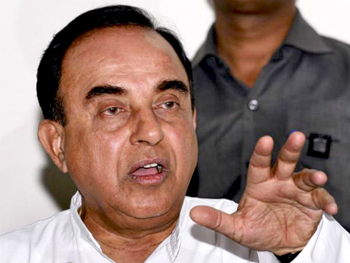
SwamyHowever, Gandhi's name was later expunged by Deputy Chairman P J Kurien.

Swamy had raised the issue through a zero hour notice, his first intervention since he took oath in the House yesterday, and referred to the allegations made by Christian Micheal, the middleman in the scandal, through a letter in the High Court of Italy.

The naming of Gandhi led the Congress members to angrily storm into the Well, with a handful even moving closer to the treasury benches menacingly. Members of the treasury benches too got up on their seats to counter the opposition.

Fearing an ugly showdown, a couple of marshalls too stepped into the Well to act as a wall between the opposition and the ruling side.

Before things got out of hand, Deputy Chairman P J Kurien adjourned the House for 10 minutes.

When the House reassembled, Kurien expunged Swamy's reference to Gandhi saying he should not name a member who cannot come and defend himself or herself.

"I am not admonishing you as this is your first speech in the House" after being nominated to the Upper House. "But the name is expunged," Kurien said.

This did not satisfy the Congress members who were in the Well again shouting slogans against Swamy.

Kurien said though it was Swamy's first day today after being nominated to the Rajya Sabha, "you have been member of this House before and you should know that the name of a member of the other House cannot be taken here".

As Congress members continued to raise slogans from the Well, the Deputy Chairman again adjourned the House till noon.

During the 10 minute break, Swamy was surrounded by BJP members, seemingly complimenting him for provoking an angry reaction from Congress.

Defence Minister Manohar Parrikar walked up to him and was seen exchanging notes with Swamy. HRD Minister Smriti Irani too walked up and complimented him.

Few Congress leaders including Anand Sharma and Leader of the House and Finance Minister Arun Jaitley walked into the Chairman's chamber during the break.

Just before the House reassembled, Minister of State for Parliamentary Affairs Mukhtar Abbas Naqvi took Swamy aside, apparently to give him some advice.

After the second adjournment, Jaitley took Swamy with him for a chat on the issue.

Earlier Jaitley, while responding to Leader of Opposition Ghulam Nabi Azad's question, said the reports about a meeting between Prime Minister Narendra Modi and his Italian counterpart were "false and untrue in entirety."

"No such meeting at all has been held," he said debunking a media report of Modi offering to free Italian marines in exchange of information on Gandhi family.

He said the principal issue was that there were allegation of bribe being paid to secure the defence deal. "The bribe giver has been convicted and now bribe taker has to be identified," he said adding written admission by the alleged middle man has to be examined.

"Investigation is underway," he said.

Earlier, Azad quoted media reports to ask the government if the Prime Minister had during a meeting with his Italian counterpart in September last year offered to free two Italian marines in exchange of information on Gandhi family in the controversial chopper deal.

"Pronouncement of judgment (on the chopper deal) has come and now NDA government is now allowing Italian marines to return home. So the deal is struck," he said.

Azad said the Congress-led UPA government had in 2013 cancelled the deal when wrong-doings were reported and had directed the CBI and ED to investigate corruption charges.

Also, the then Government had encashed bank guarantee and got back advance money paid. Besides, three helicopters received as part of the deal were not returned, he said.

The VVIP chopper deal relates to a 2010 decision of the UPA government to buy 12 helicopters from Italian manufacturer, Finmeccanica. But reports later said the Italian company had paid a bribe of up to Rs 3,565 crore to swing the deal.

Though the Italian company was blacklisted by UPA, it was part of Modi government's 'Make in India' drive, the Congress leader alleged.

Comments

Fair talker
 - 
Wednesday, 27 Apr 2016

Swamy( Asamy) is receiving Wahee from the shaitan.

Add new comment

  • Coastaldigest.com reserves the right to delete or block any comments.
  • Coastaldigset.com is not responsible for its readers’ comments.
  • Comments that are abusive, incendiary or irrelevant are strictly prohibited.
  • Please use a genuine email ID and provide your name to avoid reject.
News Network
May 15,2020

New Delhi, May 15: A group of doctors from the AIIMS, Raipur has recommended restrictions on the use of mobile phones in healthcare institutions amid the COVID-19 pandemic, warning that such devices can be a potential carrier of the virus and lead to infection among healthcare workers.

In a commentary published in the BMJ Global Health journal, the doctors stated that mobile phone surfaces are a peculiar 'high-risk' surface, which can directly come in contact with the face or mouth, even if hands are properly washed and one study indicates that some healthcare workers use phones every 15 minutes to two hours.

Though there have been many significant guidelines from various health organisations like the WHO and CDC focusing on prevention and control of disease, the commentary highlighted "there is no mention of or focus on mobile phones in these guidelines, including the WHO infection control and prevention guidelines, which recommends the use of handwashing".

In healthcare facilities, phones are used to communicate with other health care workers, look up recent medical guidelines, research drug interactions, understand adverse events and side effects, conduct telemedicine appointments and track patients among others, stated the document.

The document has been authored by Dr Vineet Kumar Pathak, Dr Sunil Kumar Panigrahi, Dr M Mohan Kumar, Dr Utsav Raj and Dr Karpaga Priya P from the Department of Community and Family Medicine.

"In their tendency to come in direct contact with the face, nose or eyes in healthcare settings, mobile phones are perhaps second only to masks, caps or goggles," the authors said.

"However, they are neither disposable nor washable like these other three, thus warranting disinfection. Mobile phones can effectively negate hand hygiene... There is growing evidence that mobile phones are a potential vector for pathogenic organisms," they said.

It is the need of the hour to address proper hygienic use of mobile phones in healthcare settings. In a study in India, almost 100 per cent of health workers of a tertiary care hospital used mobile phones in the hospital, but only 10 per cent of them had at any time wiped their mobile phones clean, the commentary published on April 22 said.

"The safest thing to do is to consider your phone as an extension of your hand, so remember you are transferring whatever is on your phone to your hand," Dr Pathak said.

Amidst the ongoing pandemic, two biggest mobile phone companies have uploaded their user support guidelines, saying that 70 pc isopropyl alcohol or Clorox Disinfecting Wipes can be used to gently wipe the exterior surface of phones in switched-off mode.

However, in doing so, the use of bleach or entry of moisture through any of the openings must be avoided, and any harsh chemical may damage the oleophobic screen, leading to damage in the touch screen sensitivity of the phone, the article stated.

Mobile phones are one of the most highly touched surfaces according to the Centers for Disease Control and Prevention (CDC), along with counters, tabletops, doorknobs, bathroom fixtures, toilets, keyboards, tablets and bedside tables.

The doctors recommended restriction on mobile phone usage in healthcare settings like hospital wards, ICUs and operation theatres, while advocating the use of headphones to prevent contact with the face while talking.

There should be no sharing of mobile phones, headphones or headsets of any kind. In addition, where available, the use of interdepartmental intercom facility may be promoted.

"Although hand hygiene and mobile phone use by a person are not mutually exclusive, it is high time to acknowledge the potential role of mobile phones in disease transmission cascade and to take evidence-based appropriate actions. This is especially important, given the ongoing COVID-19 pandemic," the authors said.

They said it is necessary for government agencies and the WHO to generate public awareness and to formulate suitable information, education and communication material on mobile phone hygiene, especially in healthcare settings.

AIIMS, New Delhi, Resident Doctors' Association (RDA) General Secretary, Dr Srinivas Rajkumar T said even outside health care settings, people should pay special attention to the usage of mobile phones as they carry them to all places.

"Phone and computer peripherals like keyboard, mouse, etc. should be covered with transparent plastic covers which can be cleaned without interfering with their function. Cleaning hands by soap or alcohol-based hand sanitizer before and after contact with phone and between contact with other surfaces can decrease the risk of potential transmission.

"Using a handsfree headset, dedicated operator/assistant per ward handling the communication via common line in hospitals while on duty can enable communication without compromising safety," Dr Srinivas said.

Comments

Add new comment

  • Coastaldigest.com reserves the right to delete or block any comments.
  • Coastaldigset.com is not responsible for its readers’ comments.
  • Comments that are abusive, incendiary or irrelevant are strictly prohibited.
  • Please use a genuine email ID and provide your name to avoid reject.
Agencies
March 22,2020

New Delhi, Mar 22: The exercise to update the National Population Register (NPR) and the first phase of the Census 2021, scheduled to begin from April 1, are likely to be deferred for an indefinite period due to Coronavirus pandemic, officials said.

A formal order on this effect is expected within a day or two.

Discussions are going on at the highest level of the government and in all probability, the NPR and house listing phase of the Census work will be deferred till the threat of the Coronavirus is over, a home ministry official said.

The exercise to update NPR and the housing listing phase of the Census is scheduled to be carried out across the country from April 1 to September 30.

Last week, the home ministry had said the preparation for the Census 2021 and updation of the NPR were at its peak and they will begin from April 1.

The ministry said this after a conference of the Directors of the Census Operations on status of preparatory work around Census 2021 and NPR updation.

There has been opposition from several state governments to the NPR and some of the assemblies even adopted resolutions expressing reservations on the exercise.

The states which have been opposing the NPR include Kerala, West Bengal, Punjab, Rajasthan, Chhattisgarh and Bihar.

However, most of them also said they will cooperate with the house listing phase of the Census.

The objective of the NPR is to create a comprehensive identity database of every usual resident in the country.

The database would contain demographic as well as biometric particulars, they said.

The notification for the house listing census and NPR exercise came recently amid furore over the contentious Citizenship Amendment Act (CAA).

The home ministry officials said most of the states have notified provisions related to the NPR.

The NPR is a register of usual residents of the country. It is being prepared at the local (village/sub-town), subdistrict, district, state and national levels under provisions of the Citizenship Act, 1955 and the Citizenship (Registration of Citizens and Issue of National Identity Cards) Rules, 2003.

The data for NPR was last collected in 2010 along with the house listing phase of the Census 2011. Updating of this data was done during 2015 by conducting door to door survey.

While updating the register in 2015, the government has asked details like Aadhaar and their mobile number.

This time, the information related to their driving licence and voter ID card may also be gathered, the officials said, adding that PAN card details will not be collected as part of this exercise.

Though information regarding the place of birth of parents will be sought, it is up to the residents whether to respond the question as it is voluntary.

For the purposes of the NPR, a 'resident' is defined as a person who has lived in a local area for the past six months or more, or a person who intends to reside in that area for the next six months.

The law compulsorily seeks to register every citizen of India and issue a national identity card.

The demographic details of every individual are required for every usual resident: name, relationship to head of household, father's name, mother's name, spouse's name (if married), sex, date of birth, marital status, place of birth, nationality (as declared), present address of usual residence, duration of stay at present address, permanent residential address, occupation, educational qualification.

The Union Cabinet has approved Rs 3,941.35 crore for the NPR exercise.

Comments

Add new comment

  • Coastaldigest.com reserves the right to delete or block any comments.
  • Coastaldigset.com is not responsible for its readers’ comments.
  • Comments that are abusive, incendiary or irrelevant are strictly prohibited.
  • Please use a genuine email ID and provide your name to avoid reject.
News Network
June 30,2020

New Delhi, Jun 30: Prime Minister Narendra Modi on Tuesday announced the extension of the Pradhan Mantri Garib Kalyan Anna Yojana (PMGKAY), a free ration scheme, for 80 crore people across the country till end of November.

In a televised address to the nation, Modi also said the government was working on a "one nation, one ration card" initiative.

On the extension of the PMGKAY, he said it will cost the government Rs 90,000 crore more.

Under the scheme, five kgs of wheat or rice and one kg of pulses per month will be given free of cost to the poor. The scheme was initially rolled out for three months.

The prime minister also said timely lockdown to contain coronavirus and other decisions saved many lives, but added that since "Unlock 1" has begun, people have shown negligence.

He said in comparison to other countries across the globe, India has done well in dealing with the pandemic.

Comments

Add new comment

  • Coastaldigest.com reserves the right to delete or block any comments.
  • Coastaldigset.com is not responsible for its readers’ comments.
  • Comments that are abusive, incendiary or irrelevant are strictly prohibited.
  • Please use a genuine email ID and provide your name to avoid reject.