


Swamy links Sonia with chopper deal, Cong forces adjournments

April 27, 2016

New Delhi, Apr 27: Angry exchanges between opposition Congress and ruling BJP members over Subramaniam Swamy seeking to drag Sonia Gandhi's name in the controversial AgustaWestland helicopter contract bribery case led to two adjournments of the Rajya Sabha in the pre-noon session.
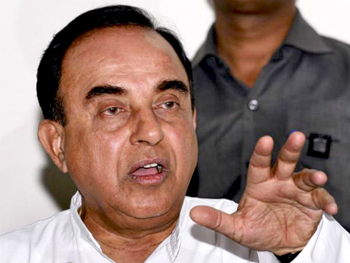
SwamyHowever, Gandhi's name was later expunged by Deputy Chairman P J Kurien.

Swamy had raised the issue through a zero hour notice, his first intervention since he took oath in the House yesterday, and referred to the allegations made by Christian Micheal, the middleman in the scandal, through a letter in the High Court of Italy.

The naming of Gandhi led the Congress members to angrily storm into the Well, with a handful even moving closer to the treasury benches menacingly. Members of the treasury benches too got up on their seats to counter the opposition.

Fearing an ugly showdown, a couple of marshalls too stepped into the Well to act as a wall between the opposition and the ruling side.

Before things got out of hand, Deputy Chairman P J Kurien adjourned the House for 10 minutes.

When the House reassembled, Kurien expunged Swamy's reference to Gandhi saying he should not name a member who cannot come and defend himself or herself.

"I am not admonishing you as this is your first speech in the House" after being nominated to the Upper House. "But the name is expunged," Kurien said.

This did not satisfy the Congress members who were in the Well again shouting slogans against Swamy.

Kurien said though it was Swamy's first day today after being nominated to the Rajya Sabha, "you have been member of this House before and you should know that the name of a member of the other House cannot be taken here".

As Congress members continued to raise slogans from the Well, the Deputy Chairman again adjourned the House till noon.

During the 10 minute break, Swamy was surrounded by BJP members, seemingly complimenting him for provoking an angry reaction from Congress.

Defence Minister Manohar Parrikar walked up to him and was seen exchanging notes with Swamy. HRD Minister Smriti Irani too walked up and complimented him.

Few Congress leaders including Anand Sharma and Leader of the House and Finance Minister Arun Jaitley walked into the Chairman's chamber during the break.

Just before the House reassembled, Minister of State for Parliamentary Affairs Mukhtar Abbas Naqvi took Swamy aside, apparently to give him some advice.

After the second adjournment, Jaitley took Swamy with him for a chat on the issue.

Earlier Jaitley, while responding to Leader of Opposition Ghulam Nabi Azad's question, said the reports about a meeting between Prime Minister Narendra Modi and his Italian counterpart were "false and untrue in entirety."

"No such meeting at all has been held," he said debunking a media report of Modi offering to free Italian marines in exchange of information on Gandhi family.

He said the principal issue was that there were allegation of bribe being paid to secure the defence deal. "The bribe giver has been convicted and now bribe taker has to be identified," he said adding written admission by the alleged middle man has to be examined.

"Investigation is underway," he said.

Earlier, Azad quoted media reports to ask the government if the Prime Minister had during a meeting with his Italian counterpart in September last year offered to free two Italian marines in exchange of information on Gandhi family in the controversial chopper deal.

"Pronouncement of judgment (on the chopper deal) has come and now NDA government is now allowing Italian marines to return home. So the deal is struck," he said.

Azad said the Congress-led UPA government had in 2013 cancelled the deal when wrong-doings were reported and had directed the CBI and ED to investigate corruption charges.

Also, the then Government had encashed bank guarantee and got back advance money paid. Besides, three helicopters received as part of the deal were not returned, he said.

The VVIP chopper deal relates to a 2010 decision of the UPA government to buy 12 helicopters from Italian manufacturer, Finmeccanica. But reports later said the Italian company had paid a bribe of up to Rs 3,565 crore to swing the deal.

Though the Italian company was blacklisted by UPA, it was part of Modi government's 'Make in India' drive, the Congress leader alleged.

Comments

Fair talker
 - 
Wednesday, 27 Apr 2016

Swamy( Asamy) is receiving Wahee from the shaitan.

Add new comment

  • Coastaldigest.com reserves the right to delete or block any comments.
  • Coastaldigset.com is not responsible for its readers’ comments.
  • Comments that are abusive, incendiary or irrelevant are strictly prohibited.
  • Please use a genuine email ID and provide your name to avoid reject.
Agencies
June 7,2020

New Delhi, Jun 7: India registered its highest single-day spike of COVID-19 cases for the fifth consecutive day on Sunday, with 9,971 new infections taking the country's tally to 2,46,628, while the death toll rose to 6,929, according to the Union Health Ministry.

India registered 287 deaths in the 24 hours since Saturday morning.

India had raced past Spain on Saturday to become the fifth worst-hit nation by the COVID-19 pandemic. Now, only the US, Brazil, Russia and the UK are ahead of it.

The number of active COVID-19 cases stands at 1,20,406, according to the Health Ministry.

A total of 1,19,292 people have recovered and one patient has migrated, the Ministry said.

During the last 24 hours, a total of 5,220 COVID-19 patients have been cured, the ministry said.

"Thus, around 48.37 per cent patients have recovered so far," a senior ministry official said.

The tally of confirmed cases includes foreigners.

The Indian Council of Medical Research has further ramped up the testing capacity for detecting the novel coronavirus in infected persons.

The number of government labs has been increased to 531 and private labs to 228, taking the total number of labs to 759.

As many as 1,42,069 samples were tested in the last 24 hours, taking the total number of samples tested till now to 46,66,386.

Deaths in India per lakh population (0.49) are much lower than the world average of 5.17 and are the lowest among countries that have eased lockdown such as Germany (10.35), Italy (55.78), the UK (59.62) and Spain (58.06), as per a WHO situation report cited by the Health Ministry.

Cases in India per lakh population (17.32) are much lower than the world average of 87.74 and are the lowest among countries that have eased lockdown such as Germany (219.93), Italy (387.33), the UK (419.54) and Spain (515.61).

Of the 287 deaths reported since Saturday morning, 120 were from Maharashtra, 53 from Delhi, 29 from Gujarat, 19 from Tamil Nadu, 17 from West Bengal, 15 from Madhya Pradesh, 13 from Rajasthan, 10 from Telangana, three from Jammu and Kashmir, two each from Karnataka, Punjab and Chhattisgarh and one each from Kerala and Bihar.

Of the total 6,929 fatalities, Maharashtra tops the tally with 2,969 deaths, followed by Gujarat with 1,219 deaths, Delhi with 761, Madhya Pradesh with 399, West Bengal with 383, Uttar Pradesh with 257, Tamil Nadu with 251, Rajasthan with 231, Telangana with 123 and Andhra Pradesh with 73 deaths.

The death toll reached 59 in Karnataka and 50 in Punjab.

Jammu and Kashmir has reported 39 fatalities due to the disease, Bihar has 30, Haryana has 24 deaths, Kerala has 15, Uttarakhand has 11, Odisha has eight and Jharkhand has reported seven deaths so far.

Himachal Pradesh and Chandigarh have registered five COVID-19 fatalities each. Assam and Chhattisgarh have recorded four deaths each.

Meghalaya and Ladakh have reported one COVID-19 fatality each, according to the Health Ministry data.

According to the Ministry's website, more than 70 per cent of the deaths are due to comorbidities.

The highest number of confirmed cases in the country are from Maharashtra at 82,968, followed by Tamil Nadu at 30,152, Delhi at 27,654, Gujarat at 19,592, Rajasthan at 10,331, Uttar Pradesh at 9,733 and Madhya Pradesh at 9,228, according to the Health Ministry data updated in the morning.

The number of COVID-19 cases has gone up to 7,738 in West Bengal, 5,213 in Karnataka, 4,915 in Bihar and 4,510 in Andhra Pradesh.

It has risen to 3,952 in Haryana, 3,496 in Telangana, 3,467 in Jammu and Kashmir and 2,781 in Odisha.

Punjab has reported 2,515 coronavirus infections so far, while Assam has 2,397 cases. A total of 1,807 people have been infected with the virus in Kerala and 1,303 in Uttarakhand.

Jharkhand has registered 1,000 cases, Chhattisgarh has 923, Tripura has 747, Himachal Pradesh has 400, Chandigarh has 309 cases, Goa has 267, Manipur has 157, Nagaland has 107, and Puducherry and Ladakh have 99 cases.

Arunachal Pradesh has 47 COVID-19 cases, while Andaman and Nicobar Islands and Meghalaya have registered 33 infections each.

Mizoram has reported 24 cases and Dadar and Nagar Haveli has 19 cases, while Sikkim has reported seven cases till now.

"8,605 cases are being reassigned to states," the Ministry said on its website adding, "our figures are being reconciled with the ICMR."

State-wise distribution is subject to further verification and reconciliation, it added.

Comments

Add new comment

  • Coastaldigest.com reserves the right to delete or block any comments.
  • Coastaldigset.com is not responsible for its readers’ comments.
  • Comments that are abusive, incendiary or irrelevant are strictly prohibited.
  • Please use a genuine email ID and provide your name to avoid reject.
News Network
February 6,2020

Feb 6: India has been ranked 40th out of 53 countries on a global intellectual property index, even as the country has shown improvement in terms of scores when it comes to the protection of IP and copyright issues, a top American industry body said on Wednesday.

India was placed at 36th position among 50 countries in 2019.

India's score, however, increased from 36.04 per cent (16.22 out of 45) in 2019 to 38.46 per cent (19.23 out of 50) in 2020, a 2.42 per cent jump in an absolute score.

However, India's relative score increased by 6.71 per cent, according to the International IP Index released by Global Innovation Policy Center or GIPC of the US Chambers of Commerce.

This year, it finds itself on the 40th place among 53 countries. Two new Index economies (Greece and the Dominican Republic) scored ahead of India. The Philippines, and Ukraine leapfrogged India.

"Since the release of the 2016 National IPR Policy, the government of India has made a focused effort to support investments in innovation and creativity through increasingly robust IP protection and enforcement," the GIPC said.

Since 2016, India has improved the speed of processing for patent and trademark applications, increased awareness of IP rights among Indian innovators and creators, and facilitated the registration and enforcement of those rights, it added.

According to the eighth edition of the annual report, India's score on the Chamber's International IP Index demonstrates the country's growing investment in IP-driven innovation and creativity. The Index specifically highlights a number of reforms over the last year that strengthen India's overall IP ecosystem, it said.

"In 2019, the Delhi High Court used dynamic injunctions to disable access to copyright-infringing content online, resulting in an increase in India's score on two of the copyright-related indicators," it said.

"The use of these injunctions places India alongside global leaders in copyright enforcement, including Singapore and the UK. As a result, India scores ahead of 24 other economies in the copyright indicators," the report said.

The Delhi High Court also issued a series of judgements that provide clarity on existing statutes related to trademark protection online, resulting in a score increase on one of the trademark-related indicators, it added.

The courts issued two precedential rulings that raised the bar for the damages awarded in IP-infringement cases and may provide a deterrent for future infringement. This resulted in an increase in score on one of the trademark-related indicators, it said.

Global Innovation Policy Center or GIPC said India also continues to score well in the Systemic Efficiency indicator, scoring ahead of 28 other economies in these indicators.

"This is a result of a concerted effort by the Indian government to consult with stakeholders during IP policy formation and create greater awareness about the importance of IP protection,” it said adding that India also remains a leader in the use of targeted incentives and IP assets for small and medium-sized enterprises (SMEs).

“To continue this upward trajectory, much work remains to be done to introduce transformative changes to India’s overall IP framework and take serious steps to consistently implement strong IP standards," the report said.

GIPC has identified several challenges for India. Prominent among them being patentability requirements, patent enforcement, compulsory licensing, patent opposition, regulatory data protection, transparency in reporting seizures by customs, and Singapore Treaty of Law of TMs and Patent Law Treaty.

"We are encouraged that Indian policymakers seem to recognize this Index as a valuable resource in their efforts to strengthen the country’s promising innovation ecosystem and enhance its competitiveness in an increasingly knowledge-based global economy,” the report said.

Observing that no other economy stands to gain more from strong Indian IP than India itself, the report said for example, no industry has been hurt more by copyright violations in India than the country’s own Bollywood industry, which loses almost USD3 billion to piracy each year.

"The number one way the Modi administration can demonstrate its commitment to the success of the Atal Innovation Mission, Accelerating Growth for New India’s Innovations, Make in India, Digital India, and Startup India is to strengthen its IP framework in ways that promote the legal and regulatory certainty necessary for greater R&D investment, high-value jobs, and greater innovative and creative outputs,” it said.

"Strong IP standards can further solidify India's position as the world’s fastest-growing economy, bolstering its reputation as a destination for doing business, foreign businesses’ ability to invest and make in India, thereby supporting the growth of India’s own innovative and creative industries," the report said.

Comments

Add new comment

  • Coastaldigest.com reserves the right to delete or block any comments.
  • Coastaldigset.com is not responsible for its readers’ comments.
  • Comments that are abusive, incendiary or irrelevant are strictly prohibited.
  • Please use a genuine email ID and provide your name to avoid reject.
News Network
February 19,2020

New Delhi, Feb 19: India will switch to the world's cleanest petrol and diesel from April 1 as it leapfrogs straight to Euro-VI emission compliant fuels from Euro-IV grades now - a feat achieved in just three years and not seen in any of the large economies around the globe.

India will join the select league of nations using petrol and diesel containing just 10 parts per million of sulphur as it looks to cut vehicular emissions that are said to be one of the reasons for the choking pollution in major cities.

Sanjiv Singh, Chairman of Indian Oil Corp (IOC) - the firm that controls roughly half of the country's fuel market, said almost all refineries began producing ultra-low sulphur BS-VI (equivalent to Euro-VI grade) petrol and diesel by the end of 2019 and oil companies have now undertaken the tedious task of replacing every drop of fuel in the country with the new one.

"We are absolutely on track for supplying BS-VI fuel from April 1. Almost all refineries have begun supplying BS-VI fuel and the same has reached storage depots across the country," he said.

From storage depots, the fuel has started travelling to petrol pumps and in the next few weeks all of them will only have BS-VI grade petrol and diesel, he said. "We are 100 per cent confident that fuel that will flow from nozzles at all the petrol pumps in the country on April 1 will be BS-VI emission compliant fuel."

India adopted Euro-III equivalent (or Bharat Stage-III) fuel with a sulphur content of 350 ppm in 2010 and then took seven years to move to BS-IV that had a sulphur content of 50 ppm. From BS-IV to BS-VI it took just three years.

"It was a conscious decision to leapfrog to BS-VI as first upgrading to BS-V and then shifting to BS-VI would have prolonged the journey to 4 to 6 years. Besides, oil refineries, as well as automobile manufacturers, would have had to make investments twice - first to producing BS-V grade fuel and engines and then BS-VI ones," he said.

State-owned oil refineries spent about Rs 35,000 crore to upgrade plants that could produce ultra-low sulphur fuel. This investment is on top of Rs 60,000 crore they spent on refinery upgrades in the previous switchovers.

BS-VI has a sulphur content of just 10 ppm and emission standards are as good as CNG.

Originally, Delhi and its adjoining towns were to have BS-VI fuel supplies by April 2019 and the rest of the country was to get same supplies from April 2020.

But oil marketing companies switched over to supply of BS-VI grade fuels in the national capital territory of Delhi on April 1, 2018.

The supply of BS-VI fuels was further extended to four contiguous districts of Rajasthan and eight of Uttar Pradesh in the National Capital Region (NCR) on April 1, 2019, together with the city of Agra.

BS-VI grade fuels were made available in 7 districts of Haryana from October 1, 2019.

Singh said the new fuel will result in a reduction in NOx in BS-VI compliant vehicles by 25 per cent in petrol cars and by 70 per cent in diesel cars.

The switchover, he said, is a tedious task as every drop of old, higher-sulphur content fuel has to be flushed out in depots, pipelines and tanks before being replaced by BS-VI.

"We are confident of disruption-free switchover to BS-VI supplies across the country," he said. "What we will be supplying is the best quality available anywhere in the world. You don't have any better fuel that is supplied in any part of the world. Perhaps our BS-VI fuel will be better than equivalent fuel in some parts of the US and Europe."

India adopted a fuel upgradation programme in the early 1990s. Low lead gasoline (petrol) was introduced in 1994 in Delhi, Mumbai, Kolkata and Chennai. On February 1, 2000, unleaded gasoline was mandated nationwide.

Similarly, BS-2000 (Euro-I equivalent, BS-1) vehicle emission norms were introduced for new vehicles from April 2000. BS-II (Euro-II equivalent) emission norms for new cars were introduced in Delhi from 2000 and extended to the other metro cities in 2001.

Benzene limits have been reduced progressively from 5 per cent in 2000 to 1 per cent nationwide. Lead content in gasoline was removed in phases and only unleaded gasoline is being produced and sold from February 1, 2000.

The octane number of gasoline signifies the improved performance of the engine. Loss in octane number due to phasing out of lead was made up by installing new facilities in the refinery and changes in refinery operation. RON (Research Octane Number) of gasoline for BS-2000 spec was increased to 88. This has over time been increased to 91.

Singh said sulphur reduction will reduce Particulate Matter (PM) emissions even in the in-use older generation diesel vehicles.

Comments

Add new comment

  • Coastaldigest.com reserves the right to delete or block any comments.
  • Coastaldigset.com is not responsible for its readers’ comments.
  • Comments that are abusive, incendiary or irrelevant are strictly prohibited.
  • Please use a genuine email ID and provide your name to avoid reject.