



Swaraj arrives in Pak; to meet PM Sharif, Aziz

December 8, 2015

Islamabad, Dec 8: External Affairs Minister Sushma Swaraj today arrived here on a two-day visit, a first by a Minister in the Modi Government, during which she will hold talks with her Pakistani counterpart Sartaj Aziz and call on Prime Minister Nawaz Sharif.sushma-swaraj
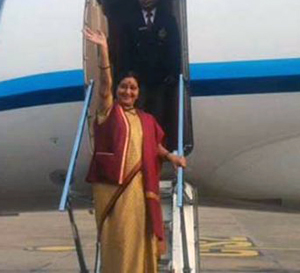
Immediately after arriving here, she said relationship between the two countries should be better and that she will hold talks with Pakistani leaders to find ways to improve bilateral ties.

"I have come with the message that ties between the two countries should be good and move forward," said Swaraj, who is here to lead the Indian delegation at the 'Heart of Asia' 5th Ministerial Meeting on Afghanistan tomorrow.

She refused to share what she would be discussing with Pakistani leaders, but said, "What will happen during the talks will be known after meeting."

Invited by Pakistan to attend the multilateral meet on Afghanistan, Swaraj will attend the conference tomorrow before holding talks with Aziz who said the focus would be on the resumption of composite dialogue process.

"Heart of Asia conference is very important for India because it is associated with Afghanistan. That is why I have come here to participate. Since it is happening in Pakistan it is necessary and appropriate for me to meet Prime Minister Nawaz Sharif and hold talks with my counterpart Sartaz Aziz to talk about improving the bilateral ties and take them forward," Swaraj said.

Adopting a cautious approach over the agenda of talks between Swaraj and Aziz, Indian officials said they will see how the meeting goes and if there will be any point of convergence.

Swaraj's visit comes after talks between the National Security Advisors of India and Pakistan in Bangkok on Sunday, where they discussed terrorism, Jammu and Kashmir and a range of key bilateral issues apart from agreeing to carry forward the "constructive" engagement.

Aziz had said yesterday that the deadlock in Indo-Pak ties had eased to some extent.
During his talks with Swaraj, Aziz said he would discuss various matters with focus on resumption of composite dialogue process between the two countries.

Swaraj's trip came three years after former external affairs minister S M Krishna's visit here in 2012 when the two sides inked a visa liberalisation pact.

Swaraj is accompanied by Foreign Secretary S Jaishankar, who was also present during the four-hour-long meeting between National Security Advisor Ajit Doval and his Pakistani counterpart Naseer Janjua in the Thai capital.

The joint statement after the meeting of NSAs said the talks were held pursuant to a meeting between Prime Ministers Narendra Modi and Sharif on the sidelines of the climate meet in Paris, rejecting the version given by the Indian side then that it was a mere "exchange of courtesies".

Sharif had told Pakistani media that he had a "good meeting" with Modi and "doors of dialogue should open".

Before Paris, Modi and Sharif had held bilateral meeting in Russian city of Ufa where they decided that their NSAs would meet to discuss all "terror-related" issues.

However, Pakistan had called-off Aziz's visit after New Delhi had made it clear that he would not be allowed to meet Kashmiri separatist leaders in the Indian capital.

Comments

Add new comment

  • Coastaldigest.com reserves the right to delete or block any comments.
  • Coastaldigset.com is not responsible for its readers’ comments.
  • Comments that are abusive, incendiary or irrelevant are strictly prohibited.
  • Please use a genuine email ID and provide your name to avoid reject.
News Network
May 28,2020

May 28: Abdul Kareem was forced out of school and into a life of odd jobs like repairing bicycles before he finally managed to pull his family out of abject poverty transporting goods across Delhi in a mini truck.

The job, and the slim financial security that came with it, was the first stepping stone to a better life.

All that is now gone as India reels under the economic impact of its protracted coronavirus lockdown. Mr Kareem's out of a job and stranded in his village in Uttar Pradesh with his wife and two children. Their minuscule savings from his Rs 9,000 a month job have been exhausted, and the money he saved for books and school uniforms is spent.

"I don't know what the job situation will be in Delhi once we go back," Mr Kareem said. "We can't stay hungry so I will do whatever I find."

At least 49 million people across the world are expected to plunge into "extreme poverty" -- those living on less than $1.90 per day -- as a direct result of the pandemic's economic destruction and India leads that projection, with the World Bank estimating some 12 million of its citizens will be pushed to the very margins this year.

Some 122 million Indians were forced out of jobs last month alone, according to estimates from the Center for Monitoring Indian Economy, a private sector think tank. Daily wage workers and those employed by small businesses have taken the worst hit. These include hawkers, roadside vendors, workers employed in the construction industry and many who eke out a living by pushing handcarts and rickshaws.

For Prime Minister Narendra Modi, who came to power in 2014 promising to lift the poorest citizens out of poverty, the fallout from the lockdown brings with it significant political risk. He won an even larger second term majority last year on the strength of his government's popular social programs that directly targeted the poor, such as the provision of cooking gas cylinders, power and public housing. The breadth and depth of this renewed economic pain will only increase the pressure on his government as it works to steer the country's economy back on track.

"Much of the Indian government's efforts to mitigate poverty over the years could be negated in a matter of just a few months," said Ashwajit Singh, managing director of IPE Global, a development sector consultancy that advises several multinational aid agencies. Noting that he did not expect unemployment rates to improve this year, Singh said: "More people could die from hunger than the virus."

Desperate Times

Mr Singh points to a United Nations University study estimating 104 million Indians could fall below the World Bank-determined poverty line of $3.2 a day for lower-middle-income countries. This will take the proportion of people living in poverty from 60% -- or 812 million currently, to 68% or 920 million -- a situation last seen in the country more than a decade ago, he said.

A World Bank report found the country had been making significant progress and was close to losing its status as the country with the most poor citizens. The impact of PM Modi's lockdown risks reversing those gains.

The World Bank and the CMIE estimates were published in late April and early May respectively. Since then the situation has only become grimmer, with harrowing images of people making desperate attempts to reach their villages, on crowded buses, the flatbeds of trucks and even on foot or on bicycles dominating media coverage.

The Rustandy Center for Social Sector Innovation at the University of Chicago Booth School of Business analyzed the unemployment data from the CMIE, collected through surveys covering about 5,800 homes across 27 states in April.

Researchers found rural areas were the hardest hit, and the economic misery was the result of the lockdown, rather than the spread of infections in the hinterland. More than 80% of households had experienced a drop income and many won't survive much longer without aid, they wrote in a report.

The government has promised cheap credit to farmers, direct transfer of money to the poor and eased access to food security programs -- but these help people who have some documentation, which many of the poorest don't. With millions of impoverished people now in transit across the country, the food security situation is dire -- news reports are emerging of people foraging through piles of rotting fruit or eating leaves.

Shattered Economy

The economy was already growing at its slowest pace in over a decade when the virus struck. The lockdown, which came into effect on March 25, has hammered it, stalling business activity and putting a lid on consumption, pushing the economy to what may be its first full-year contraction in more than four decades.

It's dire enough to warrant the country exiting its lockdown, as it has been doing incrementally since May 4, even as its infections are surging. India is now Asia's virus hotspot with infections crossing 151,000 according to data from Johns Hopkins University.

PM Modi, who has come under criticism for the pain inflicted on the poor, has said his government will spend $265 billion or about 10% of its GDP to help Asia's third-largest economy weather the pandemic's fallout. But experts say only a part of it is direct fiscal stimulus, and probably smaller than the total damage done to the economy during the lockdown period.

"What is especially worrying is the government's response," said Reetika Khera, an economics professor at the Indian Institute of Technology in Delhi. "The epidemic will magnify existing -- and already high -- inequalities in India."

Still, the economic measures aren't going to kick in for some time and industry will likely struggle to restart because of the flight of labour from industrial hubs.

And as the harsh summer unfolds more pain lies in store in the villages now dealing with returning migrant workers.

"There are no factories or industries here, there are just hills," said Surendra Hadia Damor, who had walked nearly 100 km from Ahmedabad, Gujarat, before a voluntary organisation drove him to his village in the neighboring state of Rajasthan. "We can survive for a month or two and then try and find a job nearby -- we will see what happens."

Comments

Add new comment

  • Coastaldigest.com reserves the right to delete or block any comments.
  • Coastaldigset.com is not responsible for its readers’ comments.
  • Comments that are abusive, incendiary or irrelevant are strictly prohibited.
  • Please use a genuine email ID and provide your name to avoid reject.
Agencies
July 15,2020

Mumbai, Jul 15: In a mega investment announcement, Reliance Industries (RIL) Chairman Mukesh Ambani on Wednesday said that Google will invest ₹ 33,737 crore in Jio Platforms for an equity stake of 7.73%.

Google is investing at an equity valuation of ₹ 4.36 lakh crore, said an RIL regulatory filing.

"Jio Platforms Limited, a subsidiary of the Company, today signed binding agreements with Google International LLC pursuant to which Google would invest ₹ 33,737 crore for a 7.73 % equity stake in Jio Platforms Limited on a fully-diluted basis. Google is investing at an equity valuation of ₹ 4.36 lakh crore," it said.

The transaction is subject to customary regulatory approvals.

Speaking at the Annual General Meeting of RIL, Ambani said that he looks forward to working with investors in Jio Platforms in a collaborative way.

Making another major announcement, the RIL Chairman said that Jio has designed a complete 5G solution and it will be available for trials as soon as spectrum is available.

Comments

Add new comment

  • Coastaldigest.com reserves the right to delete or block any comments.
  • Coastaldigset.com is not responsible for its readers’ comments.
  • Comments that are abusive, incendiary or irrelevant are strictly prohibited.
  • Please use a genuine email ID and provide your name to avoid reject.
News Network
March 25,2020

India will suspend all domestic flights from midnight Tuesday, the final piece of a nationwide lockdown that threatens Prime Minister Narendra Modi’s attempts to revive an economy already expanding at the slowest pace in more than a decade.

The flight ban compliments a cancellation of all passenger trains through March 31, as authorities try to halt the spread of the coronavirus in the world’s second-most populous country, which has poorly equipped hospitals and inadequate social security. Modi on Monday held a conference call with some of India’s top entrepreneurs and bankers, who urged policymakers to immediately slash interest rates by as much as a full percentage point, transfer cash to the poorest citizens, and suspend loan-repayments.

Over the past three days, state after state has declared curfews and India’s international borders have been shut for most visitors since March 11. India so far has 492 virus cases, including nine deaths. But experts say the country could be on the same trajectory as Italy, where the outbreak quickly escalated, causing hospitals to overflow.
A traveller stands outside a near-empty Delhi Junction Railway Station in Delhi, March 22.

"This is the biggest lockdown in world history,” said Raghu Raman, a former soldier with the Indian Army and founder of the National Intelligence Grid, an umbrella database aimed at countering terrorism. “This strategic pause gives decision-makers more time to arrest the exponential spread of the virus and evaluate trade-offs.”

Controlling the outbreak is crucial for Modi, who remains India’s most popular political leader currently though his economic management has faced criticism. Foreign investors are selling Indian assets at an unprecedented pace and failure to contain deaths and infections could erode some of the prime minister’s personal appeal at home.

Oxford Economics slashed India’s January-March growth forecast to 3%, a number not seen even during the worst of the global financial crisis. The main equity gauge rose about 3% on Tuesday after a record 13.2% plunge Monday, and the rupee stayed near its all-time low.

“A part of the cerebral cortex that senses fear and survival seems to have activated in the minds of investors,” said Umesh Mehta, Mumbai-based head of research at Samco Securities Ltd. “The only relief in this market can come from either policy makers and regulators, or from some positive news that a cure for the pandemic is near.”

Bloomberg Economics estimates Modi’s administration needs at least 1% of gross domestic product -- $30 billion -- to meaningfully respond to the virus outbreak. Meanwhile, the nation’s billionaires are diverting their factories to manufacture medical equipment and pledging to keep paying their staff even as production grinds to a halt. India allowed companies to use their philanthropy funds to prevent the spread of the coronavirus.

Reliance Industries Ltd., controlled by India’s richest man Mukesh Ambani, has helped equip a hospital in Mumbai dedicated to patients of Covid-19, the disease caused by the coronavirus. It will also build quarantine centers and produce 100,000 facemasks a day and other personal protective equipment for health workers. The group’s telecom unit will offer free broadband to enable work-from-home during the lockdown and will pay its lowest paid workers twice a month to protect household incomes.

Ambani joins Mahindra & Mahindra Ltd. Chairman Anand Mahindra and Vedanta Resources Ltd. Chairman Anil Agarwal -- a combined worth of more than $40 billion between the trio -- who have so far made pledges.

Indian companies are responding to Modi’s shutdown call. Maruti Suzuki India Ltd., Tata Motors Ltd., Toyota Kirloskar Motor, Hero MotoCorp., Samsung Electronics Co. and LG Electronics Inc., Mahindra Group, TVS Motor Co., Kia Motors Corp., Renault Nissan Automotive India Private Ltd., and Yamaha Motor India are among companies that have announced factory suspensions.

Policymakers are aware of the risks of such a move. India -- with a record 5.9 trillion rupees of local corporate debt maturing this year -- faces “waves of default” if cash flows aren’t maintained, the government’s principal economic adviser Sanjeev Sanyal said an interview.

Finance Minister Nirmala Sitharaman last week said the government will announce a relief package for coronavirus-affected sectors as soon as possible. The Reserve Bank of India, which is due to review interest rates April 3, announced a 1 trillion rupee cash injection on Monday.

“Let me assure, whatever it takes to keep the cash flow going in the economy will be done,” Sanyal said. “We need to make sure that when we are past the health storm, we still have an economy that has not gotten gridlocked. Because unwinding that would be more difficult.”

Comments

Add new comment

  • Coastaldigest.com reserves the right to delete or block any comments.
  • Coastaldigset.com is not responsible for its readers’ comments.
  • Comments that are abusive, incendiary or irrelevant are strictly prohibited.
  • Please use a genuine email ID and provide your name to avoid reject.