



Taliban's safe havens inside, not outside Afghanistan: Pakistan

Agencies
June 23, 2017

United Nations, Jun 23: Taliban "safe havens" are inside Afghanistan not outside, Pakistan`s Ambassador to the United Nations Maleeha Lodhi has said.maleeha
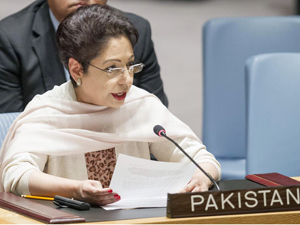
"The resilience of the insurgency led by the Taliban cannot be explained away by convenient references to external `safe havens` or `support centres`," Lodhi told the 15-member UN Security Council during a debate on Afghanistan on Wednesday.

Relations between the two countries have turned sour since Afghanistan`s President Ashraf Ghani accused Pakistan of waging an "undeclared war of aggression" against his country, Dawn reported on Thursday.

Pakistan, Lodhi asserted, was committed not to allow its territory to be used for terrorism against other countries.

"Pakistan`s Zarb-e-Azb and subsequent Raddul Fasaad military operations had succeeded in eliminating all terrorist and militant groups from its tribal territory bordering Afghanistan," she said.

She told the Council that Islamabad was "implementing border controls, including the fencing and monitoring of vulnerable sections of the Pakistan-Afghanistan border."

Lodhi said that "as a country that continues to host over two million Afghan refugees, Pakistan expects gratitude and not hostility from the Afghan government".

Both the countries, she stated, have suffered at the hands of terrorism and should cooperate with one another in order to eliminate terrorism from the region.

Lodhi said that apart from Afghanistan itself, there is no country other than Pakistan, which has suffered more from the wars and violence that have engulfed Afghanistan for over 35 years.

"There is no other country, which will gain more from peace in Afghanistan," she said.

Lodhi added that a political strategy is needed since it was impossible to reach a political solution with only an increase in troops and military involvement.

On his part, Afghanistan`s Ambassador Mahmoud Saikal said reversing the tide against terror was contingent on eliminating support centres beyond the country`s borders that produced, nurtured and empowered terrorists operating in Afghanistan.

Comments

Add new comment

  • Coastaldigest.com reserves the right to delete or block any comments.
  • Coastaldigset.com is not responsible for its readers’ comments.
  • Comments that are abusive, incendiary or irrelevant are strictly prohibited.
  • Please use a genuine email ID and provide your name to avoid reject.
News Network
April 17,2020

Paris, Apr 17: The number of coronavirus-related deaths in France has increased by 753 to 17,920 over the past 24 hours, with the total case count now standing at 108,847, Jerome Salomon, the head of the state health agency, said on Thursday.

On Wednesday, the country reported a total of 106,206 cases, including a record 1,438 new fatalities. Salomon specified that it was not the daily death toll, as the data had been compiled over the last three-day weekend.

"The total number of victims since March 1 is 17,920," Salomon said at a briefing on Thursday.
He noted that 11,060 of them had died in hospitals, and 6,860 others in social and medical-social facilities.

President Emmanuel Macron on Monday extended nationwide movement restrictions, which had been introduced due to the epidemic, until May 11. Afterwards, the country is set to gradually reopen kindergartens, schools and universities.

Comments

Add new comment

  • Coastaldigest.com reserves the right to delete or block any comments.
  • Coastaldigset.com is not responsible for its readers’ comments.
  • Comments that are abusive, incendiary or irrelevant are strictly prohibited.
  • Please use a genuine email ID and provide your name to avoid reject.
Agecnies
July 13,2020

Moscow, Jul 13: Russia has become the first nation to complete clinical trials of a COVID-19 vaccine on humans. Chief researcher Elena Smolyarchuk, who heads the Center for Clinical Research on Medications at Sechenov University, told Russian news agency TASS on Sunday that the human trials for the vaccine have been completed at the university and the volunteers will be discharged soon.

"The research has been completed and it proved that the vaccine is safe. The volunteers will be discharged on July 15 and July 20," Smolyarchuk was quoted as saying in the report.

Though the results have been favourable with respect to the medication’s effectiveness, no further information was provided on when this vaccine would enter commercial production stage.

Russia had allowed clinical trials of two forms of a potential COVID-19 vaccine developed by the Gamaleya National Research Center for Epidemiology and Microbiology on June 18.

The first vaccine, in the form of a solution for intramuscular administration, was carried out at the Burdenko Military Hospital.

Another vaccine, in the form of a powder for the preparation of a solution for intramuscular administration, was carried out at Sechenov First Moscow State Medical University.

The first stage of research on the vaccine at Sechenov University involved a group of 18 volunteers and the second group involved 20 volunteers.

After vaccination, all volunteers were expected to remain in isolation in a hospital for 28 days.

Earlier, results of the COVID-19 vaccine tests performed on a group of volunteers in Russia showed that they were developing immunity to the coronavirus.

"The data obtained by the Gamalei National Research Center for Epidemiology and Microbiology, proves that volunteers of the first and second groups are forming an immune response after injections of the vaccine against the coronavirus," according to an earlier statement from the Russian Defense Ministry.

Russia has reported 719,449 cases and 11,188 deaths to date.

There are at least 21 vaccines currently under key trials, according to the World Health Organisation (WHO).

The overall number of global COVID-19 cases crossed 12.9 million, while the deaths have increased to more than 5,69,000, according to Johns Hopkins University in the US.

As of Monday morning, the total number of cases stood at 1,29,10,357, while the fatalities rose to 5,69,128.

The US accounted for the world's highest number of infections at over 33 lakh. Brazil came in the second place with over 18 lakh infections. India is third worst affected with over 8.7 lakh people reported to have COVID-19.

Comments

Add new comment

  • Coastaldigest.com reserves the right to delete or block any comments.
  • Coastaldigset.com is not responsible for its readers’ comments.
  • Comments that are abusive, incendiary or irrelevant are strictly prohibited.
  • Please use a genuine email ID and provide your name to avoid reject.
News Network
May 20,2020

Kensington (United States), May 20: The world cut its daily carbon dioxide emissions by 17% at the peak of the pandemic shutdown last month, a new study found.

But with life and heat-trapping gas levels inching back toward normal, the brief pollution break will likely be “a drop in the ocean" when it comes to climate change, scientists said.

In their study of carbon dioxide emissions during the coronavirus pandemic, an international team of scientists calculated that pollution levels are heading back up — and for the year will end up between 4% and 7% lower than 2019 levels.

That's still the biggest annual drop in carbon emissions since World War II.

It'll be 7% if the strictest lockdown rules remain all year long across much of the globe, 4% if they are lifted soon.

For a week in April, the United States cut its carbon dioxide levels by about one-third.

China, the world's biggest emitter of heat-trapping gases, sliced its carbon pollution by nearly a quarter in February, according to a study Tuesday in the journal Nature Climate Change. India and Europe cut emissions by 26% and 27% respectively.

The biggest global drop was from April 4 through 9 when the world was spewing 18.7 million tons (17 million metric tons) of carbon pollution a day less than it was doing on New Year's Day.

Such low global emission levels haven't been recorded since 2006. But if the world returns to its slowly increasing pollution levels next year, the temporary reduction amounts to ''a drop in the ocean," said study lead author Corinne LeQuere, a climate scientist at the University of East Anglia.

“It's like you have a bath filled with water and you're turning off the tap for 10 seconds," she said.

By April 30, the world carbon pollution levels had grown by 3.3 million tons (3 million metric tons) a day from its low point earlier in the month. Carbon dioxide stays in the air for about a century.

Outside experts praised the study as the most comprehensive yet, saying it shows how much effort is needed to prevent dangerous levels of further global warming.

“That underscores a simple truth: Individual behavior alone ... won't get us there,” Pennsylvania State University climate scientist Michael Mann, who wasn't part of the study, said in an email.

“We need fundamental structural change.”

If the world could keep up annual emission cuts like this without a pandemic for a couple decades, there's a decent chance Earth can avoid warming another 1.8 degrees (1 degree Celsius) of warming from now, study authors said. But getting the type of yearly cuts to reach that international goal is unlikely, they said.

If next year returns to 2019 pollution levels, it means the world has only bought about a year's delay in hitting the extra 1.8 degrees (1 degree Celsius) of warming that leaders are trying to avoid, LeQuere said. That level could still occur anywhere from 2050 to 2070, the authors said.

The study was carried out by Global Carbon Project, a consortium of international scientists that produces the authoritative annual estimate of carbon dioxide emissions. They looked at 450 databases showing daily energy use and introduced a measurement scale for pandemic-related societal “confinement” in its estimates.

Nearly half the emission reductions came from less transportation pollution, mostly involving cars and trucks, the authors said. By contrast, the study found that drastic reductions in air travel only accounted for 10% of the overall pollution drop.

In the US, the biggest pollution declines were seen in California and Washington with plunges of more than 40%.

Comments

Add new comment

  • Coastaldigest.com reserves the right to delete or block any comments.
  • Coastaldigset.com is not responsible for its readers’ comments.
  • Comments that are abusive, incendiary or irrelevant are strictly prohibited.
  • Please use a genuine email ID and provide your name to avoid reject.