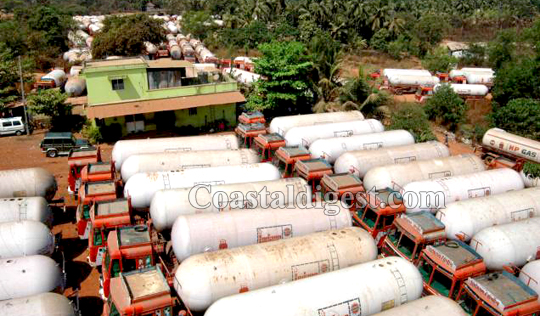
Tankers on Mangaluru-Bengaluru road declines as LPG pipeline commissioned

[email protected] (CD Network)
November 8, 2016

Mangaluru, Nov 8: A sharp decline in the number of bullet tankers on the Mangaluru-Bengaluru National Highway (NH 75) is expected as the Hindustan Petroleum Corporation Ltd., (HPCL) has commissioned the Mangaluru-Hassan-Yediyur/Mysuru LPG pipeline.

gas

About 175 bullet tankers move from HPCL's LPG Import Facility at Mangaluru towards Bengaluru/ Mysuru and another about 80 towards Karwar/ Kerala every day.

Originally envisaged to be till Solur near Bengaluru, the pipeline now terminates at Yediyur. Line has been laid for the entire 355.22 km length, including Hassan-Mysuru and it has passed the mandatory inspection by the Oil Industry Safety Directorate.

According to sources, the LPG pipeline was commissioned on October 23 and pumping of LPG commenced on that day itself. As a result, the number of LPG tankers should drastically reduce, the sources said.

The Dakshina Kannada district administration thanked farmers and others who provided land for the pipeline and urged the general public to cooperate for the smooth working of the pipeline.

The pipeline was constructed by Hindustan HPCL at a cost of about Rs. 838 crore to make the highways safe and also to reduce environment pollution.

HPCL has commenced patrolling, with the help of the Supervisory Control and Data Acquisition-enabled remote control system, besides manual checking.

Besides manual patrolling, the Supervisory Control and Data Acquisition (SCADA)-enabled remote control system would monitor the pipeline round-the-clock. The chances of LPG pilferage are highly remote as its storage is not easy. The line lies 1.5 m below the earth surface and goes up to 6 m depth at river-beds and roads.

Comments

Skazi
 - 
Tuesday, 8 Nov 2016

Good work done by the govt ..... Similarly implement the same system on Mangalore - goa route ..... Accidents will be reduced...Thanks to Almighty

Add new comment

  • Coastaldigest.com reserves the right to delete or block any comments.
  • Coastaldigset.com is not responsible for its readers’ comments.
  • Comments that are abusive, incendiary or irrelevant are strictly prohibited.
  • Please use a genuine email ID and provide your name to avoid reject.
News Network
July 22,2020

Bengaluru, Jul 22: Karnataka Congress President DK Shivakumar on Wednesday urged Karnataka Chief Minister BS Yediyurappa to waive all property taxes in urban local and rural panchayats for a period of one year as citizens are bearing a huge financial brunt of the COVID-19 pandemic.

Taking to Twitter, Shivakumar wrote, "Citizens are bearing a huge financial brunt of the Corona Pandemic. It's imperative on the government to ease the financial burden on citizens. I urge CM B.S. Yediyurappa to waive all property taxes, in urban local bodies and rural panchayats, for a period of one year on humanitarian grounds."
In yet another demand, Shivakumar on Tuesday said the state government should give details of the amount it spent on migrants and labourers during the coronavirus crisis if it is transparent.

"The image of Karnataka has come to a very rotten position. We all know that Karnataka has failed in sorting out the problem. Let them (the state government) tell what has been the amount spent on the labour, migrants and food kits on the health department. We want an account (of the expenditure) if they are so transparent," Shivakumar said.

He said the state government should have approached the hospitals for treating COVID-19 patients and if any private hospital refused, a message should have been given that the government would take it over.

He also accused the state government of corruption.

Comments

Add new comment

  • Coastaldigest.com reserves the right to delete or block any comments.
  • Coastaldigset.com is not responsible for its readers’ comments.
  • Comments that are abusive, incendiary or irrelevant are strictly prohibited.
  • Please use a genuine email ID and provide your name to avoid reject.
News Network
February 14,2020

Bengaluru, Feb 14: Karnataka Legislative Assembly Speaker Vishvesha Hegde Kageri on Friday announced continuation of ban on private TV channels from live coverage of the Budget Session being held this Month and next month.

Addressing a press conference here, Mr Kageri said that the ban was imposed on the lines of practice in Lok Sabha and Rajya Sabha in the Parliament. Private channels will not be allowed to cover live on going session instead they will be provided with clippings by the concerned Department as was done during the previous Session.

For the first time in the history the BJP government, which had come to power for the second time in the state last year after pulling down Congress-JDS coalition government, had banned live coverage of the session by private channels and despite Chief Minister BS Yediyurappa's appeal the ban was not lifted.

Comments

Add new comment

  • Coastaldigest.com reserves the right to delete or block any comments.
  • Coastaldigset.com is not responsible for its readers’ comments.
  • Comments that are abusive, incendiary or irrelevant are strictly prohibited.
  • Please use a genuine email ID and provide your name to avoid reject.
Agencies
February 20,2020

India ranked 77th on a sustainability index that takes into account per capita carbon emissions and ability of children in a nation to live healthy lives and secures 131st spot on a flourishing ranking that measures the best chance at survival and well-being for children, according to a UN-backed report.

The report was released on Wednesday by a commission of over 40 child and adolescent health experts from around the world. It was commissioned by the World Health Organization (WHO), UN Children's Fund (UNICEF) and The Lancet medical journal.

In the report assessing the capacity of 180 countries to ensure that their youngsters can survive and thrive, India ranks 77th on the Sustainability Index and 131 on the Flourishing Index, it said.

Flourishing is the geometric mean of Surviving and Thriving. For Surviving, the authors selected maternal survival, survival in children younger than 5 years old, suicide, access to maternal and child health services, basic hygiene and sanitation, and lack of extreme poverty.

For Thriving, the domains were educational achievement, growth and nutrition, reproductive freedom, and protection from violence.

Under the Sustainability Index, the authors noted that promoting today's national conditions for children to survive and thrive must not come at the cost of eroding future global conditions for children's ability to flourish.

The Sustainability Index ranks countries on excess carbon emissions compared with the 2030 target. This provides a convenient and available proxy for a country's contribution to sustainability in future.

The report noted that under realistic assumptions about possible trajectories towards sustainable greenhouse gas emissions, models predict that global carbon emissions need to be reduced from 39·7 giga­ tonnes to 22·8 gigatonnes per year by 2030 to maintain even a 66 per cent chance of keeping global warming below 1·5°C.

It said that the world's survival depended on children being able to flourish, but no country is doing enough to give them a sustainable future.

"No country in the world is currently providing the conditions we need to support every child to grow up and have a healthy future," said Anthony Costello, Professor of Global Health and Sustainability at University College London, one of the lead authors of the report.

"Especially, they're under immediate threat from climate change and from commercial marketing, which has grown hugely in the last decade," said Costello – former WHO Director of Mother, Child and Adolescent health.

Norway leads the table for survival, health, education and nutrition rates - followed by South Korea and the Netherlands. Central African Republic, Chad and Somalia come at the bottom.

However, when taking into account per capita CO2 emissions, these top countries trail behind, with Norway 156th, the Republic of Korea 166th and the Netherlands 160th.

Each of the three emits 210 per cent more CO2 per capita than their 2030 target, the data shows, while the US, Australia, and Saudi Arabia are among the 10 worst emitters. The lowest emitters are Burundi, Chad and Somalia.

According to the report, the only countries on track to beat CO2 emission per capita targets by 2030, while also performing fairly – within the top 70 – on child flourishing measures are: Albania, Armenia, Grenada, Jordan, Moldova, Sri Lanka, Tunisia, Uruguay and Vietnam.

"More than 2 billion people live in countries where development is hampered by humanitarian crises, conflicts, and natural disasters, problems increasingly linked with climate change," said Minister Awa Coll-Seck from Senegal, Co-Chair of the commission.

The report also highlights the distinct threat posed to children from harmful marketing.

Evidence suggests that children in some countries see as many as 30,000 advertisements on television alone in a single year, while youth exposure to vaping (e-cigarettes) advertisements increased by more than 250 per cent in the US over two years, reaching more than 24 million young people.

Studies in Australia, Canada, Mexico, New Zealand and the US – among many others – have shown that self-regulation has not hampered commercial ability to advertise to children.

Children's exposure to commercial marketing of junk food and sugary beverages is associated with purchase of unhealthy foods and overweight and obesity, linking predatory marketing to the alarming rise in childhood obesity, it said.

The number of obese children and adolescents increased from 11 million in 1975 to 124 million in 2016 – an 11-fold increase, with dire individual and societal costs, the report said.

To protect children, the authors call for a new global movement driven by and for children.

Specific recommendations include stopping CO2 emissions with the utmost urgency, to ensure children have a future on this planet; placing children and adolescents at the centre of global efforts to achieve sustainable development, the report said.

New policies and investment in all sectors to work towards child health and rights; incorporating children's voices into policy decisions and tightening national regulation of harmful commercial marketing, supported by a new Optional Protocol to the UN Convention on the Rights of the Child, it said.


Comments

Add new comment

  • Coastaldigest.com reserves the right to delete or block any comments.
  • Coastaldigset.com is not responsible for its readers’ comments.
  • Comments that are abusive, incendiary or irrelevant are strictly prohibited.
  • Please use a genuine email ID and provide your name to avoid reject.