


Tanzanian girl stripped, beaten in Bengaluru; 'deeply pained' says Sushma

[email protected] (News Network)
February 3, 2016

Bengaluru, Feb 3: The African students in north Bengaluru closed ranks on Wednesday as details emerged of a mob of locals allegedly attacking and stripping a Tanzanian girl in the neighourhood on Sunday.

The 21-year-old girl who had been attacked met with top police officials on Wednesday to narrate what the mob had done to her. She gave her statement at the DCP's office in Peenya.tanzanian
As the details spread, community leaders were constantly in touch with their fellow nationals and relayed the safer routes they should take when commuting between their homes and colleges.

"We are now scared of every Indian around us after what happened to me," the 21-year-old student of a city college told mediapersons at Sapthagiri Hospital, where she was taken for a medical test by police.

External affairs minister Sushma Swaraj took note of the incident and tweeted, "We are deeply pained over the shameful incident with a Tanzanian girl in Bengaluru."

She asked the state government to ensure the safety and security of all foreign students.

Earlier, in a note verbale, Tanzania high commission asked the external affairs ministry to take strong legal action against those who assaulted the girl.

Bengaluru police on Wednesday registered a case under 354 IPC (outraging the modesty of a woman) against unidentified persons.

Four locals were taken into custody later in the evening.

The girl's nightmare unfolded around 7.30pm on Sunday when she and her three Tanzanian friends were going in a car in Ganapathinagar, off Hesaraghatta Main Road. Almost 2km away and about 30 minutes hour earlier, a car driven by a Sudanese student had run over Shabana Taj, 35, who had been walking with her husband, electrical contractor Sanaullah.

A mob allegedly comprising locals, who were rioting following the accident, stopped the girl's car. "We got out of the car and there were many people around. There was a policeman standing nearby and I asked him what had happened. He said nothing. A friends rushed to me and asked me not to walk around. By then, the mob started hitting him," she said.

"They pushed me around and hit me. I was wearing a T-shirt. They tugged at it and tore it, leaving me literally without anything. They continued to thrash us and we ran for our lives. My friends and I hopped onto a bus. The driver didn't move and the other passengers threw us out. We were at the mob's mercy. A passerby who offered me a T-shirt was also attacked. They thrashed us again till we took shelter near some shops," she said.

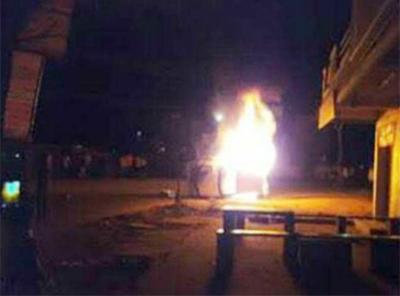
The mob, meanwhile, had set ablaze the car.

As they made their way to Sapthagiri Hospital, the mob chased them. Even at the hospital, the mob allegedly threatened to storm the hospital if the Africans were not sent out.

Police sources said they took the girl's statement on Wednesday, confirming there's been a three-day delay in acting on the incident.

African student leaders condemned the killing of the woman in an accident involving a Sudanese student but said the law should take its course. However, attacking innocent people based on their ethnicity should not be tolerated, they said, adding that the matter has been taken up with their embassies too.

"A woman has died and those responsible for the accident should be brought to book. But these students had nothing to do with it," said Bosco Kweesi, legal adviser to the African students.

A leader of the Tanzanian association, said she and some of her friends rushed to the police station Sunday night, seeking help to take their injured compatriots to hospital. "They plainly refused to come to our help or accept our complaint.. Police already had one of our fellow nationals who was in no way connected to the accident in their custody. A policeman told us that 'you all look alike and your fellow national will be set free only if you bring the guilty African car driver'," she said.

Comments

mohammad.n
 - 
Thursday, 4 Feb 2016

She asked the state government to ensure safety and security of all FOREIGN STUDENTS. What about indian students safety? What about indian ladies safety? What about justice for raped indian girls?

Worst ruling indian government, nothing less than a british rule before independence, worried about foreigners rather than the Indians which should be the most priority.

Mohammed SS
 - 
Thursday, 4 Feb 2016

Sushma Didi, show more and more pain as you want BJP govt. in Karnataka, there Is no such pain in your backyard for criminal acts and incidents where your party is ruling... apply Burnol deeply in to your backyard

Add new comment

  • Coastaldigest.com reserves the right to delete or block any comments.
  • Coastaldigset.com is not responsible for its readers’ comments.
  • Comments that are abusive, incendiary or irrelevant are strictly prohibited.
  • Please use a genuine email ID and provide your name to avoid reject.
Media Release
February 14,2020

Veteran journalist P. Sainath has said that the nation is in a crisis. And this crisis is not limited to just the rural area. It has become a national crisis at various areas such as agriculture, education, economy, job creation etc.

He was delivering the endowment lecture on the topic ‘Indian democracy at the post-liberalization and post-truth era’ at Media Manthan 2020 organized by the PG department of journalism and mass communication at St Aloysius College (Autonomous). 

Mr Sainath said that the many policies adopted in the 90s led to India becoming unusually unequal. Referring to the speech Ambedkar had made at the Constituent Assembly while handing over the draft of the Constitution, Mr Sainath said, “Ambedkar had warned about the weakness of Indian democracy that liberty without equality allows the supremacy of a few over the multitude. Liberty, equality and fraternity must be kept together as we cannot have one without the other.” 

Mr Sainath stated that the agrarian crisis was no longer about the loss of productivity, employment or about farmer suicide; it was a societal, civilizational crisis. Commenting on the lopsided policies such as cow-slaughter ban, he explained how cow slaughter ban had adversely affected many industries due to their interdependency. While Muslims who slaughtered cows were rendered helpless, the cattle traders who were mostly OBCs lost their earnings as the cattle prices crashed. An important industry like Kolhapur sandals industry in Maharashtra went bankrupt as a result of the cow slaughter ban in Maharashtra. He said the policymakers had no idea how the rural industries were interconnected. Demonetisation too devastated the rural economy as 98 percent of rural transactions happen through cash. 

Mr Sainath also spoke about the crisis of inequality which affects the Dalits and the Adivasis far more than anyone else as 90 percent of the rural households take home less than Rs 10,000/- per month. “Women are yet another group whose labour is never counted in the gross domestic product. Women and girls globally do unpaid work which amounts to about 12.5 billion working hours per year. Monetarily speaking, this is worth 10.8 trillion dollars,” Mr Sainath added. 

Speaking about the crisis of jobs Mr Sainath said that major companies were laying off employees just to create more profits for the investors and the adoption of artificial intelligence in the industry would further destroy millions of jobs.

Rector of St Aloysius College Institutions Fr Dionysius Vaz SJ, Principal Dr (Fr) Praveen Martis SJ, HOD of Journalism and Mass Communication department Dr (Fr) Melwyn Pinto SJ were present.

‘Veerappan and Vijay Mallya’s business models are interesting!’

Addressing the gathering during his endowment lecture on Friday, Mr Sainath made an interesting comment on the so called ‘revenue model’. “Whenever I visit IIMs and IITs for lectures on my PARI project, the students there ask me what my revenue model for my project is. I tell them that I do not have a revenue model. In fact, journalism does not begin with a revenue model. Gandhiji, Ambedkar, Bhagat Singh were all great journalists. But they did not have a revenue model,” Mr Sainath said.

On a lighter note, he said that the best revenue model that he liked was that of forest brigand Veerappan and liquor baron Vijay Mallya. “Veerappan ruled the forest for forty years and from the top ministers to the villagers he could dictate terms and liver royally. Similarly, Mallya’s revenue model was to steal the banks and run away abroad and live like a king,” Mr Sainath added.

Journalism is not and can never be a business. It is a calling, he opined. While newspaper can be a business, television can be a business, journalism per se cannot be reduced to a business. “Unfortunately today, journalists are recruited on a contract basis and they have no bargaining power; and there are no unions to fight for their cause. Hence, they are at the mercy of the corporate media houses for their survival and are made to write stories that cannot be called journalism,” Mr Sainath said.

Answering a question as to the pressures he faced as a journalist, he said that external pressures from the government or others could be very well handled. It is the internal pressures from once own media house that journalists find it difficult to manage.


Comments

Add new comment

  • Coastaldigest.com reserves the right to delete or block any comments.
  • Coastaldigset.com is not responsible for its readers’ comments.
  • Comments that are abusive, incendiary or irrelevant are strictly prohibited.
  • Please use a genuine email ID and provide your name to avoid reject.
coastaldigest.com news network
August 7,2020

Bengaluru, Aug 7: Dr Mohammed Yusuf, chairperson of the Karnataka State Board of Auqaf, passed away at a private hospital in the city today following a brief illness. He was 74.

Dr Yusuf was an industrialist and was known for his philanthropic activities. 

A veterinarian, Dr Yusuf had quit the government job and set up business in Bengaluru and Dubai decades ago and has earned considerable success.

He was re-elected as Board of Auqaf chief in January this year. He had held the post more than once in the past. 

He will be buried at the graveyard near Masjid-e-Muzammil which was built by himself at Govindapura, source said.

Comments

Add new comment

  • Coastaldigest.com reserves the right to delete or block any comments.
  • Coastaldigset.com is not responsible for its readers’ comments.
  • Comments that are abusive, incendiary or irrelevant are strictly prohibited.
  • Please use a genuine email ID and provide your name to avoid reject.
coastaldigest.com news network
June 28,2020

Mandya, Jun 28: Prime Minister Narendra Modi praised an 83-year-old farmer from Malavalli taluk in Mandya district of Karnataka for his efforts in water conservation.

While urging the people to focus on saving water, Modi, in his 'Man Ki Baat' on All India Radio quoted Kamegowda from Dasna Doddi village who single handedly dug small 16 ponds over the years in his farm land and in nearby hill while taking his animals for grazing.

"Kamegowda ji is an ordinary farmer, albeit possessing an extraordinary personality. He has achieved a personal feat that will leave anyone awestruck! Kamegowda ji, aged 80-85 takes out his animals for grazing but at the same time he has taken it upon himself to build new ponds in his area", the PM said in his Mann Ki Baat, a monthly radio address on Sunday.

To overcome problems of water scarcity in the area, Gowda started building small ponds. Thereby, he contributed a lot for water conservation, the PM said.

"... An octagenerarian like Kamegowda ji, till now, has dug 16 ponds through his hard work and the sweat of his brow. It is possible that the ponds he has constructed may not be very big but then his efforts are huge. Today, the entire area has got a new lease of life on account of these ponds," the PM said.

A little effort by us helps nature and environment quite significantly. Many of our countrymen are putting extraordinary efforts in this endeavour, the PM said. 

Kamegowda, used to take his sheep and goats to nearby hill for grazing. After finding no water to sheeps, he started digging ponds to address water scarcity. With collection of rain water, these lakes are brimming with water even during peak summer.

Comments

Add new comment

  • Coastaldigest.com reserves the right to delete or block any comments.
  • Coastaldigset.com is not responsible for its readers’ comments.
  • Comments that are abusive, incendiary or irrelevant are strictly prohibited.
  • Please use a genuine email ID and provide your name to avoid reject.