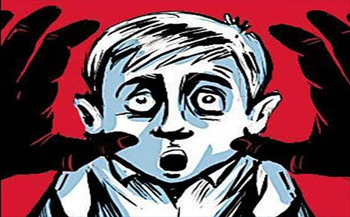
Teacher arrested for sexually abusing 16-yr-old boy

October 30, 2016

Kasargod, Oct 30: A 56-year-old teacher has been arrested and remanded in judicial custody for allegedly repeatedly sexually abusing a teenage boy, police said Saturday.

abusThe accused Suresh, who was arrested Friday, used to take classes for students at a Sunday school attached to a Syrian Jacobite Church near Kothamangalam in Ernakulam district.

Suresh, who is a neighbour of the 16-year-old victim, had allegedly sexually abused the boy since 2015 after threatening him. The victim also used to attend the Sunday school classes, they added.

The teacher has been charged with IPC Section 377, (Unnatural offences) and the Protection of Children from Sexual Offences Act (POCSO Act), they said.

He was produced before a magistrate court yesterday which remanded him in 14-day judicial custody. Three such incidents of sexual abuse have been narrated in the complaint lodged with the police, police said.

Comments

True indian
 - 
Sunday, 30 Oct 2016

Indian law is very weak. Thats why Allah made law will reduce crime.

If u ask the victims family. They will say hang him.

In this matter court should not decide the punishment. The victim or their parents should decide what punishment to give.

Add new comment

  • Coastaldigest.com reserves the right to delete or block any comments.
  • Coastaldigset.com is not responsible for its readers’ comments.
  • Comments that are abusive, incendiary or irrelevant are strictly prohibited.
  • Please use a genuine email ID and provide your name to avoid reject.
News Network
July 20,2020

Bengaluru, Jul 20: Janata Dal (Secular) leader HD Kumaraswamy has urged the Karnataka government to stop putting warning signboards in front of COVID-19 patients' houses alleging that they are leading to "social discrimination and untouchability" in the present times.

"A local government warning signboards in front of the homes of COVID-19 infected people is leading to neo-social discrimination and untouchability in the new age. Even after infection, the individual and family should live with dignity. The government should immediately stop the practice of placing signboards," Kumaraswamy's first tweet read.

"Instead of placing them in front of their homes and creating untouchability, send health workers to their homes to create courage and awareness. They should be told not to leave the house. There is no such degrading practice left behind. I would like to ask Chief Minister Karnataka BS Yediyurappa to pay attention to this," he added.

The former chief minister further said that threatening to cancel the licenses of medical colleges for refusing treatment to patients would not solve the problem and urged the government to take them into confidence instead of rebuking them.

"Refusing treatment is the fault of any hospital. But for the same reason, threatening to cancel government medical college licenses is not right. There is no profit in this emergency of health. MCI also has the power to revoke the licenses of medical colleges. Remember not the government," he said.

"In this case, the government should look to the Medical Colleges to get their services in order to get them to trust them instead of getting angry. Let them focus on meeting their needs. I insist on a collective fight against the coronavirus through this," he further added.

The COVID-19 count in Karnataka reached 63,772 on Sunday, including 39,370 active cases and 23,065 cured and discharged patients.

Comments

Add new comment

  • Coastaldigest.com reserves the right to delete or block any comments.
  • Coastaldigset.com is not responsible for its readers’ comments.
  • Comments that are abusive, incendiary or irrelevant are strictly prohibited.
  • Please use a genuine email ID and provide your name to avoid reject.
Agencies
May 8,2020

Washington D.C., May 8: The prime time for brain development in a child's life is the first year, where the infant spends most of the time asleep. It is the time when neural connections form and sensory memories are encoded.

However, when sleep is disrupted, as occurs more often among children with autism, brain development may be affected, too.

New research led by the University of Washington finds that sleep problems in a baby's first 12 months may not only precede an autism diagnosis but also may be associated with altered growth trajectory in a key part of the brain, the hippocampus.

The study, which was published in the American Journal of Psychiatry, researchers report that in a sample of more than 400 taken of 6- to 12-month-old infants, those who were later diagnosed with autism were more likely to have had difficulty falling asleep.

It also states that this sleep difficulty was associated with altered growth trajectories in the hippocampus.

"The hippocampus is critical for learning and memory, and changes in the size of the hippocampus have been associated with poor sleep in adults and older children.

As many as 80 per cent of the children with autism spectrum disorder have sleep problems," said Annette Estes, director of the UW Autism Center and senior author of the study.

"In our clinical experience, parents have a lot of concerns about their children's sleep, and in our work on early autism intervention, we observed that sleep problems were holding children and families back," added Estes, who is also a UW professor of speech and hearing sciences.

"It could be that altered sleep is part-and-parcel of autism for some children. One clue is that behavioural interventions to improve sleep don't work for all children with autism, even when their parents are doing everything just right. This suggests that there may be a biological component to sleep problems for some children with autism," said Estes.

To consider links among sleep, brain development, and autism, researchers at the IBIS Network looked at MRI scans of 432 infants, surveyed parents about sleep patterns, and measured cognitive functioning using a standardized assessment.

At the outset of the study, infants were classified according to their risk for developing autism: Those who were at higher risk of developing autism -- about two-thirds of the study sample -- had an older sibling who had already been diagnosed.

Infant siblings of children with autism have a 20 per cent chance of developing autism spectrum disorder -- a much higher risk than children in the general population.

In the current study, 127 of the 432 infants were identified as "low risk" at the time the MRI scans were taken because they had no family history of autism.

They later evaluated all the participants at 24 months of age to determine whether they had developed autism. Of the roughly 300 children originally considered "high familial risk," 71 were diagnosed with autism spectrum disorder at that age.

Problems with sleep were more common among the infants later diagnosed with an autism spectrum disorder, as were larger hippocampi. No other subcortical brain structures were affected, including the amygdala, which is responsible for certain emotions and aspects of memory, or the thalamus, a signal transmitter from the spinal cord to the cerebral cortex.

The authors note that while parents reported more sleep difficulties among infants who developed autism compared to those who did not, the differences were very subtle and only observed when looking at group averages across hundreds of infants.

Sleep patterns in the first years of life change rapidly as infants transition from sleeping around the clock to a more adult-like sleep/wake cycle. Until further research is completed, Estes said, it is not possible to interpret challenges with sleep as an early sign of increased risk for autism.


Comments

Add new comment

  • Coastaldigest.com reserves the right to delete or block any comments.
  • Coastaldigset.com is not responsible for its readers’ comments.
  • Comments that are abusive, incendiary or irrelevant are strictly prohibited.
  • Please use a genuine email ID and provide your name to avoid reject.
News Network
April 19,2020

New Delhi, Apr 19: The government on Sunday prohibited the sale of non-essential items through e-commerce platforms during the ongoing lockdown, four days after allowing such companies to sale mobile phones, refrigerators and ready-made garments.

Union Home Secretary Ajay Bhalla issued an order excluding the non-essential items from sale by the e-commerce companies from the consolidated revised guidelines, which listed the exemption given to the services and people from the purview of the lockdown.

The order said the following clause -- "E-commerce companies. Vehicles used by e-commerce operators will be allowed to ply with necessary permissions" -- is excluded from the guidelines.

The previous order had said such items were allowed for sale through e-commerce platforms from April 20.

However, the reason for reversing the order is not known immediately.

Comments

Add new comment

  • Coastaldigest.com reserves the right to delete or block any comments.
  • Coastaldigset.com is not responsible for its readers’ comments.
  • Comments that are abusive, incendiary or irrelevant are strictly prohibited.
  • Please use a genuine email ID and provide your name to avoid reject.