Teacher arrested for sexually abusing 16-yr-old boy

October 30, 2016

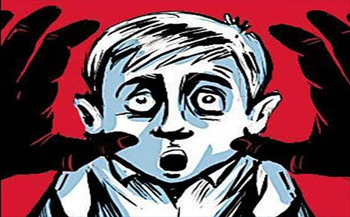
Kasargod, Oct 30: A 56-year-old teacher has been arrested and remanded in judicial custody for allegedly repeatedly sexually abusing a teenage boy, police said Saturday.

abusThe accused Suresh, who was arrested Friday, used to take classes for students at a Sunday school attached to a Syrian Jacobite Church near Kothamangalam in Ernakulam district.

Suresh, who is a neighbour of the 16-year-old victim, had allegedly sexually abused the boy since 2015 after threatening him. The victim also used to attend the Sunday school classes, they added.

The teacher has been charged with IPC Section 377, (Unnatural offences) and the Protection of Children from Sexual Offences Act (POCSO Act), they said.

He was produced before a magistrate court yesterday which remanded him in 14-day judicial custody. Three such incidents of sexual abuse have been narrated in the complaint lodged with the police, police said.

Comments

True indian
 - 
Sunday, 30 Oct 2016

Indian law is very weak. Thats why Allah made law will reduce crime.

If u ask the victims family. They will say hang him.

In this matter court should not decide the punishment. The victim or their parents should decide what punishment to give.

Add new comment

  • Coastaldigest.com reserves the right to delete or block any comments.
  • Coastaldigset.com is not responsible for its readers’ comments.
  • Comments that are abusive, incendiary or irrelevant are strictly prohibited.
  • Please use a genuine email ID and provide your name to avoid reject.
Ram Puniyani
June 29,2020

In Minneapolis, US an African American, George Floyd lost his life as the white policeman, Derek Chauvin, caught hold of him and put his knee on his neck. This is a technique developed by Israel police. For nine long minutes the knee of the while policeman was on the neck of George, who kept shouting, I can’t breathe.

Following this gruesome murder America erupted with protests, ‘Black lives matter’. The protestors were not just African Americans but also a large section of whites. Within US one police Chief apologized for the act of this. In a touching gesture of apology the police force came on its knees. This had reverberations in different parts of the World.

The act was the outcome of the remnants of the racial hatred against blacks by the whites. It is the hatred and the perceptions which are the roots of such acts of violence. What was also touching that the state of democracy in US is so deep that even the police apologized, the nation, whites and blacks, stood up as a sensitive collective against this violence.

US is not the only country where the brutal acts of violence torment the marginalized sections of society. In India there is a list of dalits, minorities and adivasis who are regularly subjected to such acts. But the reaction is very different. We have witnessed the case of Tabrez Ansari, who was tied to the pole by the mob and beaten ruthlessly. When he was taken to police station, police took enough time to take him to hospital and Tabrez died.

Mohsin Sheikh, a Pune techie was murdered by Hindu Rashtra Sena mob, the day Modi came to power in 2014. Afrazul was killed by Shambhulal Regar, videotaped the act released on social media. Regar believed that Muslims are indulging in love Jihad, so deserve such a fate. Mohammad Akhlaq is one among many names who were mob lynched on the issue of beef cow. The list can fill pages after pages.

Recently a young dalit boy was shot dead for the crime of entering a temple. In Una four dalits were stripped above waste and beaten mercilessly. Commenting on this act the Union Minister Ramvilas Paswan commented that it is a minor incident. Again the list of atrocities against dalits is long enough. The question is what Paswan is saying is the typical response to such gruesome murders and tortures. In US loss of one black life, created the democratic and humane response. In India there is a general silence in response to these atrocities. Some times after a good lapse of time, the Prime Minister will utter, ‘Mother Bharati has lost a son’. Most of the time victim is blamed. Some social groups raise their voice in some fora but by and large the deafening silence from the country is the norm.

India is regarded as the largest democracy. Democracy is the rule of law, and the ground on which the injustices are opposed. In America though the present President is insensitive person, but its institutions and processes of democratic articulations are strong. The institutions have deepened their roots and though prejudices may be guiding the actions of some of the officers like the killer of George, there are also police officers who can tell their President to shut up if he has nothing meaningful to say on the issue. The prejudices against Blacks may be prevalent and deep in character, still there are large average sections of society, who on the principles of ‘Black lives matter’. There are large sections of vocal population who can protest the violation of basic norms of democracy and humanism.

In India by contrast there are multiple reasons as to why the lives of Tabrez Ansari, Mohammad Akhlaq, Una dalit victims and their likes don’t matter. Though we claim that we are a democracy, insensitivity to injustices is on the rise. The strong propaganda against the people from margins has become so vicious during last few decades that any violence against them has become sort of a new normal. The large populace, though disturbed by such brutalities, is also fed the strong dose of biases against the victims. The communal forces have a great command over effective section of media and large section of social media, which generates Hate against these disadvantaged groups, thereby the response is muted, if at all.

As such also the process of deepening of our democracy has been weak. Democracy is a dynamic process; it’s not a fixed entity. Decades ago workers and dalits could protest for their rights. Now even if peasants make strong protests, dominant media presents it as blocking of traffic! How the roots of democracy are eroded and are visible in the form where the criticism of the ruling dispensation is labelled as anti National..

Our institutions have been eroded over a period of time, and these institutions coming to the rescue of the marginalized sections have been now become unthinkable. The outreach of communal, divisive ideology, the ideology which looks down on minorities, dalits and Adivasis has risen by leaps and bounds.

The democracy in India is gradually being turned in to a hollow shell, the rule of law being converted in to rule of an ideology, which does not have faith in Indian Constitution, which looks down upon pluralism and diversity of this country, which is more concerned for the privileges of the upper caste, rich and affluent. The crux of the matter is the weak nature of democracy, which was on way to become strong, but from decades of 1980s, as emotive issues took over, the strength of democracy started dwindling, and that’s when the murders of the types of George Floyd, become passé. One does complement the deeper roots of American democracy and its ability to protect the democratic institutions, which is not the case in India, where protests of the type, which were witnessed after George Floyd’s murder may be unthinkable, at least in the present times. 

Comments

Add new comment

  • Coastaldigest.com reserves the right to delete or block any comments.
  • Coastaldigset.com is not responsible for its readers’ comments.
  • Comments that are abusive, incendiary or irrelevant are strictly prohibited.
  • Please use a genuine email ID and provide your name to avoid reject.
Agencies
February 6,2020

Even more than three years after demonetisation and all-out efforts to make most transactions through electronic, cash is still king, as it thrives in a digital India, said fintech start-up Paytm founder Vijay Sekhar Sharma.

"While cashless economy is not possible in India, less cash economy will be in the future. Less cash is the only solution, not the elimination of cash," Sharma told IANS in an interview after unveiling an all-in-one payment gateway on Tuesday.

Asserting that it would take 5-10 years for India to make the transition to digital payments from the traditional mode of cash, Sharma, 41, said the e-payment industry benefitted more from the November 8, 2016 note ban and withdrawal of old Rs 1,000 and Rs 500 denominations.

"I think it (demonetisation) helped the industry despite lack of specific help. But the world has changed since then. It is about the scale of distribution of merchants that is what is propelling digital payments," said Sharma.

Most of the cash not only came back into circulation, but also remains as the mode of payment for the majority due to its convenience for the people used to such transactions.

Expounding Paytm's zero service charge, Sharma said the strategy is sustainable as it leads to acquiring more customers and merchants, enabling newer business opportunities.

Paytm also does not levy a service charge to small merchants for its payments services, unlike organised players like Uber.

"Though there is a monetisation model, the merchants who are small shopkeepers, become our financial services customers as they open a bank account, which is profitable."

Paytm secured a Payments Bank license from the Reserve Bank of India to offer a savings bank account, Rupay debit card and money transfer services.

"We are banking on payment services acquiring customers and merchants who avail banking, lending, insurance, wealth and software services like billing software and business ledger software services eventually," Sharma noted.

The mobile first bank services include zero balance and zero digital transaction charge accounts.

"Basically, payments, cloud, commerce and financial services are a cohort we follow. So, payments is our customer as well as merchant acquisition. If it breaks even, we are happy because other line items make more money, he affirmed.

Noting that in a market like India, one cannot price services at a premium unlike in a developed country like the US, the billionaire businessman said a consumer in a developing country would not be able to afford such a hefty charge.

Forbes ranked Sharma as India's youngest billionaire in 2017, with a net worth of $2.1 billion.

While several countries operate on the model of higher service charges, Sharma said newer business models have to be discovered in India, as customer lifecycle value is accounted for more stages than in other nations.

Asked about an upscale retailer like Zara not giving a wallet payment option during its recent end of season sale in Bengaluru, Sharma said Paytm was addressing such hiccups with its all-in-one payment solutions.

"It's an opportunity, because if the retailer has our all-in-one point of sale machine, where in they enter the amount, it shows both the Quick Response code (QR) and card payment options," he observed.

Sharma compared older swiping payment machine to feature phones and modern ones to feature-rich smartphones.

"If you notice, they look like feature phones and the modern day card machine is more a smartphone like. You can add the smatphone components, which can add the features," reiterated Sharma.

Though Paytm's all-in-one QR point of sale machine integrates the billing system, its chief executive said it was not ideal to have an independent QR feature.

Paytm has 16 million strong merchant user base, which Sharma aims to raise to 26 million base in the next one year.

Sharma has launched in this tech city an all-in-one payment gateway and Paytm Business Payments solution, which enable digital payments through multiple methods for small and medium enterprises (SMEs) and an Android point of sale machine.

With the new gateway solution, collecting digital payments through multiple methods can be achieved seamlessly while Paytm Business Payments solution enables automated vendor payments, including employee salaries and customer refunds among others.

The One97 Communications-owned Paytm aims to help SMEs streamline and digitise their business activities using its new solutions, which enhance the overall efficiency of both accepting and making payments.

Paytm has a data bank of over 200 million saved cards and bank accounts, a feature which enables partner apps to shorten transaction times and propel faster conversions while using the all-in-one payment gateway.

Complementing the two solutions, Sharma also launched an all-in-one Android point of sale machine, which can accept payments through all forms such as cards, wallets, UPI apps and even cash.

The device has a QR code that supports all contact and contactless payments, coming with integrated billing software customized solutions for different sectors such as catering, ticketing, parking and others.

The handheld Android device is equipped with an in-built printer, scanner and can also generate bills.

Valued at $16 billion, Paytm is not alone in the fiercely competitive Indian fintech space where a dozen players like PhonePe, MobiKwik, Kotak 811 and deep pocketed international giants Google Pay and Amazon Pay are in the fray.


Comments

Add new comment

  • Coastaldigest.com reserves the right to delete or block any comments.
  • Coastaldigset.com is not responsible for its readers’ comments.
  • Comments that are abusive, incendiary or irrelevant are strictly prohibited.
  • Please use a genuine email ID and provide your name to avoid reject.
News Network
June 1,2020

Manglauru, Jun 1: The southwest monsoon has made an onset over Kerala, marking the commencement of the four-month long rainfall season, the India Meteorological Department said on Monday.

"The southwest monsoon has made an onset over Kerala," IMD director general Mrutyunjay Mohapatra said.

The four-month monsoon season from June to September accounts for 75 per cent of rainfall in the country.

Private forecaster Skymet Weather on May 30 had declared arrival of monsoon, but the IMD had differed, saying conditions were not ripe then for such an announcement.

Orange alert

Meanwhile, coastal Karnataka’s Dakshina Kannada district, which is receiving sporadic rains for past couple of days, is on orange alert.

Deputy Commissioner Sindhu B Rupesh declared the orange alert following IMD’s prediction of heavy rainfall in the region.

Comments

Add new comment

  • Coastaldigest.com reserves the right to delete or block any comments.
  • Coastaldigset.com is not responsible for its readers’ comments.
  • Comments that are abusive, incendiary or irrelevant are strictly prohibited.
  • Please use a genuine email ID and provide your name to avoid reject.