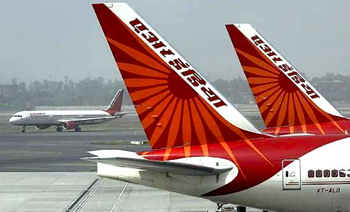
Techie Held For Hacking Air India Frequent Flyers Accounts

July 18, 2016

New Delhi, Jul 18: A 23-year-old techie has been arrested for hacking Air India's Frequent Flyer member accounts and using them to book tickets sold to several travel agents, Delhi Police said on Sunday.

airindiaThe accused, Anitesh Giri Goswami, a BCA graduate from Pune, was arrested from Jaipur on Friday.

According to police, a complaint was received in the Cyber Crime Cell of the Delhi Police's Economic Offences Wing (EOW) alleging some persons were selling Air India tickets by redeeming of miles of genuine Flying Returns Members after hacking the Frequent Flyer members account.

In a statement, the EOW said it was found that the hub of the scam was in Rajasthan's Jodhpur and Anitesh was its mastermind. On basis of electronic surveillance and information of a local informer, a raid was conducted at an apartment in Jaipur and Anitesh was nabbed.

A laptop, several mobile phones and other relevant documents were also recovered from his possession.

Police further claimed that Anitesh was an IT expert, who had earlier worked with Kingfisher Airlines and Air India and was well versed with the online ticket-booking system and functioning of Air India's intranet and internet-based systems.

Explaining the modus operandi, police said that Anitesh first understood functioning of the ticketing system as well as the points/miles system of the airlines and then hacked into the Loyalty Plus programme website of Air India.

After gaining access, he administrator user rights, which he used to upgrade several other user IDs with the same rights, police said.

Using these IDs, he verified hundreds of dormant accounts of Frequent Flyer members by uploading fraudulently prepared KYC (know your customer) documents, and used these membership accounts and the miles or points accumulated in these accounts for booking airline tickets. These were sold to various travel or ticketing agents based in Pune, Delhi, Jaipur and Mumbai.

He gained access to the internal functioning of Air India website while working at the Jodhpur airport, and left his Air India job to start exploiting loopholes in the Frequent Flyer Programme's functioning.

Comments

Suresh
 - 
Monday, 18 Jul 2016

May be brother of arnab!!

Ahmed Ali K
 - 
Monday, 18 Jul 2016

Both Go-Swamis are jokers and talk of the town now a days

Add new comment

  • Coastaldigest.com reserves the right to delete or block any comments.
  • Coastaldigset.com is not responsible for its readers’ comments.
  • Comments that are abusive, incendiary or irrelevant are strictly prohibited.
  • Please use a genuine email ID and provide your name to avoid reject.
Media Release
February 14,2020

Veteran journalist P. Sainath has said that the nation is in a crisis. And this crisis is not limited to just the rural area. It has become a national crisis at various areas such as agriculture, education, economy, job creation etc.

He was delivering the endowment lecture on the topic ‘Indian democracy at the post-liberalization and post-truth era’ at Media Manthan 2020 organized by the PG department of journalism and mass communication at St Aloysius College (Autonomous). 

Mr Sainath said that the many policies adopted in the 90s led to India becoming unusually unequal. Referring to the speech Ambedkar had made at the Constituent Assembly while handing over the draft of the Constitution, Mr Sainath said, “Ambedkar had warned about the weakness of Indian democracy that liberty without equality allows the supremacy of a few over the multitude. Liberty, equality and fraternity must be kept together as we cannot have one without the other.” 

Mr Sainath stated that the agrarian crisis was no longer about the loss of productivity, employment or about farmer suicide; it was a societal, civilizational crisis. Commenting on the lopsided policies such as cow-slaughter ban, he explained how cow slaughter ban had adversely affected many industries due to their interdependency. While Muslims who slaughtered cows were rendered helpless, the cattle traders who were mostly OBCs lost their earnings as the cattle prices crashed. An important industry like Kolhapur sandals industry in Maharashtra went bankrupt as a result of the cow slaughter ban in Maharashtra. He said the policymakers had no idea how the rural industries were interconnected. Demonetisation too devastated the rural economy as 98 percent of rural transactions happen through cash. 

Mr Sainath also spoke about the crisis of inequality which affects the Dalits and the Adivasis far more than anyone else as 90 percent of the rural households take home less than Rs 10,000/- per month. “Women are yet another group whose labour is never counted in the gross domestic product. Women and girls globally do unpaid work which amounts to about 12.5 billion working hours per year. Monetarily speaking, this is worth 10.8 trillion dollars,” Mr Sainath added. 

Speaking about the crisis of jobs Mr Sainath said that major companies were laying off employees just to create more profits for the investors and the adoption of artificial intelligence in the industry would further destroy millions of jobs.

Rector of St Aloysius College Institutions Fr Dionysius Vaz SJ, Principal Dr (Fr) Praveen Martis SJ, HOD of Journalism and Mass Communication department Dr (Fr) Melwyn Pinto SJ were present.

‘Veerappan and Vijay Mallya’s business models are interesting!’

Addressing the gathering during his endowment lecture on Friday, Mr Sainath made an interesting comment on the so called ‘revenue model’. “Whenever I visit IIMs and IITs for lectures on my PARI project, the students there ask me what my revenue model for my project is. I tell them that I do not have a revenue model. In fact, journalism does not begin with a revenue model. Gandhiji, Ambedkar, Bhagat Singh were all great journalists. But they did not have a revenue model,” Mr Sainath said.

On a lighter note, he said that the best revenue model that he liked was that of forest brigand Veerappan and liquor baron Vijay Mallya. “Veerappan ruled the forest for forty years and from the top ministers to the villagers he could dictate terms and liver royally. Similarly, Mallya’s revenue model was to steal the banks and run away abroad and live like a king,” Mr Sainath added.

Journalism is not and can never be a business. It is a calling, he opined. While newspaper can be a business, television can be a business, journalism per se cannot be reduced to a business. “Unfortunately today, journalists are recruited on a contract basis and they have no bargaining power; and there are no unions to fight for their cause. Hence, they are at the mercy of the corporate media houses for their survival and are made to write stories that cannot be called journalism,” Mr Sainath said.

Answering a question as to the pressures he faced as a journalist, he said that external pressures from the government or others could be very well handled. It is the internal pressures from once own media house that journalists find it difficult to manage.


 

Comments

Add new comment

  • Coastaldigest.com reserves the right to delete or block any comments.
  • Coastaldigset.com is not responsible for its readers’ comments.
  • Comments that are abusive, incendiary or irrelevant are strictly prohibited.
  • Please use a genuine email ID and provide your name to avoid reject.
News Network
May 17,2020

Bengaluru, May 17: Karnataka Deputy Chief Minister and Transport Minister Laxman Savadi on Sunday wrote to Union Minister Nitin Gadkari requesting to issue new lockdown guidelines including permission to operate public transport and said the lockdown has caused a financial loss of Rs 16,00 crore to all four Karnataka Transport Undertakings.

In view of these problems, the state Transport Minister requested Gadkari to permit the deployment of Non-AC buses on scheduled routes to ensure the adequacy of services.

The four State Transport Undertakings (STUs) in Karnataka which are providing bus-based public transport services within the state and to the neighbouring states are Karnataka State Road Transport Corporation (KSRTC), North West Karnataka Road Transport Corporation (NWKRTC), North Eastern Karnataka Road Transport Corporation (NEKRTC) and Bangalore Metropolitan Transport Corporation (BMTC).

"KSRTC, NWKRTC and NEKRTC operate buses for mofussil services i.e. Interdistrict, intradistrict and interstate, whereas BMTC operates only in urban and suburban areas in the city of Bengaluru. The four STUs put together hold a fleet of about 24,900 buses including 1,520 air-conditioned buses and operate about 71.00 lakh km. per day and carries about 98.00 lakh passengers every single day," Savadi outlined in the letter.

The Minister said due to the COVID-19 outbreak and the lockdown that ensued have brought regular bus operations and functioning to a grinding halt.

"This has caused a devastating impact on the operations of all the four STUs due to the combination of lack of revenue and continuing fixed costs such as salaries and pensions to staff, payables against existing loans etc. It has been estimated that the lockdown has caused a financial loss of INR 1,600/- crore to these four STUs," he added.

Savadi said even after post-COVID lockdown, operations and revenues won't reach its previous demand& supply patterns in the next six to eight months due to reduced economic activity and users' perceived risk of contacting COVID in public transport.

In addition to that, "occupancy should be allowed up to seating capacity (without standees). This is essential to meet minimal demand," he said in the letter.

"The crew should wear facemask and hand gloves. The crew with health issues should not be deployed. The face masks should be made mandatory for all the passengers. Only asymptomatic persons should be allowed to travel in public transport. The Government of India may consider staggering working hours for various sectors to reduce peak hour traffic demand," the minister listed out these recommendations in the letter.

Savadi said that with social distancing norm of reduced seating capacity in public transport, it will not be possible to provide transport facility to all the daily passengers. This will create demand for more buses, which cannot be met.

"Restrictions on public transport will lead to passenger commute by overcrowding in smaller vehicles like cars, maxi cabs, goods tempos etc. which will adversely affect preventive measures," he added.

Therefore, Savadi requested Union Minister to look into the above matter and issue fresh guidelines to all the states / UT's.

Comments

Add new comment

  • Coastaldigest.com reserves the right to delete or block any comments.
  • Coastaldigset.com is not responsible for its readers’ comments.
  • Comments that are abusive, incendiary or irrelevant are strictly prohibited.
  • Please use a genuine email ID and provide your name to avoid reject.
coastaldigest.com news network
June 2,2020

Udupi, Jun 2: As many as 150 persons tested positive for COVID-19 in Udupi district on Tuesday. This is the highest spike in COVID-19 cases in a single day in the district.

According to the district administration, all the 150 persons have travel history from Maharashtra. The number of COVID-19 cases has more than doubled when compared to June 1, when the district recorded 73 cases.

Deputy Commissioner G. Jagadeesha said here that of the 150 persons who tested positive, 120 were male and 30 female. This also included nine children aged less than 10. All these persons had been shifted to the designated hospitals for treatment.

He said that since 2,000 persons were tested in the last two days, 150 persons were found positive. Earlier, about 200 to 300 persons were being tested daily and about 10 to 15 used to be found positive. Nearly 10 % of persons coming from Mumbai/Maharashtra tested positive for COVID-19.

“We have 1,120 beds to treat COVID-19 positive cases in the district. Even after including these 150 persons, we still have 800 beds left. Hence, people need not panic. We will provide treatment for all affected persons,” Mr. Jagadeesha said.

With 150 cases on Tuesday, the total number of persons who have tested positive in the district since March has touched 410. There are 345 active cases.

As many as 63 persons who had recovered had been discharged from hospitals. There was one death due to the disease on May 14. The test reports of nearly 5,400 persons are still awaited.

The district had recorded only three COVID-19 cases from March 29 to May 14. But the number of COVID-19 cases started increasing from May 15.

Comments

Add new comment

  • Coastaldigest.com reserves the right to delete or block any comments.
  • Coastaldigset.com is not responsible for its readers’ comments.
  • Comments that are abusive, incendiary or irrelevant are strictly prohibited.
  • Please use a genuine email ID and provide your name to avoid reject.