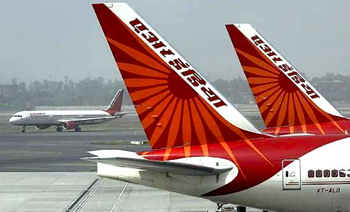
Techie Held For Hacking Air India Frequent Flyers Accounts

July 18, 2016

New Delhi, Jul 18: A 23-year-old techie has been arrested for hacking Air India's Frequent Flyer member accounts and using them to book tickets sold to several travel agents, Delhi Police said on Sunday.

airindiaThe accused, Anitesh Giri Goswami, a BCA graduate from Pune, was arrested from Jaipur on Friday.

According to police, a complaint was received in the Cyber Crime Cell of the Delhi Police's Economic Offences Wing (EOW) alleging some persons were selling Air India tickets by redeeming of miles of genuine Flying Returns Members after hacking the Frequent Flyer members account.

In a statement, the EOW said it was found that the hub of the scam was in Rajasthan's Jodhpur and Anitesh was its mastermind. On basis of electronic surveillance and information of a local informer, a raid was conducted at an apartment in Jaipur and Anitesh was nabbed.

A laptop, several mobile phones and other relevant documents were also recovered from his possession.

Police further claimed that Anitesh was an IT expert, who had earlier worked with Kingfisher Airlines and Air India and was well versed with the online ticket-booking system and functioning of Air India's intranet and internet-based systems.

Explaining the modus operandi, police said that Anitesh first understood functioning of the ticketing system as well as the points/miles system of the airlines and then hacked into the Loyalty Plus programme website of Air India.

After gaining access, he administrator user rights, which he used to upgrade several other user IDs with the same rights, police said.

Using these IDs, he verified hundreds of dormant accounts of Frequent Flyer members by uploading fraudulently prepared KYC (know your customer) documents, and used these membership accounts and the miles or points accumulated in these accounts for booking airline tickets. These were sold to various travel or ticketing agents based in Pune, Delhi, Jaipur and Mumbai.

He gained access to the internal functioning of Air India website while working at the Jodhpur airport, and left his Air India job to start exploiting loopholes in the Frequent Flyer Programme's functioning.

Comments

Suresh
 - 
Monday, 18 Jul 2016

May be brother of arnab!!

Ahmed Ali K
 - 
Monday, 18 Jul 2016

Both Go-Swamis are jokers and talk of the town now a days

Add new comment

  • Coastaldigest.com reserves the right to delete or block any comments.
  • Coastaldigset.com is not responsible for its readers’ comments.
  • Comments that are abusive, incendiary or irrelevant are strictly prohibited.
  • Please use a genuine email ID and provide your name to avoid reject.
News Network
July 5,2020

Mangaluru, Jul 5: A COVID-19 patient escaped from a hospital in Mangaluru on Sunday, Mangaluru Commissioner of Police Vikas Kumar.

A total of 1,925 cases of COVID-19 and 37 deaths recorded in Karnataka in the last 24 hours, taking the total number of cases to 23,474.

The health department informed that the death toll rose to 372 while active cases stood at 13,251 in the state.

According to the Union Health Ministry, India has recorded 6,73,165 numbers of COVID-19 cases and 19,268 deaths. 

Comments

Add new comment

  • Coastaldigest.com reserves the right to delete or block any comments.
  • Coastaldigset.com is not responsible for its readers’ comments.
  • Comments that are abusive, incendiary or irrelevant are strictly prohibited.
  • Please use a genuine email ID and provide your name to avoid reject.
Ram Puniyani
February 10,2020

Noam Chomsky is one of the leading peace workers in the world. In the wake of America’s attack on Vietnam, he brought out his classic formulation, ‘manufacturing consent’. The phrase explains the state manipulating public opinion to have the public approve of it policies—in this case, the attack of the American state on Vietnam, which was then struggling to free itself from French colonial rule.

In India, we are witness to manufactured hate against religious minorities. This hatred serves to enhance polarisation in society, which undermines India’s democracy and Constitution and promotes support for a Hindu nation. Hate is being manufactured through multiple mechanisms. For example, it manifests in violence against religious minorities. Some recent ghastly expressions of this manufactured hate was the massive communal violence witnessed in Mumbai (1992-93), Gujarat (2002), Kandhamal (2008) and Muzaffarnagar (2013). Its other manifestation was in the form of lynching of those accused of having killed a cow or consumed beef. A parallel phenomenon is the brutal flogging, often to death, of Dalits who deal with animal carcasses or leather.

Yet another form of this was seen when Shambhulal Regar, indoctrinated by the propaganda of Hindu nationalists, burned alive Afrazul Khan and shot the video of the heinous act. For his brutality, he was praised by many. Regar was incited into the act by the propaganda around love jihad. Lately, we have the same phenomenon of manufactured hate taking on even more dastardly proportions as youth related to Hindu nationalist organisations have been caught using pistols, while police authorities look on.

Anurag Thakur, a BJP minster in the central government recently incited a crowd in Delhi to complete his chant of what should happen to ‘traitors of the country...” with a “they should be shot”. Just two days later, a youth brought a pistol to the site of a protest at Jamia Millia Islamia university and shouted “take Azaadi!” and fired it. One bullet hit a student of Jamia. This happened on 30 January, the day Nathuram Godse had shot Mahatma Gandhi in 1948. A few days later, another youth fired near the site of protests against the CAA and NRC at Shaheen Bagh. Soon after, he said that in India, “only Hindus will rule”.

What is very obvious is that the shootings by those associated with Hindu nationalist organisations are the culmination of a long campaign of spreading hate against religious minorities in India in general and against Muslims in particular. The present phase is the outcome of a long and sustained hate campaign, the beginning of which lies in nationalism in the name of religion; Muslim nationalism and Hindu nationalism. This sectarian nationalism picked up the communal view of history and the communal historiography which the British introduced in order to pursue their ‘divide and rule’ policy.

In India what became part of “social common sense” was that Muslim kings had destroyed Hindu temples, that Islam was spread by force, and that it is a foreign religion, and so on. Campaigns, such as the one for a temple dedicated to the Hindu god Rama to be built at the site where the Babri masjid once stood, further deepened the idea of a Muslim as a “temple-destroyer”. Aurangzeb, Tipu Sultan and other Muslim kings were tarnished as the ones who spread Islam by force in the subcontinent. The tragic Partition, which was primarily due to British policies, and was well-supported by communal streams also, was entirely attributed to Muslims. The Kashmir conflict, which is the outcome of regional, ethnic and other historical issues, coupled with the American policy of supporting Pakistan’s ambitions of regional hegemony, (which also fostered the birth of Al-Qaeda), was also attributed to the Muslims.

With recurring incidents of communal violence, these falsehoods went on going deeper into the social thinking. Violence itself led to ghettoisation of Muslims and further broke inter-community social bonds. On the one hand, a ghettoised community is cut off from others and on the other hand the victims come to be presented as culprits. The percolation of this hate through word-of-mouth propaganda, media and re-writing of school curricula, had a strong impact on social attitudes towards the minorities.

In the last couple of decades, the process of manufacturing hate has been intensified by the social media platforms which are being cleverly used by the communal forces. Swati Chaturvedi’s book, I Am a Troll: Inside the Secret World of the BJP’s Digital Army, tells us how the BJP used social media to spread hate. Whatapp University became the source of understanding for large sections of society and hate for the ‘Other’, went up by leaps and bounds. To add on to this process, the phenomenon of fake news was shrewdly deployed to intensify divisiveness.

Currently, the Shaheen Bagh movement is a big uniting force for the country; but it is being demonised as a gathering of ‘anti-nationals’. Another BJP leader has said that these protesters will indulge in crimes like rape. This has intensified the prevalent hate.

While there is a general dominance of hate, the likes of Shambhulal Regar and the Jamia shooter do get taken in by the incitement and act out the violence that is constantly hinted at. The deeper issue involved is the prevalence of hate, misconceptions and biases, which have become the part of social thinking.

These misconceptions are undoing the amity between different religious communities which was built during the freedom movement. They are undoing the fraternity which emerged with the process of India as a nation in the making. The processes which brought these communities together broadly drew from Gandhi, Bhagat Singh and Ambedkar. It is these values which need to be rooted again in the society. The communal forces have resorted to false propaganda against the minorities, and that needs to be undone with sincerity.

Combating those foundational misconceptions which create hatred is a massive task which needs to be taken up by the social organisations and political parties which have faith in the Indian Constitution and values of freedom movement. It needs to be done right away as a priority issue in with a focus on cultivating Indian fraternity yet again.


Comments

Add new comment

  • Coastaldigest.com reserves the right to delete or block any comments.
  • Coastaldigset.com is not responsible for its readers’ comments.
  • Comments that are abusive, incendiary or irrelevant are strictly prohibited.
  • Please use a genuine email ID and provide your name to avoid reject.
Ram Puniyani
January 22,2020

Shivaji is a great icon in Maharashtra. Different sections of society have given him very high status, though for diverse reasons. Folklores about him abound in the state. His statues, popular songs on him are very prevalent. These folk songs (Powadas) praise his multifarious actions. So it was no surprise that when Jayabhagwan Goyal, released his book, ‘Aaj ka Shivaji: Narendra Modi’, at religious-cultural meet organized by Delhi BJP, there was a strong resentment in Maharashtra. Various leaders from Maharashtra were furious. The Shiv Sena leader Sanjay Raut challenged the Shivaji’s descendent, Sambhaji Raje who is in BJP and is member of Rajya Sabha, to resign on the issue. Sambhaji Raje in turn stated that "We respect Narendra Modi, who was elected as the prime minister of the country for the second time. But neither (Narendra) Modi nor anybody else in the world can be compared with Chhatrapati Shivaji Maharaj,"

Not to be left behind Jitendra Awhad of NCP felt Modi-BJP are insulting the pride of Maharashtra. It is not the first time that controversy is erupting around the Maharashtra warrior of medieval period. Earlier we had seen Sambhaji Brigrade demanding the ban on James Laine book, Shivaji: ‘A Hindu King in an Islamic Kingdom’, for its objectionable content. Bhandarkar Institute in Pune, which had helped James Laine in his research, was also vandalized. At another level there was a talk that Babasaheb Purandare, a Brahmin, who has written some popular material on Shivaji will be made as the Chairman of the committee for statue of Shivaji. Maratha Mahasangh and Shiv Dharm officials objected to a Brahmin heading the committee for a statue for the Maratha warrior. The caste angel in Shivaji’s case is coming to the fore from quite some time.

While there is no dearth of controversies around Shivaji, it is also true that each political tendency has created Shivaji’s image from their political point of view. Who was the real Shivaji, is the question. One can see two clear streams of projection in this matter. On one hand there is an attempt to present Shivaji as the anti Muslim King, a king who was respecting Cows and Brahmins (Go Brahman pratipalak). This view was brought forward from the times of Lokmanya Tilak and picked up by Hindu nationalists, who have been looking for icons in history to suit their political agenda. Nathram Godse, while criticizing Gandhi says that Gandhi’s nationalism was dwarf in front of the one of Shivaji or Rana Pratap.

In tune with this the Hindu nationalists are promoting both these as icons of Hindu nationalism and giving anti-Muslim slant to the whole discourse. This discourse also hides in this the Brahmanical agenda of Hindu nationalism as Cows and Brahmins are presented as the central object of veneration by Shivaji. This image of Shivaji fits well into the current agenda of Hindu nationalists, being spearheaded by RSS Combine.

It is because of this that for seeking votes in Mumbai Narendra Modi on the eve of 2014 elections stated that Shivaji attacked Surat to plunder the treasury of Aurangzeb. This also presents Shivaji-Aurangzeb, Shivaji-Afzal Khan interactions as battle between Hindus and Muslims. The truth is that Surat was plundered for its wealth as it was a rich port city and Bal Samant’s book on the topic gives in depth description of the same. It is noteworthy that Shivaji began his real career of conquest in 1656 when he conquered Javli from the Maratha Chief Chandra Rao More. He took over the treasures of this kingdom. That it was not a Hindu Muslim battle becomes clear when we know that in confrontation with Aurangzeb it was Mirza Raja Jaisingh who was negotiating and engaging with Shivaji on behalf of Aurangzeb. And Shivaji had Muslim officers like Kazi Haider as confidential secretary and many Muslim Generals in his army.

Darya Sarang was chief of armor division, Daulat Khan was in-charge of his naval division; Ibrahim Khan was another general of significance in his army.  This mixed up administration just shows that the kings were not having Hindu or Muslim administration depending on their religion. In the confrontation between Shivaji and Afzal Khan, Rustam-e-Jaman was Shivaji’s side and Afzal Khan had Krisnaji Bhaskar Kulkarni on his side.

As far as Shivaji’s popularity is concerned it was due to his being a King with welfare of his subjects in his mind. He lightened the burden of taxation on the average peasants, and reduced the domination of landlords over the serfs. This picture of Shivaji is well documents in the booklets by Com. Govind Pansare (Who was Shivaji) and Jayant Gadkari (Shivaji: Ek Lok Kalyankari Raja- Shivaji: King doing People’s Welfare). He did not belong to the warrior caste so Brahmins had refused to coronate him, for which purpose Gaga Bhatt a Brahmin from Kashi was brought in with heavy fees. Teesta Setalvad’s hand book on History for teachers underlined this fact.

Today while BJP-Brahmanical forces want to present Shivaji as worshipper of Brahmins and cows, the non upper caste have seen through the game. As such it was Jotirao Phule who brought forward the caste angel of Shivaji as he wrote Powada (Poem) in his honor and today dalit Bahujan are not toeing Hindu Nationalist projection on the issue.

The likes of Jayabhagwan Goyal of BJP as such are trying to give two messages through such attempts. One hand they want to paint Shivaji in anti Muslim and Brahmanical color, they also want to give the subtle message of similarity of this presentation of Shivaji with what Modi is doing. Non BJP forces have seen this game and want to present the other picture of Shivaji, which was highlighted by the likes of Jotirao Phule and which today many of those standing for rights of dalit-Bahujan are trying to articulate. The criticism of the said, book, since withdrawn is on these twin aspects. One about the picture of Shivaji who was concerned about welfare of the farmers, and two his respect for people of all religions.

Comments

Add new comment

  • Coastaldigest.com reserves the right to delete or block any comments.
  • Coastaldigset.com is not responsible for its readers’ comments.
  • Comments that are abusive, incendiary or irrelevant are strictly prohibited.
  • Please use a genuine email ID and provide your name to avoid reject.