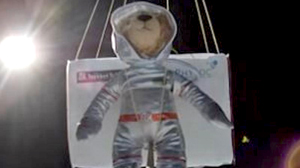
Teddy bear reaches space after tied to balloon by kids in UK

Agencies
June 12, 2017

London, Jun 12: A teddy bear rose to 100,000 feet into space after it was tied to a helium balloon by a group of school children in the UK.teddy

The teddy bear, named as Roffa by the children of King's Rochester Preparatory School field in Boley Hill, Kent, reached the stratosphere, the second major layer of Earth's atmosphere, and travelled around 29 km (18 miles) before the balloon exploded due to altitude pressure.

Footage showed the curvature of the Earth taking in the Thames Estuary, where the River Thames meets the waters of the North Sea, the Isle of Wight and across the English Channel to France, the metro.co.uk reported.

Roffa was in the air for around four-and-a-half hours and the GoPro camera stopped recording an hour before he was found in Hadlow, near Tonbridge in England.

John Jones, head of computing, and Magnus Caithness, head of science, led the project nicknamed 'Operation Cosmic Dust'.

"We recovered Roffa at around 7pm from Hadlow, but we think he landed at about 6.15pm. A couple were enjoying an evening in their garden when they saw a peculiar object falling from the sky. They noticed where it landed and retrieved it, read the notice on it and called our number," Caithness said.

"We were just a mile away looking where the last GPS signal had been sent from," he said.

The children, aged eight to 13, have been learning about space as part of the project.

They chose to name the teddy bear Roffa as former pupils call themselves Old Roffensians.

Comments

Add new comment

  • Coastaldigest.com reserves the right to delete or block any comments.
  • Coastaldigset.com is not responsible for its readers’ comments.
  • Comments that are abusive, incendiary or irrelevant are strictly prohibited.
  • Please use a genuine email ID and provide your name to avoid reject.
Agencies
February 6,2020

Washington D.C., Feb 6: An international team of astronomers has found an unusual monster galaxy that existed about 12 billion years ago when the universe was only 1.8 billion years old.

The team of astronomers was led by scientists at the University of California, Riverside.

Dubbed XMM-2599, the galaxy formed stars at a high rate and then died. Why it suddenly stopped forming stars is unclear.

"Even before the universe was 2 billion years old, XMM-2599 had already formed a mass of more than 300 billion suns, making it an ultra massive galaxy," said Benjamin Forrest, a postdoctoral researcher in the UC Riverside Department of Physics and Astronomy and the study's lead author.

"More remarkably, we show that XMM-2599 formed most of its stars in a huge frenzy when the universe was less than 1 billion years old and then became inactive by the time the universe was only 1.8 billion years old," Forrest added.

The team used spectroscopic observations from the W. M. Keck Observatory's powerful Multi-Object Spectrograph for Infrared Exploration or MOSFIRE, to make detailed measurements of XMM-2599 and precisely quantify its distance.

The study results appear in the Astrophysical Journal.

"In this epoch, very few galaxies have stopped forming stars, and none are as massive as XMM-2599," said Gillian Wilson, a professor of physics and astronomy at UCR in whose lab Forrest works.

"The mere existence of ultramassive galaxies like XMM-2599 proves quite a challenge to numerical models. Even though such massive galaxies are incredibly rare at this epoch, the models do predict them."

"The predicted galaxies, however, are expected to be actively forming stars. What makes XMM-2599 so interesting, unusual, and surprising is that it is no longer forming stars, perhaps because it stopped getting fuel or its black hole began to turn on. Our results call for changes in how models turn off star formation in early galaxies," the professor stated.

The research team found XMM-2599 formed more than 1,000 solar masses a year in stars at its peak of activity -- an extremely high rate of star formation. In contrast, the Milky Way forms about one new star a year.

"XMM-2599 may be a descendant of a population of highly star-forming dusty galaxies in the very early universe that new infrared telescopes have recently discovered," said Danilo Marchesini, an associate professor of astronomy at Tufts University and a co-author on the study.

"We have caught XMM-2599 in its inactive phase," Wilson said, who led the W. M. Keck Observatory data acquisition
Co-author Michael Cooper, a professor of astronomy at UC Irvine, said this outcome is a strong possibility.

"Perhaps during the following 11.7 billion years of cosmic history, XMM-2599 will become the central member of one of the brightest and most massive clusters of galaxies in the local universe," he said.

"Alternatively, it could continue to exist in isolation. Or we could have a scenario that lies between these two outcomes," he stated.

The study was supported by grants from the National Science Foundation and NASA.

Comments

Add new comment

  • Coastaldigest.com reserves the right to delete or block any comments.
  • Coastaldigset.com is not responsible for its readers’ comments.
  • Comments that are abusive, incendiary or irrelevant are strictly prohibited.
  • Please use a genuine email ID and provide your name to avoid reject.
Agencies
March 15,2020

Cybercriminals continue to exploit public fear of rising coronavirus cases through malware and phishing emails in the guise of content coming from the Centers for Disease Control and Prevention (CDC) in the US and World Health Organisation (WHO), says cybersecurity firm Kaspersky.

In the APAC region, Kaspersky has detected 93 coronavirus-related malware in Bangladesh, 53 in the Philippines, 40 in China, 23 in Vietnam, 22 in India and 20 in Malaysia. 

Single-digit detections were monitored in Singapore, Japan, Indonesia, Hong Kong, Myanmar, and Thailand. 

Along with the consistent increase of 2019 coronavirus cases comes the incessant techniques cybercriminals are using to prey on public panic amidst the global epidemic, the company said in a statement. 

Kaspersky also detected emails offering products such as masks, and then the topic became more commonly used in Nigerian spam emails. Researchers also found scam emails with phishing links and malicious attachments.

One of the latest spam campaigns mimics the World Health Organisation (WHO), showing how cybercriminals recognise and are capitalising on the important role WHO has in providing trustworthy information about the coronavirus.

"We would encourage companies to be particularly vigilant at this time, and ensure employees who are working at home exercise caution. 

"Businesses should communicate clearly with workers to ensure they are aware of the risks, and do everything they can to secure remote access for those self-isolating or working from home," commented David Emm, principal security researcher.

Some malicious files are spread via email. 

For example, an Excel file distributed via email under the guise of a list of coronavirus victims allegedly sent from the World Health Organisation (WHO) was, in fact, a Trojan-Downloader, which secretly downloads and installs another malicious file. 

This second file was a Trojan-Spy designed to gather various data, including passwords, from the infected device and send it to the attacker.

Comments

Add new comment

  • Coastaldigest.com reserves the right to delete or block any comments.
  • Coastaldigset.com is not responsible for its readers’ comments.
  • Comments that are abusive, incendiary or irrelevant are strictly prohibited.
  • Please use a genuine email ID and provide your name to avoid reject.
Agencies
June 5,2020

With the scrapping of Mitron and Remove China Apps from its Play Store gaining a lot of attention in India, Google on Thursday said that it removed a video app "for a number of technical policy violations", while adding that it also does not allow an app that "encourages or incentivizes users into removing or disabling third-party apps".

Both the apps became immensely popular in India within a short span of time due to the prevailing anti-China sentiment amid border tensions between India and China in Ladakh and calls by Indian activists to boycott Chinese products.

Reports suggested that the Mitron app is a repackaged version of TicTic, which is a TikTok clone.

The Remove China Apps was designed to help users identify applications of Chinese origin.

Without naming the apps, Google hinted that the Mitron app may make a comeback on the Play Store once it fixes some technical issues, but the chances of the Remove China Apps are thin.

"We have an established process of working with developers to help them fix issues and resubmit their apps. We've given this developer (of the video app) some guidance and once they've addressed the issue the app can go back up on Play," Sameer Samat, Vice President, Android and Google Play, said in a statement.

Google said that its Android app store was designed to provide a safe and secure experience for the consumers while also giving developers the platform and tools they need to build sustainable businesses.

Samat said that Google Play recently suspended a number of apps for violating the policy that it does not allow an app that "encourages or incentivizes users into removing or disabling third-party apps or modifying device settings or features unless it is part of a verifiable security service".

"This is a longstanding rule designed to ensure a healthy, competitive environment where developers can succeed based upon design and innovation. When apps are allowed to specifically target other apps, it can lead to behaviour that we believe is not in the best interest of our community of developers and consumers," Samat said.

"We've enforced this policy against other apps in many countries consistently in the past - just as we did here," he added.

Comments

Add new comment

  • Coastaldigest.com reserves the right to delete or block any comments.
  • Coastaldigset.com is not responsible for its readers’ comments.
  • Comments that are abusive, incendiary or irrelevant are strictly prohibited.
  • Please use a genuine email ID and provide your name to avoid reject.